Skip to content
Agorix
Updated 29 July 2026

Follow-up funnel: the machine for everyone who didn’t buy.

Most funnels stop at the offer, which is exactly where the majority of the audience is standing. This is the sequence that runs after the no: the objection lane, an honest downsell, the re-open, the long lane, and the point where you stop selling to somebody.

05lanes
14build checks
21day window

What you will have at the end

  • A definition of the didn’t-buy segment that says what it excludes as well as what it contains
  • An objection sequence that surfaces the real objection before it answers one
  • A downsell framed as a smaller true offer rather than a pressure tactic
  • A re-open path built on a date that exists — the next cohort, the next live session
  • A long nurture lane that does not read as a sales sequence in disguise
  • A written rule for the point at which you stop selling to somebody
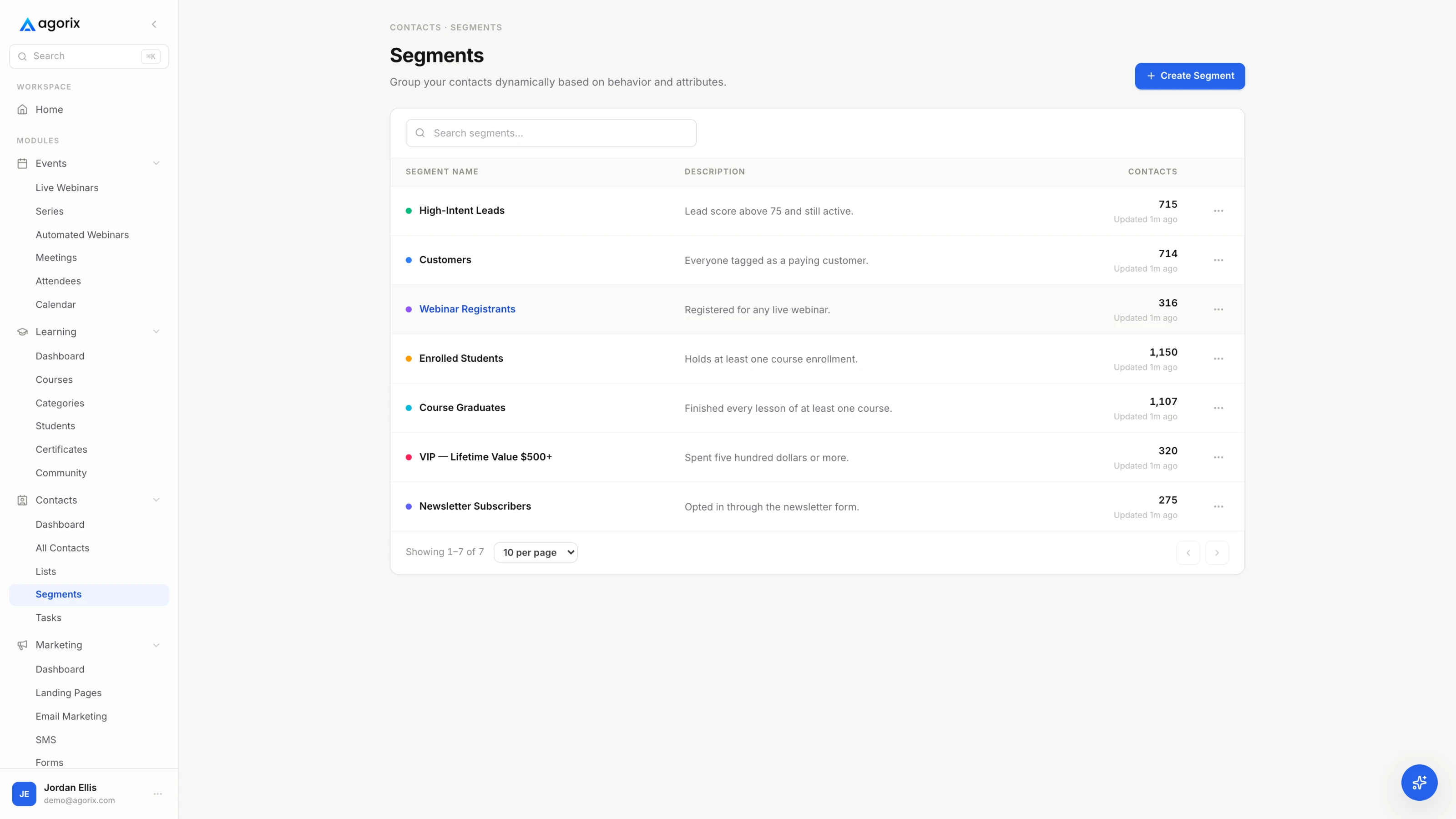
Audience segments built from attendance, engagement and purchase behaviour.
T+0Where funnels end

The funnel stops where most of the audience is standing.

Unless more than half the people who saw your offer bought it, the larger group is the one that did not. Nearly every funnel has a complete, well-written path for the smaller group and silence for the larger one.

That silence is not neutral. People read it as a verdict — the thing was not for them, the moment has passed, the door is shut. And it arrives at the exact point where you have already paid for everything: the traffic, the room, the sequence, the time spent making the case. The follow-up funnel is the only part of the machine with no acquisition cost attached to it, which makes it the cheapest revenue in the building and the piece most often left unbuilt.

What the lane is not

It is not a way to wear people down. It exists because “no” is almost never a complete sentence — it is a compressed version of not this, not now, not at this price, not until I understand the part I missed, or not from somebody I have known for nine days. Those are five different conversations, and the funnel that answers them with the same discount three times is doing the thing that gives follow-up a bad name.

The whole guide rests on one operating assumption: a person who declined your offer is still somebody you want on your list next year. Everything below — the questions, the honest downsell, the exit — follows from taking that seriously rather than treating the segment as a resource to be extracted from.

Day 0Who didn’t buy

Not buying is at least five different things.

Before a single email is written, split the non-buyers by how far they actually got. They are not one audience, and the most common mistake in follow-up is answering an objection to somebody who never heard the offer.

  1. Never engaged. Did not open, did not attend, never reached the offer at all. This is a promotion or deliverability problem in a sales costume, and answering objections to people who never saw the offer is answering questions nobody asked.
  2. Engaged, never reached the ask. Opened the emails, watched part of the room, stopped before the offer. The content lost them, not the price. What this group needs is the part they missed — the argument, the demonstration, the section they left before — rather than a debate about value.
  3. Reached the offer, did not start checkout. The objection lane proper. Almost everything in this guide is written for this group, because they saw the whole case, understood it, and decided against it for a reason they could probably tell you.
  4. Started checkout, did not finish. Usually mechanical, occasionally last-second nerve. One short, specific message the same day, with a link back to the same checkout — not a sales sequence. Checkout page optimization is where the recurring version of this problem gets fixed.
  5. Already owns it, or bought something else. The exclusion that has to be automatic rather than remembered. Nothing damages a list faster than selling somebody a thing they bought from you last week.

The groups need different messages and one of them needs no sales message at all. Group one gets promotion work, not persuasion. Group two gets the part they missed. Group three is the objection lane and the subject of most of this guide. Group four gets one specific message about a specific checkout. Group five gets removed, automatically, before anything sends.

The exclusions matter more than the includes

A didn’t-buy segment defined only by who is in it will eventually email a customer about the thing they just bought. Define it by exclusion first — buyers, refunders, people who asked to stop, anybody already inside another active sequence — and let the remainder be the audience. The difference shows up on the worst possible day, which is the day the launch is going well.

The didn’t-buy build0 / 14 ready

Before you write anything

The sequence itself

Day 1–5The objection laneLane 01 / 05

Ask what stopped them before you argue with them.

The standard follow-up sequence guesses the objection and then answers the guess. Price is the easiest one to guess, the easiest to answer badly, and frequently not the thing that was in the way.

So the first email in the lane does not argue. It asks. One plain-text message, from a person, with no links and no offer in it, asking a question that can be answered in six words while somebody is standing in a queue. The answers you get back are worth more than the rest of the sequence, because they are the only source of the actual objection in the actual words.

Subject: quick question

[First name] — you had a look at [the offer] and did not
take it, which is completely fine.

If you have ten seconds: what stopped you? One line is
plenty. [Price / timing / not sure it fits / something else
entirely] all count.

I read every reply and I am not going to pitch you in the
answer.

[Your name]

Keep every reply. They are your objection bank, the next version of your sales page, and quite often the brief for your next offer. Two launches of doing this and you will stop guessing entirely — which is the real return on an email that sells nothing.

The five objections behind almost every no

  1. Price. The most guessed objection and the most often answered badly. The honest answers are a payment plan, a genuinely smaller offer, or an accepted no — not a discount on the same thing to the same people, which teaches a list to wait. Pricing digital products and subscription versus one-time are where that decision belongs.
  2. Time. “I cannot start this now” is a scheduling objection, and the answer is scheduling information: how long the work actually takes, whether access expires, and what happens if they begin in three months. Sometimes the correct answer is “then buy it in September” — and saying so is what makes the rest of your emails believable.
  3. Risk. What if it does not work. This is answered with terms and evidence rather than adjectives: what the refund policy actually is, what is included, what happens if they get stuck. Refund policies and guarantees covers writing one you can honour without resenting it.
  4. Fit. Will this work for somebody like me. The answer is occasionally no, and an email that says so — naming the people this is not for, plainly — buys more credibility than any guarantee. It also removes the refunds you would otherwise have earned.
  5. Priority. Nothing is wrong with the offer. It simply is not next. This group cannot be argued into a purchase and should not be; they belong in the long lane, where the next launch finds them still subscribed.

Then answer them one at a time. One objection per email, named in the subject line, answered in the first paragraph, and — this is the part that makes the difference — including the case in which the honest answer is do not buy this. An email that names the people an offer is wrong for is read as a different kind of document from one that insists it is right for everybody, and the people it disqualifies were never going to buy anyway.

Where the no arrived at the end of a live session, the clock is much shorter than a launch and the first messages should go out while the room is still fresh — the webinar follow-up window covers what changes when the offer was made live.

Day 7The downsellLane 02 / 05

A smaller true offer, described straight.

A downsell is legitimate when the smaller thing genuinely solves a smaller version of the problem. It becomes manipulation when it is the same offer with the value removed, or the same price wearing the costume of a concession.

There are three honest shapes. Sell a real component of the offer on its own — the templates without the coaching, the course without the calls — priced for what it is. Offer the same thing on a payment plan, which answers the cash-flow objection that price objections often turn out to be. Or offer a lower-commitment format of the same material, which is the move cohort versus self-paced is really about.

Honest downsells

  • A real component of the offer, sold on its own and priced accordingly
  • The same offer on a payment plan, because a price objection is often a cash-flow objection
  • A lower-commitment format — self-paced where the main offer is a cohort
  • A smaller first step that solves the urgent part of the problem properly
  • A clear statement of what the smaller thing does not include
  • An upgrade path priced so nobody is punished for starting small

Downsells that are pressure

  • The same offer at a lower price, presented as a personal exception it is not
  • A “last chance” that is followed by another last chance
  • A stripped version that removes the part the offer needed to work
  • A countdown attached to a date nothing actually happens on
  • A downsell that costs more in total than the thing they already declined
  • Anything that requires the reader not to notice something

Whatever shape you pick, say what the smaller thing does not include, in the email that offers it. The temptation is to leave that quiet, and the cost of leaving it quiet arrives later as refunds, support load and a customer who tells the story of what they thought they were buying.

The test that settles it

Would you be comfortable if they could see both offers side by side.

With the pricing, the reasoning and the upgrade path all visible at once. An honest downsell survives that view easily — it is a smaller thing at a smaller price for somebody with a smaller problem. A manipulative one depends on the reader not putting the two next to each other, and every customer eventually does.

Day 21The re-openLane 03 / 05

A real date is a reason to write that is not a discount.

Three weeks after the lane closes you need a legitimate reason to contact somebody who already said no. The next cohort starting, the next live session, a price changing on a day you will honour — these are events. A deadline you invented is a habit you will regret.

Re-open with what changed rather than with the same email and a fresh countdown. The material was rebuilt. The format moved from live to self-paced. The price went up and this is the last week at the old one, because that is true. Somebody who declined once and is now being shown an identical argument concludes, correctly, that nothing has been learned since.

The best re-open is a room

Invite the non-buyers to the next live session rather than back to the sales page. A seat is a smaller ask than a purchase, it re-qualifies everybody who takes it, and it puts you back in front of the objection with the ability to answer it in real time — how to host a webinar covers running the session, and the people from the last launch are the warmest registrations it will ever have.

Twenty-one days, laid out

WhenWhat goes outLane
Day 0The offer closes, or the room ends. Before a single email is written, everybody who did not buy is split by how far they actually got.Segment
Day 1The one-question email. Plain text, from a person, no links, one question that can be answered in six words. The only email in the lane that asks for something other than money.Ask
Day 2Objection one — named in the subject line, answered in the first paragraph, including the case where the honest answer is that this is not for them.Objections
Day 3Objection two, same shape. Whichever objection the replies keep raising goes first: the order is set by the inbox rather than by the sales page.Objections
Day 5Objection three, and the last of them. Three real objections answered honestly does more work than seven emails restating the offer.Objections
Day 7The downsell, if there is a genuinely smaller offer to make. If there is not, the day is skipped rather than filled.Downsell
Day 9The close of the lane: what happens now, what keeps arriving, and one line for anybody who would rather hear nothing further.Exit
Day 21The re-open, tied to a date that exists — the next cohort, the next live session, the next time this is open. Never the same email with a fresh deadline on it.Re-open
Day 22 onwardThe ordinary rhythm of the list. No countdown, no sequence, nothing that reads as a launch wearing a disguise.Long lane

Two rows in that table do most of the work and are the two most often skipped. Day 1, because everything after it is guesswork without the replies. And Day 22, because a lane that ends in silence rather than in the newsletter loses the people who would have bought at the next launch.

Where a tool decision changes the plan

The re-open only works if last time is still on the record.

Inviting the people who did not buy means knowing who they were, how much of the last room they watched and whether they ever reached the checkout — which usually means reconciling a webinar export, an email export and a payments export. In Agorix that behaviour sits on one customer record and the audience removes somebody the moment they buy — see how marketing works.

Start your 14-day trial 14 days · $0 due today · Payment method required · Cancel before first charge and pay nothing
OngoingThe long laneLane 04 / 05

Most of the no is a not now.

After the objection lane and the re-open, the majority of this segment should return to the ordinary rhythm of your list — which means you need one, and it has to be worth receiving on its own terms.

The long lane is not a slower sales sequence. It is the newsletter, the thing you send whether or not anything is for sale, and its job is to still be arriving when the timing finally changes for somebody. A person who declined in March because a project was mid-flight can only buy in November if they were still hearing from you in October, and nothing about that requires them to be sold to in between. The newsletter system guide covers building one you can actually sustain.

Cadence is the other half. The honest rule is a rhythm you can keep and a reader who knows what to expect — a weekly letter that arrives weekly beats a daily one that arrives for nine days and then stops, and both beat the pattern where the list hears nothing for two months and then receives six launch emails. Email frequency is where that decision gets made properly.

When somebody in the long lane goes quiet for months, run a re-engagement campaign once and act on what it tells you. The campaign is only useful if you are willing to remove the people who do not answer it.

StopExit honestyLane 05 / 05

Write down the point at which you stop selling to somebody.

A follow-up funnel with no exit condition is just persistence with a schedule attached. Decide the conditions before the launch, while you are not yet emotionally invested in the number.

  1. They said no in words. Somebody who replies “not for me” has given you the clearest signal available. The correct response is one line — understood, here is what keeps arriving, here is how to stop that too — and the sales lane ends for them. Continuing after an explicit no is the fastest way to convert a polite prospect into somebody who tells other people about you.
  2. They bought something that makes the offer irrelevant. Ownership has to remove somebody from the lane automatically. If this depends on you remembering, it will fail during the launch when you are busiest and it will fail in front of your best customers.
  3. They have been through the whole lane twice with no engagement. Two full passes with no opens, no clicks and no replies is an answer. Run a re-engagement campaign once, act on the result, and stop. Keeping unengaged addresses is not free: they cost you deliverability with the people who do want to hear from you.
  4. They told you the fit is wrong. Somebody who says “I am not your customer” is doing you a favour. Take them out of the selling lane and leave them the newsletter if they want it. Some of the best referrals come from people who never bought anything.

The exit itself should be an email rather than a silence. Say what is stopping, say what continues, and give one click for each — the people who wanted the newsletter and not the sales lane will take it, and you will have kept a reader instead of losing a subscriber. The version of this that skips the email loses both.

The part that gets rebuilt and breaks

A suppression list has to survive the next launch.

Somebody who exited in March should still be excluded in November without anybody remembering. This is the point at which hand-built segments fail: a list rebuilt from a fresh export has no memory of who asked to be left alone, and the person receiving that email is the one person guaranteed to notice. If your exclusions live in a spreadsheet, they will eventually live in a complaint.

There is a commercial argument for all of this that does not depend on being decent. Every send to somebody who never opens costs a little of the sender reputation that gets you into the inbox of somebody who does, so the exit is not a concession — it is how the emails you care about keep arriving. Email deliverability basics covers the mechanics.

Day 90Judging the lane

Two reads, and one of them is the cost.

A follow-up lane is easy to judge flatteringly, because every sale it produces looks like found money. Read the revenue and the damage together or you will keep a sequence that is quietly spending your list.

The revenue read

What the lane produced

Purchases from the didn’t-buy segment inside the window, plus purchases at the next launch by people who entered from a previous one. The second number is the argument for the long lane and it only exists if you keep the cohort labelled.

The damage read

What the lane cost

Unsubscribes, complaints and the drop in engagement among people who stayed. A sequence that earns revenue while burning a portion of the list has taken a loan against the next launch, and the repayment is not visible on the report that made it look good.

There is no benchmark to hit here, and anybody quoting one is averaging across offers, prices and audiences that have nothing to do with yours. The bar is simply whether the lane produced more than the silence it replaced, and whether the people who did not buy still open the next thing you send. If the first is yes and the second is no, the sequence is working and the business is not.

When the whole path needs inspecting rather than the lane — traffic, page, offer, checkout and follow-up together — the funnel diagnostics guide runs it in order, and customer journey mapping is where the didn’t-buy lane gets a place in the wider picture instead of being bolted on after a bad launch.

Common questions

Six questions about the people who said no.

What should I send someone who did not buy?

A question first, answers second. Send one plain-text email asking what stopped them, read the replies, then write two or three emails that each name a single objection and answer it honestly — including the case where the honest answer is that this is not for them. Make one downsell if a genuinely smaller offer exists. Then return everybody to the ordinary rhythm of your list rather than to a second sales sequence.

How long should a follow-up sequence be after a launch?

Around nine days of active follow-up, then a re-open about three weeks later tied to a date that actually exists. The length is set by how many real objections you have rather than by a template — three answered properly beats seven emails restating the offer. After that, cadence is a list-wide question rather than a launch one, and email frequency is where it belongs.

Is a downsell manipulative?

It is manipulative when the smaller thing is the same offer with the value stripped out, when a discount is dressed up as a personal exception it is not, or when a countdown is attached to a date on which nothing happens. It is legitimate when the smaller thing genuinely solves a smaller version of the problem, states plainly what it does not include, and carries an upgrade path that does not punish somebody for starting small. The test is simple: would you be comfortable if the reader could see both offers side by side with the reasoning attached.

Should I discount for people who did not buy?

Discounting the same offer to the same people teaches your list to wait, and the invoice for that lesson arrives at the next launch. If you need a lower price point, build a lower-priced thing — a component sold on its own, a self-paced version of a cohort programme, or the same offer on a payment plan, which answers the cash-flow objection that a price objection frequently turns out to be. A lower price is a product decision, not a follow-up tactic.

When should I stop emailing someone who never buys?

Decide the conditions before the launch and write them down: they said no in words, they bought something that makes the offer irrelevant, they have been through the whole lane twice with no opens or clicks, or they told you the fit is wrong. Keeping unengaged addresses is not free — every send to somebody who never opens costs you a little of the reputation that gets you into the inbox of somebody who does, which is why deliverability and exit honesty turn out to be the same subject.

How do I segment the people who did not buy?

By how far they got, rather than as one audience. Separate the people who never engaged at all, the people who engaged but never reached the offer, the people who reached the offer and did not start checkout, the people who started checkout and did not finish, and everybody who already owns something that makes the offer irrelevant. Those five groups need genuinely different messages, and the first of them needs no sales message whatsoever — that is a promotion problem, not an objection.

Keep going

What sits on either side of the no.

From a no to a next launch

You now have the lane. Agorix is the system that runs it.

The room, the offer, the checkout and the follow-up on one customer record — so the didn’t-buy audience is a question about behaviour rather than a list rebuilt by hand, and a purchase takes somebody out of the sales lane the moment it happens.

14 days · $0 due today · Payment method required · Cancel before first charge and pay nothing