
A customer journey map for funnels: one page that sets the build order.
Seven stages, and for each one the belief that moves somebody forward, the asset that does the moving, and the signal that proves it happened. Written to work with any stack; where a tool decision genuinely changes the plan, it says so.
What you will have at the end
- A seven-stage map of one offer on a single page, written in your customers’ words
- The one belief each stage has to change, stated as a sentence a person would say out loud
- The single asset that does the moving at each stage, with an owner and a state
- A recorded signal per stage, so “it happened” is a fact rather than a feeling
- A build order that starts at the money and works outward in both directions
- Each stage’s signal turned into the funnel ratio you will actually read
A funnel diagram shows your steps. A map shows their beliefs.
Most funnel drawings are built from the business side: page, email, webinar, checkout, boxes and arrows. That drawing is genuinely useful for building things. It is close to useless for diagnosing, because it cannot tell you why anybody stopped.
A journey map is the same funnel written from the other side of the table. One row per stage of the relationship, and three columns that each answer one question. What has to become true in their head for them to take the next step. What you own that makes it true. What gets recorded when it happens.
The value is not the finished diagram — it is the three arguments filling it forces you to have. Naming the belief forces you to say what a person must accept before they move. Naming the asset forces one artifact and one owner, rather than a channel strategy. Naming the signal forces the honest answer to “how would we know”, which is where most funnels turn out to be held together by an assumption nobody has checked in a year.
One offer at a time, on one page
A map that covers every product you sell stops being a map of a journey and becomes a diagram of your company. Pick the single path that produces most of the revenue, or the one you are about to build, and map that. If it does not fit on one page, it is describing an organisation rather than a customer.
Two hours with a blank table and the seven-stage default below is enough for a first version. Do it with the people who actually talk to customers in the room, and do not let anyone leave until every cell has a sentence in it, including the ones where the honest sentence is “we have never built this”.
Seven stages, each named for what the person is.
These names are a working default. Rename them to your business freely — but keep the rule underneath them, because the rule is what makes the map diagnostic rather than decorative.
- Stranger. Somebody who has the problem and does not know you exist. They are in this stage while they are reading, watching or searching, and they leave it the moment they hand over a way to reach them. Everything before that is traffic, and traffic you cannot contact again is not a stage — it is weather.
- Subscriber. On your list with permission, nothing bought and nothing scheduled. This is the longest stage in most businesses and the one people describe as “nurture”, which is a word that hides the actual job: earning the right to ask for an hour of their time.
- Registrant. They have committed to a specific time — a session, a call, a live class. The commitment is the boundary, not the interest. Somebody who clicked the invitation and left the page is still a subscriber, and treating them as a registrant is how show-up rates get quietly misread.
- Attendee. They turned up. This is the stage most maps skip, because it looks like the same person one hour later. It is not: the gap between registrant and attendee is usually the largest single drop in the whole journey, and it has its own asset and its own signal.
- Buyer. Money has changed hands. The boundary is a completed payment, not an expressed intention, a booked call or a proposal sent. This is the row every other row is eventually judged against.
- Student or client. They are using what they bought. Somebody who has paid and never logged in, never booked the first session or never opened lesson one is a buyer, not a student — and the difference between those two words is most of your refund rate.
- Repeat. They bought again, renewed, or referred somebody who bought. Businesses without this row are re-acquiring their entire customer base every year and calling the cost of that “marketing”.
The boundary rule
Every boundary between two stages should be an event you could point at in a list: an opt-in, a registration, an attendance record, a payment, a first login, a second payment. If you cannot name the event, the boundary is a feeling. And if two stages share the same boundary event, they are one stage wearing two names — delete one.
Delete rows you do not have rather than inventing traffic for them. A consulting business often reads registrant → attendee as booked-a-call → showed-up. A product business may have no registrant stage at all and jump from subscriber to buyer. Both are fine. What is not fine is keeping a row because the template had one.
The sentence they have to be able to say.
This is the column people skip, and it is the one that makes the map worth having. Skip it and you get a list of assets, which is a project plan. Fill it and you get a reason each asset exists, which is a strategy.
Write it in the first person, in their words, as a sentence a real person could say out loud without embarrassment. Two tests: could somebody genuinely disagree with it, and is it specific to this stage rather than to your business in general. “They trust us” fails both. “I have tried fixing this twice myself and it came back both times” passes both, and it also tells you what the asset has to contain.
It helps to write two lines per stage: what they arrive believing, and what they have to leave believing. The gap between those two sentences is the entire job of the asset in the next column. When the gap is enormous, you have found a missing stage. When there is no gap at all, you have found an asset that is not doing anything.
Beliefs that do work
- “I have tried fixing this myself twice and it came back both times.”
- “An hour on a Thursday is worth it if I leave with the thing half built.”
- “They have done this for a business that looks like mine.”
- “If it does not work I can get my money back without an argument.”
- “I know what to do on Monday morning.”
Beliefs that do not
- “They are the market leader in innovative solutions.” — nobody says this
- “The customer sees value.” — value is not a belief, it is a summary of one
- “They trust us.” — trust about what, exactly, and compared to what
- “The customer is ready to buy.” — a stage, restated, with no argument in it
- “They understand our differentiators.” — written from your side of the table
Where to find the words
Not in a workshop. The sentences already exist in your reply emails, your sales-call recordings, the questions asked in the last live session, the reasons given for refunds, and the messages from people who nearly bought and did not. Copy the phrasing exactly rather than improving it. Improved phrasing is how a customer sentence quietly turns back into a marketing sentence.
One asset per stage, with one owner and one state.
The asset is the specific thing that does the moving: a page, a sequence, a session, a call, a checkout. Not a channel. Not a campaign. Something with a URL or a file name that a person is responsible for.
If a stage lists three assets, one of them is doing the work and the other two are decoration — or the stage is really two stages and you have not split it yet. Force yourself to name one. The others can exist; they just do not go in the cell, because the cell is answering “what would we fix first if this stage were broken”.
- Give it an owner. A named person, not a team. Assets without an owner are the ones still in draft at the end of the quarter.
- Give it a state. Built, drafted, or not started. Three words, written on the map. Most maps look finished until this column is added and half the rows turn out to say “not started”.
- Give it a home. A link to the actual thing. A map that describes assets nobody can open decays into fiction within one quarter.
Four assets go missing more often than the rest, and all four sit near the money: the reminder sequence between registrant and attendee, the offer itself between attendee and buyer, onboarding between buyer and student, and the second offer between student and repeat. When a map is filled honestly, those are usually the rows that say “not started”, which is also the reason the build order later in this guide starts where it does.
Each of those has its own guide when you get to it — the lead magnet funnel for the first row, the landing page anatomy for the pages, checkout page optimisation for the buyer row, and student onboarding emails for the row after it.
If nothing is recorded, the stage did not happen.
A signal is an event with a timestamp, attached to a person. Not a page view. Not an impression. Something that says this specific human crossed this specific line on this date.
Three tests decide whether a signal is worth writing in the cell. It attaches to a person rather than to a page, because a funnel is made of people moving and page-level counts cannot follow them. It is recorded automatically, because a signal that depends on somebody remembering to log it is a signal that stops existing in December. And it can be counted this week without an export, because a number you have to assemble by hand is a number you will assemble twice and then stop.
The failure this column exposes
In most stacks the seven signals live in five systems: opt-ins in the email tool, registrations in the webinar tool, attendance in a different report inside that tool, purchases in the payment processor, and first lesson opened in the course platform. Each one is individually available. Joining them to one person is the part that quietly does not happen, which is why so many businesses can tell you their opt-in rate and their revenue but not what an opt-in from a particular source is worth.
Write the join into the map on purpose. Next to each signal, record where you will read it, and whether it can be tied to the same person as the row above. Where it cannot, write that down too. A map that admits its blind spots is worth more than one that quietly assumes the join exists.
Drawing the map is free. Joining the seven signals to one person is the expensive part.
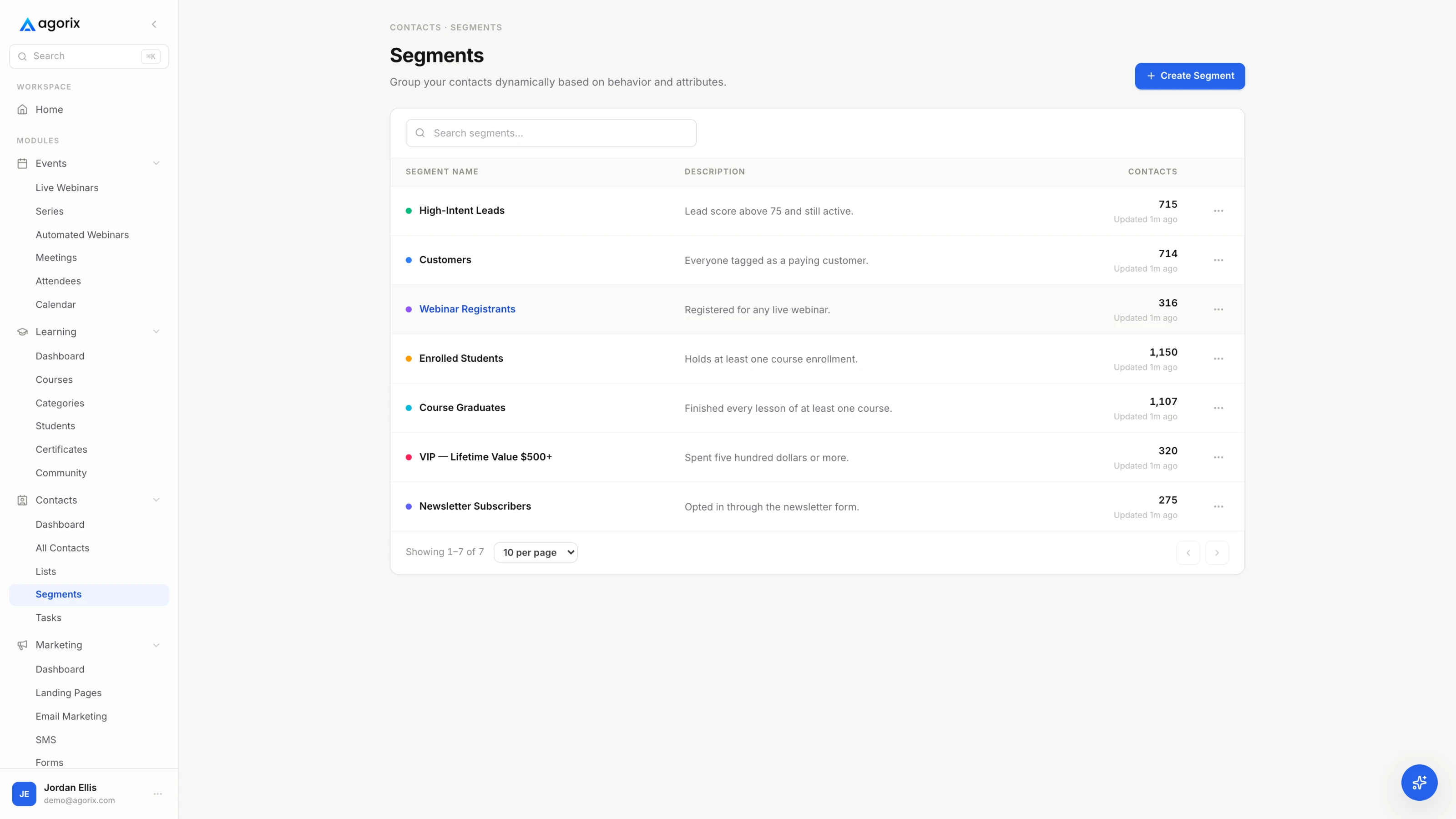
Any stack can record each signal individually. Following the same human from opt-in through registration, attendance, purchase and first lesson normally means reconciling exports on an email address. In Agorix those events land on one customer record as they happen — see how the shared customer timeline works.
The whole thing, filled in once.
A worked example for a webinar-led offer, written the way a real map is written. Take the shape and the discipline; write your own sentences, because these beliefs belong to a business that is not yours.
| Stage | Belief they reach | Asset that moves them | Signal recorded |
|---|---|---|---|
| Stranger | “This describes my problem better than I have heard it described.” | One public artifact on the problem — an article, a search result, a clip from a session | A visit from a source you can name |
| Subscriber | “Handing this person my email address will be worth what it costs me.” | The lead magnet and the page that promises it | A confirmed opt-in, tagged with the source |
| Registrant | “This specific hour is worth blocking out in my week.” | The registration page and the invitation sequence | A registration, attached to its source |
| Attendee | “I said I would be there, and being there will be worth it.” | The reminder sequence, and the first ten minutes of the session | Attendance, with minutes watched |
| Buyer | “This solves it, and I trust them to deliver what they described.” | The offer, and the checkout it points at | A completed purchase, attached to the journey that produced it |
| Student or client | “I made the right decision, and I can see it starting to work.” | Onboarding, and whatever produces the first real result | First meaningful use — first lesson finished, first session held |
| Repeat | “The next thing from these people is worth buying too.” | The second offer, timed to a completed outcome rather than to a calendar | A second purchase, a renewal, or a referral that converts |
Read it down the signal column first. That column is the honest one: every row where you cannot point at a recorded event is a row you are running on faith, and it is almost always the same rows that turn out to be missing their asset as well.
Then read the belief column top to bottom as a single argument. It should escalate: from recognising a problem, to trusting a person, to spending an hour, to spending money, to spending money again. If two adjacent rows ask for the same leap, one of them is not earning its place. If one row asks for a leap three times bigger than the rows around it, that is where the funnel leaks, and no amount of extra traffic will fix it.
Copy this, fill the brackets, argue about it once.
One block per stage. Seven blocks, one page, one meeting. The copy button gives you all seven with the stage names already in, so the only work left is the part that requires thinking.
STAGE — [stage name]

They arrive believing   [what they believe now, in their words, that keeps them here]
They leave believing    [the one sentence they must be able to say to move on]
Asset that moves them   [the one page, email, session or call that changes it]
Owner                   [the person who writes or builds it]
State                   [built / drafted / not started]
Signal recorded         [the event that proves the move happened]
Read the signal in      [the report, list or field where you will see it]
Two fields do more work than the rest. State turns the map from a description into a plan, because a map where four rows say “not started” is no longer a discussion about messaging. Read the signal in is the one people leave blank, and leaving it blank is how a funnel ends up with a measurement plan that exists only in the map.
Nobody leaves until every cell has a sentence, including the embarrassing ones.
The value of the exercise is entirely in the cells people want to skip. “We have never built this”, “we do not know”, and “nothing is recorded” are three of the most useful sentences the map can contain, and each one is worth more than a confident guess written to keep the page looking finished.
Build the assets closest to money first.
The map’s real output is not the diagram. It is the order. Start at the transaction, then take the stage immediately before it, then the stage immediately after it, and keep alternating outward.
The reasoning is unglamorous. Every stage before the transaction is worth exactly what the transaction is worth, so building them first means multiplying a number you have not established yet. Traffic into a funnel that cannot take money is a cost with no upside. A checkout with no traffic is at least testable this week, with ten people you email personally — and ten real buyers will teach you more about the belief column than a thousand visitors ever will.
The stage immediately after the money comes early for the same reason in reverse: it protects revenue you have already earned. Onboarding that produces a first result is the cheapest refund prevention available, and it is the only asset on the map that pays twice — once by keeping the first sale, and again by making the second one possible.
Build first — the money and its neighbours
Build next — working outward
Two exceptions, and one thing that is not one
- Breakage jumps the queue. A registration page that does not load, a sequence sending to the wrong segment, a checkout failing on mobile — fix it before building anything new. Breakage is not a stage, it is maintenance, and it does not get an entry in the order.
- A stage with no audience cannot be tested. If nobody at all reaches the offer, the offer cannot teach you anything, and the honest first build is a small amount of the nearest traffic — a personal email to a few dozen people — rather than a lead magnet and an ad account.
- Wanting a better lead magnet is not an exception. It is the most common way this order gets abandoned. The first row is the furthest from the money and the most fun to build, which is exactly why it belongs last.
Repeat sits above stranger in the order for the same reason: selling something else to people who have already paid you once is closer to the money than acquiring anybody new. It needs a second offer to exist, which is why it is not first — but it is reliably cheaper than the row below it, and the row below it is where most businesses start.
Every signal in column three is a funnel metric.
This is where the map stops being a planning artifact and becomes a measurement plan. Each pair of adjacent signals is a ratio, and the six ratios below are the whole scoreboard.
| The move | The ratio it becomes | How to read it |
|---|---|---|
| Stranger → Subscriber | Opt-in rate, split by source | Blended, it tells you almost nothing. Split by source, it tells you which article, partner or channel to write more of. |
| Subscriber → Registrant | Registrations per invitation sent | Judge the invitation, not the list. A list that will not register for anything is a different problem from an invitation nobody accepts. |
| Registrant → Attendee | Show-up rate | Usually the largest drop on the page, and the one with the cheapest fix, because reminders are the least expensive asset in the whole map. |
| Attendee → Buyer | Offer take rate | The ratio the offer is actually being tested by. Keep the denominator at attendees rather than registrants, or a promotion push will look like a sales improvement. |
| Buyer → Student or client | Activation rate | The share of buyers who reach first meaningful use inside a window you set. This is the number that predicts refunds before the refunds arrive. |
| Student → Repeat | Repeat purchase rate | Measured from customers who finished something, not from everybody who ever paid. The second sale is made by the first result, not by the second email. |
Record them the same way every time, with the denominators written down. Most disagreements about whether a funnel is working turn out to be disagreements about a denominator — take rate over registrants rather than attendees, activation over everybody who ever bought rather than everybody who bought this month. Decide once, write it on the map, and do not quietly change it between reporting periods.
Which ratio to work on
Not the lowest one. The one where a fix is cheapest relative to the revenue it unlocks, which is usually the stage nearest the money with a missing asset beside it. A show-up rate improved by a reminder sequence costs an afternoon and lands directly on the offer moment. The same percentage gained at the top of the map costs a quarter and arrives diluted by every ratio underneath it.
Reading a drop when one of these ratios moves is a discipline of its own — which stage, which direction, and whether the cause is the stage itself or the one before it. That is covered in funnel diagnostics, and the same seven stages drawn as a live working funnel — with the assets named and the sequence written — are in the webinar funnel guide.
Six questions about mapping the journey.
What is a customer journey map for a funnel?
A one-page table with one row per stage of the relationship and three columns: the belief the person has to reach in order to move on, the asset you own that changes that belief, and the signal recorded when it happens. A funnel diagram describes your steps; a journey map describes their state. That difference is what makes it useful for deciding what to build next, and for answering the question a diagram cannot — why people stopped where they stopped.
How many stages should a customer journey map have?
Seven is a working default: stranger, subscriber, registrant, attendee, buyer, student or client, and repeat. Delete the rows your business does not have rather than inventing them — plenty of businesses have no registrant stage at all. Only split a row when it has its own asset and its own recorded signal, and remember the boundary rule: if two stages share a boundary event, they are one stage wearing two names.
What is the difference between a customer journey map and a funnel diagram?
A funnel diagram is drawn from your side — page, email, webinar, checkout — and it is genuinely useful for building. A journey map is drawn from theirs and names what has to become true in their head at each step. The diagram tells you what exists; the map tells you why somebody stopped. Both are worth having, and the webinar funnel guide shows the same seven stages drawn as a working funnel.
What should I build first after mapping the journey?
Build the assets closest to money first. Start at the transaction, then take the stage immediately before it, then the stage immediately after it, and keep alternating outward until you run out of budget or patience. Traffic into a funnel that cannot take money is a cost with no upside; a checkout with no traffic can still be tested this week with ten people you email personally.
How do I know a stage in the map is actually working?
Every stage needs a signal: an event with a timestamp, attached to a person rather than to a page, recorded automatically, and countable this week without an export. Opt-in, registration, attendance with minutes watched, completed purchase, first lesson finished, second purchase. A stage with no signal is not built — it is hoped for, and hope does not appear in any report you can act on.
How often should I redraw the journey map?
When the offer changes, when a stage appears or disappears, or when a ratio moves far enough to change what you would build next. That is a few times a year for most businesses. The map is a decision record rather than a dashboard, and redrawing it every month is usually a comfortable substitute for building the thing the last version already told you to build.
The rows, built out one at a time.
You now have the map. Agorix is where the rows get built.
Pages, forms, email sequences, live and automated sessions, courses, checkout and behavioural follow-up — on one customer record, so each stage’s signal lands on the same person and the six ratios are a report rather than a reconciliation exercise.
14 days · $0 due today · Payment method required · Cancel before first charge and pay nothing