Front-loaded, visible, and it ends.
You know when the work is done. The obligation completes at delivery, the feedback arrives fast, and a bad month is obvious immediately — unpleasant, but honest.

One model makes you find buyers every month. The other makes you give them a reason to stay every month. Neither is passive, and the revenue comparison people usually make leaves out the part that decides it. Written to work with any billing stack; where a tool decision genuinely changes the plan, it says so.
The comparison is almost always made on revenue shape — a sawtooth against a rising line — and that framing hides the thing that actually determines which one you can sustain.
Sell once and every month starts empty. The work is finding buyers: a launch, a campaign, a webinar, a partner send, whatever fills the top of the month. It is visible, bounded and repeatable, and when it goes badly you know within a week.
Sell a subscription and every month starts with last month’s customers still in it. The work is keeping them: delivering something they would miss, noticing the ones who have gone quiet, and shipping in the eleventh month with the same care as the first. It is invisible, unbounded, and when it goes badly you find out six weeks later, from a cancellation whose cause happened in month three.
Both are real jobs. Neither is passive income, and the choice between them is mostly a question about you: which of those two rhythms you can actually run for two years without resenting it. The rest of this guide is about making that choice honestly and then implementing it without damaging the people who pay you.
You know when the work is done. The obligation completes at delivery, the feedback arrives fast, and a bad month is obvious immediately — unpleasant, but honest.
The obligation renews with the charge. Revenue accumulates while you deliver and drains while you do not, and the draining is slow enough to be mistaken for stability.
This distinction sounds pedantic until the first refund request arrives, at which point it turns out to have been the whole argument.
A payment plan splits a fixed price into instalments. The customer is buying the thing outright; the schedule is a convenience. Three payments of one-third, and at the end they own it — access does not depend on anything continuing, because nothing is continuing. Your obligation is delivery, once.
A subscription is rent. The customer pays for a period and receives that period. When payment stops, access stops, because the thing being paid for was never ownership. Your obligation renews with every charge.
Both models produce a card being charged monthly, which is why they get blurred in the copy, and buyers resolve ambiguity in the direction that favours them. Somebody who thought they were paying off a course and discovers they were renting one does not write to say they misread the page — they ask for their money back, and they are not entirely wrong to.
“Three payments of [amount] — yours to keep” and “[amount] per month — cancel any time, access ends when you do” are both one line long, and they remove the entire category of dispute. Put the sentence beside the price on the checkout page, on the sales page and in the receipt.
The related trap is the instalment plan that revokes access if a payment fails. That is a reasonable protection and it needs to be said out loud on the page, because it is the detail that makes a payment plan behave like a subscription at the worst possible moment.
This is the whole test, and it is worth applying before any of the arithmetic, because a subscription the customer does not believe in churns regardless of what the model says it should do.
Three questions, answered honestly about the product you actually have rather than the one you intend to have by December.
Three yes answers and a subscription describes the truth. Two, and you probably have a one-time product with something recurring beside it — which is the hybrid, and it is a good place to be. One or none, and charging monthly is a decision to bill for something that is not happening.
A subscription without ongoing delivery does not fail immediately; it fails on a delay. The first two or three months look fine because people are still consuming what they bought. Then the consumption ends, the charge does not, and the cancellations arrive together — usually alongside a handful of refund requests for the months where nothing happened, and those requests are reasonable. You are then choosing between refunding revenue you have spent and defending a position you know is weak.
Not a scorecard — there is no winner. A list of the axes on which the two models genuinely diverge, so that whichever you choose, you choose it knowing what comes with it.
| Axis | One-time | Subscription |
|---|---|---|
| What you sell | A finished thing. The transaction completes at the receipt and the obligation ends when it is delivered. | A continuing relationship. The transaction repeats, and so does the obligation behind it. |
| Where the work is | Acquisition. Every month starts empty and has to be filled with buyers you have not met yet. | Retention. Last month’s customers carry into this one, and the job is giving them a reason not to leave. |
| What a bad month looks like | A flat month. Unpleasant, visible immediately, and fixable by selling again. | A quiet month. Cancellations arrive weeks after the reason for them, so the damage is done before the number moves. |
| What compounds | Nothing, automatically. Assets compound — the page, the list, the proof — but revenue restarts at zero. | The customer base, in both directions. It accumulates while you deliver and it drains while you do not. |
| What the customer risks | One payment for one thing. The decision is bounded and they can evaluate it against a fixed number. | An open-ended commitment. The buying decision now includes “how hard is this to get out of”. |
| What you owe them | The thing, delivered as described, plus support for a stated period. | Something, every period, forever — including in the months when you would rather be doing something else. |
| Where it breaks | When the audience is exhausted and the same offer stops finding new buyers. | When delivery quietly stops but billing does not. This is the failure that ends brands rather than months. |
Two rows deserve a second read. “Where the work is” is the one people underestimate before choosing, and “where it breaks” is the one they underestimate afterwards. A subscription that keeps billing after delivery has quietly stopped is not a bad quarter — it is the thing that ends the relationship with an entire customer base at once.
The two models are usually presented as a fork. In practice the products that survive tend to charge once for the finished thing and monthly for the part that genuinely continues — because that is what is actually true about them.
The product is bought once and owned. Beside it sits something ongoing that a subset of buyers want: a community, monthly office hours, reviews of their work, a room where the questions get answered.
This is the safest hybrid because the two halves fail independently. If the layer does not find enough subscribers, the core still sells. If the core stops selling, the layer still has members.
Rule: the core must be complete and usable by someone who never subscribes. The moment the layer is required to make the core work, you have sold an incomplete product.
A setup, onboarding, installation or intensive charged once, then a monthly fee for what continues. Common in services and in anything where the first month costs you five times what the twelfth does.
It prices the shape of your own effort honestly, and it filters for people who are serious enough to pay for the beginning.
Rule: charge the entry fee only if the entry is real work you actually do. An arbitrary joining fee on a product with no onboarding is a price rise with a costume on.
A single price that buys permanent access to something with ongoing delivery attached. Popular because it converts, and because it pulls cash forward at exactly the moment cash is short.
It is a loan against work you have not done yet. Every lifetime buyer is someone you owe delivery to for as long as the product exists, at a price that stops arriving.
Rule: only sell it if you can name the month it stops being a loss, and only cap it. If you cannot do that arithmetic, you are not pricing — you are borrowing from your future self.
The hybrid also solves a sequencing problem. You can sell the one-time core first, watch what buyers ask for next, and build the recurring layer out of the requests — which means the subscription launches with a delivery obligation you already know you can meet. That is a considerably better position than committing to monthly delivery on a guess.
Everything below is arithmetic on invented assumptions — it is a worked example, not a benchmark and not a forecast. Replace every number with yours; the shape of the answer is the part worth keeping.
Sold once at [$300], or as a subscription at [$30] a month. Twenty new customers arrive every month in both cases. In the subscription, [5%] of the existing customer base cancels each month. No price changes, no refunds, no processing fees, no growth or decline in demand. None of those hold in reality, which is the point of writing them down.
| Illustrative figure | One-time at [$300] | Subscription at [$30]/month |
|---|---|---|
| Revenue in month 1 | $6,000 | $600 |
| Revenue in month 6 | $6,000 | about $3,180 |
| Revenue in month 12 | $6,000 | about $5,520 |
| Revenue in month 24 | $6,000 | about $8,500 |
| Cumulative by month 12 | $72,000 | about $39,200 |
| Cumulative by month 24 | $144,000 | about $126,600 |
| What month 25 opens with | Zero, and twenty more buyers to find | About 283 customers, and a reason they need to stay |
Rebuild this with your own price, your own monthly acquisition and — the hard one — an honest cancellation rate. If you have no cancellation history, run the arithmetic twice at two very different rates and notice how far apart the answers are. That distance is a fair measure of how much you currently know.
Cancellation friction does not retain customers. It delays them by a few weeks and converts a neutral event into a story — and the story outlives the few weeks by years.
The reasoning is not only ethical. Somebody who cancels cleanly stays on your list, keeps reading, recommends you to someone whose situation fits better, and comes back when theirs changes. Somebody who had to fight to leave does none of those, and tells the story in the exact places your next buyers are reading. The saved fortnight of revenue is the most expensive money in the business.
It is being made about people who have already decided, in exchange for a delay, and paid for in the currency you can least afford to spend. If the subscription needs friction to hold its numbers, the numbers were never real — and the fix is in the delivery, not in the exit.
Move them to a list that treats them as former customers rather than lapsed leads. They know the product, they know your voice, and they are the warmest audience for the next thing you make — provided the last interaction was a graceful one. Re-engagement campaigns work on that group and fail completely on the group that had to email three times to stop being charged.
The decision is usually made on the revenue model and paid for in the operations. These are the six recurring costs that do not appear in any comparison of the two lines.
None of these are reasons not to run a subscription. They are the reasons to decide the answers before the first customer rather than during the first crisis — every one of them turns into a trust question if it is improvised, and trust questions are settled against you by default.
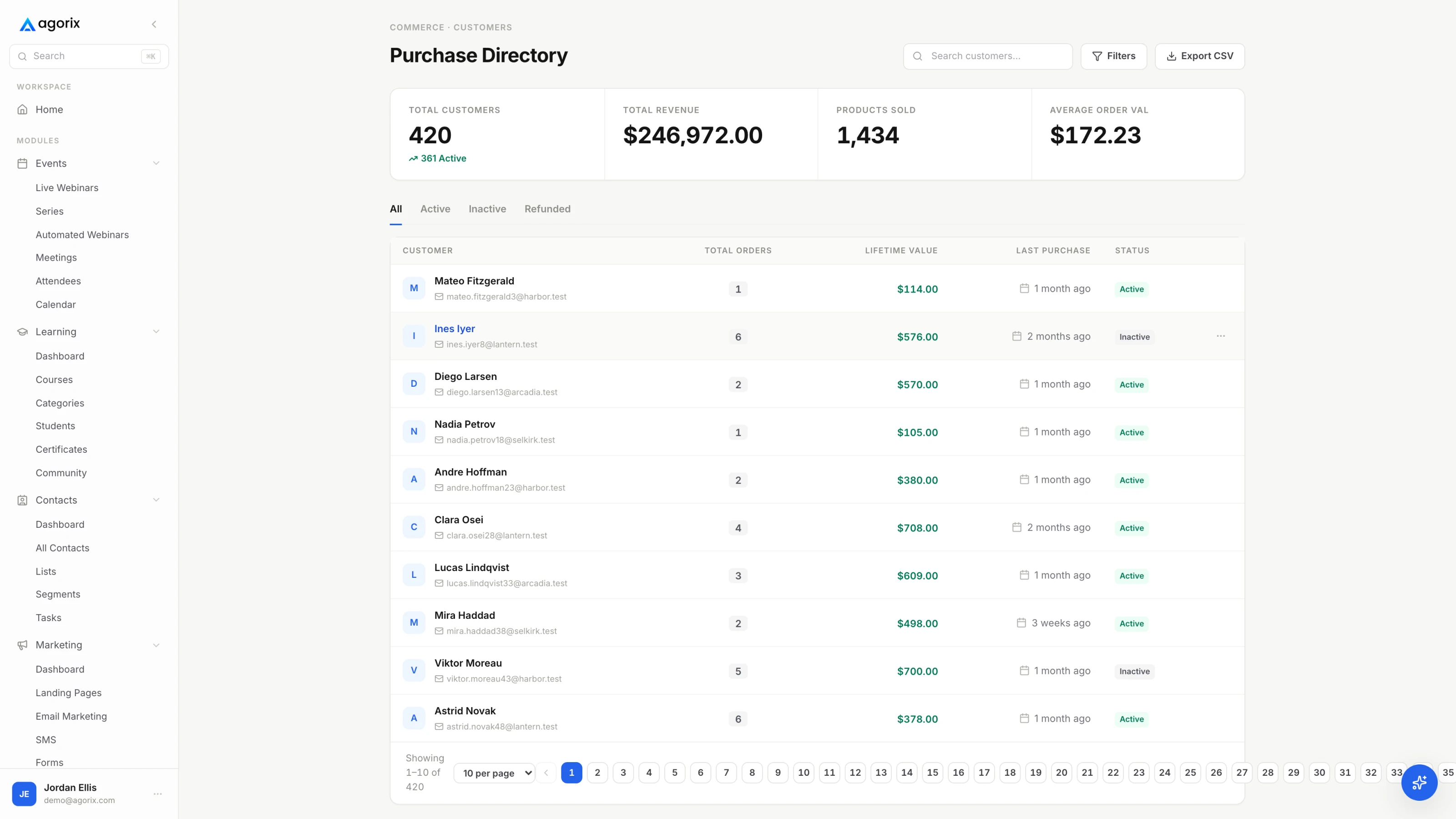
Which means the same event has to do several things at once: change what somebody can access, change what they receive, and change what the reporting counts them as. Every paid Agorix plan includes checkout and subscriptions, and a successful payment can update the customer record, grant access, stop irrelevant promotion and start onboarding on that same record — see how commerce works.
Switching is normal and usually a sign the business learned something. What damages people is not the change — it is discovering the change through a charge, or finding that something they owned has become something they rent.
If fewer than eight of those ten are true, the subscription is not ready — and the honest interim move is usually the hybrid: sell the finished thing once, build the recurring layer out of what buyers ask for next, and launch it when you already know what you are promising to deliver every month.
Choose by what you are actually delivering rather than by which revenue line looks better. If something genuinely arrives or changes each period — a room with people in it, access to you, work you perform, content that would be stale if you stopped — then a subscription describes the truth and customers will accept it. If the product is finished and static, sell it once. Charging monthly for permanent access to something that never changes is billing without delivery, and buyers work that out around month three. If you have not settled the shape of the product yet, choosing a first digital product comes before this decision.
Ongoing delivery, not ongoing billing. Three questions settle it. Is there something each period a customer would notice missing if it did not arrive? Does the value decay if you stop working on it? Would a customer who stopped paying reasonably expect to lose access? Three yes answers make a subscription honest and easy to defend. If the only thing genuinely recurring is the charge, what you have is a one-time product with a payment schedule attached, and it will be treated as one.
No, and confusing the two causes more refund requests than any other pricing mistake in this category. A payment plan is one price collected in instalments: the customer owns the product at the end, and access does not depend on continuing to pay. A subscription is rent: access ends when payment ends. Buyers default to assuming the friendlier of the two, so say which one you are selling in the words on the checkout page — beside the number, not in the terms.
Yes, and the hybrid is often the honest answer: a one-time core that people own outright, plus an optional recurring layer for whatever genuinely continues — a community, office hours, updates, reviews of their work. The rule that keeps it clean is that the core has to be complete and usable for someone who never subscribes. The moment the subscription is required for the purchase to work, you have sold an incomplete product and attached a fee to the missing part.
Announce it before it happens, apply it only to new purchases, and state in writing that existing buyers keep what they bought for as long as the product exists. Retroactively converting a purchase into a rental is the fastest way to turn customers into people who warn other people, and no amount of migration messaging fixes it afterwards. The same principle governs price rises on an existing subscription: either existing subscribers keep their rate indefinitely, or they get a full billing cycle of written notice, the exact new amount, and a completely trivial way to leave before it applies.
Yes, and not only for ethical reasons. Cancellation friction does not retain customers — it delays them, and it converts a neutral event into a story they tell about you. Cancelling should happen in the account without contacting anyone, be confirmed in writing with the date access ends, and immediately stop the campaigns that assume they are still a member. The person who leaves cleanly is the person who comes back, and the one who recommends you while they are away; a re-engagement campaign only works on people who left without a grievance.
Checkout, subscriptions, order bumps, course and product access, and the follow-up that changes when somebody buys or leaves — on one customer record, so a cancellation updates what they can reach and what they receive rather than only what they are billed.
14 days · $0 due today · Payment method required · Cancel before first charge and pay nothing