Skip to content
Agorix
Updated 29 July 2026

Order bump vs upsell: one yes, three different moments.

Where the bump belongs, where the one-click upsell belongs, what a downsell is actually for, and how to price all three against your core offer. Written to work with any checkout; where a tool decision genuinely changes the plan, it says so.

03positions
10placement tests
04numbers to watch

What you will have at the end

  • A one-line definition of the bump, the one-click upsell and the downsell that survives an argument
  • Ten tests that put a candidate offer in the right position — or out of the checkout entirely
  • Illustrative price bands relative to your core offer, labelled as arithmetic rather than as results
  • The honesty rules that keep the core offer complete without any of the extras
  • A sequencing rule for the second offer, and a clear place to stop
  • The four numbers that tell you whether any of it is working, including the one that warns you
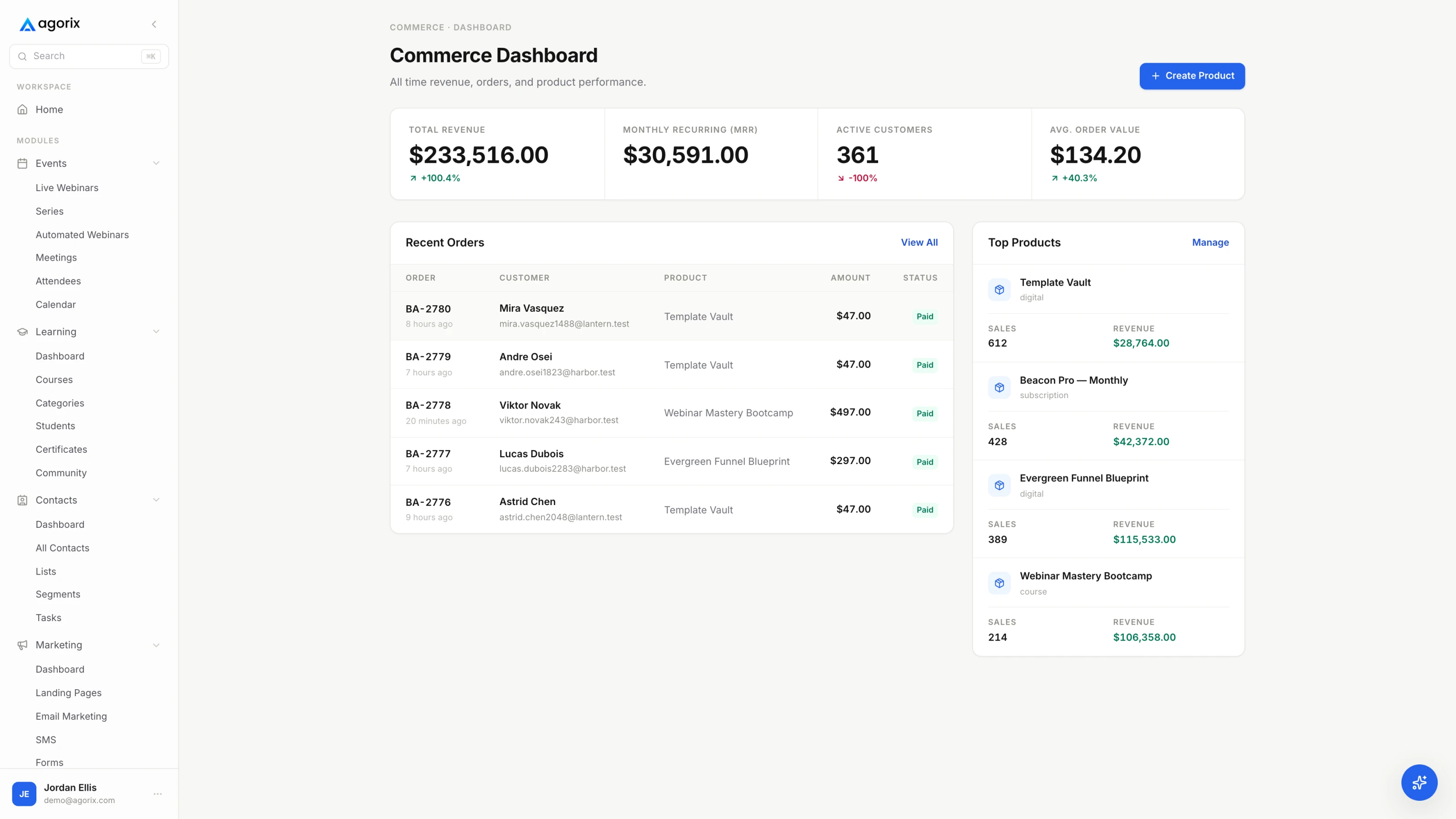
A commerce dashboard showing revenue, monthly recurring revenue, recent paid orders and the products earning them.
Pos. 00Three positions

Three positions, and one difference between them.

The bump, the one-click upsell and the downsell are not three sizes of the same idea. They sit at three different points in a single decision, and the point decides everything else: how big the offer can be, how much explaining it is allowed to carry, what it can cost, and what happens if the answer is no.

01Before payment

The order bump

A checkbox on the checkout itself, beside the payment details. One line, one price, one click. It adds something adjacent to the transaction that is already about to happen.

Buyer stateThey have chosen the core offer and have not yet paid.

02After payment

The one-click upsell

A separate offer shown once the core purchase has completed, accepted without re-entering payment details. It is the next product, not a larger version of the one just bought.

Buyer stateThey have paid. The relationship has changed.

03After a decline

The downsell

One smaller-scope alternative, shown once, only to somebody who has just declined the upsell. It answers the objection the decline was actually about.

Buyer stateThey have paid, and they have said no once.

Read the buyer-state line in each card and the rest of this guide becomes obvious. A person who has not paid yet is still deciding, so anything you put in front of them competes with the decision you actually want. A person who has just paid has already decided, which is why the offer after payment can be bigger and why it must never jeopardise what they just bought.

The most common mistake is sorting by size rather than by position — putting a substantial second product on the checkout because it is worth more, or shrinking a genuinely useful add-on into a post-purchase page because the checkout already looks busy. Size follows position. It never leads it.

BeforeThe order bumpPosition 01 / 03

Small, adjacent, and read in the seconds before the card details.

The bump occupies the only moment in a funnel where somebody has decided to buy and has not yet paid. That moment is valuable and fragile in equal measure, which is why the format is so tightly constrained.

One line, one price, one checkbox. If it needs a paragraph of persuasion, it is in the wrong position — not because the offer is bad, but because a paragraph on a checkout is an invitation to start thinking again, and thinking again is the last thing you want from somebody with their card in their hand.

  • Adjacency is the whole test. It makes the thing in the cart work better, arrive faster, or be easier to use. Anything pointing at a different problem is a second decision at the worst possible moment.
  • One bump, not three. A checkout with a stack of add-ons converts worse on the thing you actually wanted to sell. If two candidates are equally good, run one, then the other, and keep the one that did not cost you core sales.
  • It delivers with the purchase. Same moment, same email, no second onboarding. A bump that arrives separately a day later has all the cost of a second product and none of the benefit.
  • The description does the work. Name the thing, name what it saves, name the price. “Add the twelve-page workbook and the fill-in templates — [price]” beats any adjective available to you in that space.

Candidates that tend to fit: the workbook or template pack beside a course, the transcript and notes bundle beside an event pass, an extra seat or licence, a faster-start option, an offline or printable version of something digital. Candidates that almost never fit: a second course, a coaching package, anything priced near the core offer, and anything that needs a demonstration before it makes sense.

Everything else about the page the bump sits on — the fields, the trust marks, the mobile layout, the failure states — is covered in checkout page optimisation. Build the checkout first. A bump on a checkout that leaks is a rounding error on a bigger problem.

After yesThe one-click upsellPosition 02 / 03

The next product, offered at the only moment it is easy.

The seconds after a completed purchase are the second-highest-intent moment in the whole journey. The buyer has just resolved a decision, the payment details are already captured, and nothing is standing between them and one more yes.

One-click is not a marketing word here, it is the mechanic: the buyer does not re-enter payment details. That single property is why the position works, and it is also the property that makes the honesty rules further down this page non-negotiable — the friction that normally protects people from accidental purchases has been removed on purpose.

  1. Confirm before you ask. The first line on the page states what is already done: their purchase is complete and on its way. Everything after that is optional, and it has to read that way.
  2. Offer the next product, not a bigger version. A larger tier of the same thing is a pricing decision, and pricing decisions belong before the checkout. What belongs here is the thing they will need after this one works: implementation, a done-with-you tier, the next level, the tool that makes it faster.
  3. Give it a page, not a checkbox. This position can carry a short paragraph, a list of what is included, and a two-minute video. Use that room to explain rather than to pressure.
  4. Make declining one obvious click. The decline link sits near the accept button, in readable text, worded plainly. Both have to be visible without scrolling on a phone.
  5. Give it its own first step. Its own access, its own onboarding, its own opening email. An upsell that lands the buyer in the same welcome sequence as the core offer reads as an accident, because it is one.

If a candidate cannot be accepted without a conversation — because it needs qualification, scheduling or a scope discussion — it does not belong in this position at any price. Put it in the follow-up sequence where it can have a proper argument made for it, and use the post-purchase page for something that genuinely resolves in one click.

After noThe downsellPosition 03 / 03

One smaller answer to the no you just heard.

A downsell is not the same offer at a discount. It is a smaller scope at a smaller price, or the same scope with the timing changed. The distinction matters more than almost anything else on this page.

Declines have three common causes — price, time, and fit — and a discount only answers one of them. Somebody who declined because the programme needs six hours a week does not need it cheaper; they need a version that needs two. Somebody who declined because they are not sure it applies to them does not need a discount either; they need a smaller commitment to find out. Decide which objection your downsell answers before you build it, because a downsell that answers the wrong one is just a price cut with extra steps.

  • Smaller scope. Fewer sessions, one module instead of the set, the self-paced version of the live thing, group access instead of one-to-one. The buyer can see what they are giving up, which is what makes the lower price honest.
  • Or a payment plan. The most honest downsell available, because nothing about the offer changes except when the money moves. State the total plainly alongside the instalment — a plan presented only as a monthly figure is the one form of this that ages badly.
  • Shown once. One screen, then the receipt. A second downsell is a negotiation, and somebody who has just paid you should never be negotiated with.
  • Never discounting what they already bought. Offering the core purchase cheaper moments after it completes is the fastest way to turn a new customer into a support ticket.

If you cannot construct a genuinely smaller version, skip the downsell. There is no obligation to have one, and an invented smaller tier that nobody would be proud to deliver costs more in refunds and reputation than it collects at checkout.

Sort itTen placement tests

Ten questions that decide where a candidate goes.

Take one candidate offer and work down both columns. Pass all five bump tests and it belongs on the checkout. Pass all five upsell tests and it belongs after the payment. Pass neither set cleanly and it belongs somewhere else entirely.

The tests are written to be failed. Most candidates fail two or three, and the failures are the useful part — a candidate that fails “explained in one sentence” is telling you it needs a page, and a candidate that fails “complete without it” is telling you something worse, which the honesty rules below deal with directly.

Placement tests0 / 10 passed

Bump tests — all five, or it is not a bump

One-click upsell tests — all five, or move it

If it passes both

Put it after the payment

A candidate that satisfies both sets is almost always too substantial for a checkbox. The checkout is the scarcer real estate, so the bigger offer moves to the position with room to explain itself.

If it passes neither

Put it in the follow-up

Not every good offer belongs in a checkout flow. A week later, with a sequence behind it and a page of its own, it can make the argument that neither of these positions has room for.

PricingPrice relationships

Price them against the core offer, not against each other.

The only fixed point is your core price. Everything else is expressed as a relationship to it, because a relationship is what the buyer is actually judging in the two seconds they spend on it.

PositionIllustrative bandWhy the band has that shape
Order bumpRoughly a tenth to a quarter of the core priceSmall enough that adding it does not reopen a decision that has already been made, and large enough to be worth the checkout attention it costs. Above about a quarter it stops being a checkbox and starts being a second purchase, which is the wrong shape for the position.
First one-click upsellFrom about half the core price to several times itIt is a different product with its own delivery, so it is priced on its own merits rather than as a fraction of anything. The practical ceiling is whether somebody could accept it without a conversation. If the honest answer is no, it belongs in the follow-up sequence with a real argument attached, not on a post-purchase page.
Downsell after a declined upsellCommonly a third to a half of the upsell priceThe price falls because the scope falls. A payment plan is the exception: the scope is unchanged and only the timing moves, in which case state the total plainly rather than the instalment alone.
Second upsell, if there is oneBelow the firstAttention and patience are both lower by this point, and the buyer has already made two decisions since paying. If the second offer needs to be the expensive one, it is the first offer that is in the wrong place.
Read this before using the table

These are illustrative price ratios. They are not benchmarks, and they are not results.

Every band above describes a relationship between prices you set — nothing more. There is no claim anywhere on this page about how many people accept a bump, an upsell or a downsell, because that number depends on your offer, your audience, your price and your traffic, and a borrowed figure would produce a forecast with false precision. Start from the ratios, then replace them with what your own checkout tells you.

The arithmetic, with your numbers in it

The shape of the calculation is worth knowing even before you have any data to put in it, because it shows which term you can actually control. Prices are decisions. Rates are measurements. The bracketed terms below are the ones only your own checkout can fill.

Revenue per completed checkout

  =   [core price]
  +   [bump attach rate]     ×  [bump price]
  +   [upsell take rate]     ×  [upsell price]
  +   [upsell decline rate]  ×  [downsell take rate]  ×  [downsell price]

Two things fall out of that line. The downsell term is multiplied twice, so it is structurally the smallest contributor and should never be the reason a flow gets complicated. And every rate in it is a measurement rather than an assumption — which is why the four numbers at the end of this guide matter more than any price band above it.

Setting the core price itself is a separate job, and the extras cannot rescue a core price that is wrong: pricing digital products covers that decision on its own terms.

RulesHonest framing

The core offer has to be complete without any of this.

One rule sits underneath the other six. Nothing in this flow is allowed to make the core offer worse, and nothing in it is allowed to work by making the core offer work harder than it should.

  1. The bump must be genuinely useful, not quietly necessary. If declining it leaves the buyer stuck, it was never a bump — it was a part of the thing you sold, removed and sold back. The test is simple: could you describe the core offer to somebody, out loud, without mentioning the bump, and would that description still be true?
  2. Never manufacture the gap. Holding back the transcripts, the checklist or the implementation guide so there is something to sell at checkout creates a hole you then charge to fill. It works for one purchase and it is visible in the refund reasons for the rest of the year.
  3. Confirm before you ask. Every post-purchase page opens by stating what is already done. Nobody should have to wonder whether their payment went through while reading an offer.
  4. Declining is one plain click. No shrunken grey text, no “no thanks, I do not want results”, no countdown that has nothing to count. Shaming somebody into a purchase is a refund with a delay attached.
  5. One offer per moment. One bump on the checkout, one upsell after payment, one downsell after a decline. Stacked offers are how a purchase turns into an obstacle course.
  6. Same policy for everything in the flow. The extras follow the core refund terms, the same support, and the same delivery promises. Different terms for the small item is a support ticket waiting for a slow week.
  7. Price where you would defend it. Every buyer eventually meets another buyer. If you would flinch explaining the price of the upsell to somebody who took it, the number is wrong.
The test that catches the rest

Would you walk a customer through this flow, out loud, while they watched?

Read the whole path aloud as if the buyer were in the room: here is what you bought, here is the checkbox and why it is there, here is the offer after you paid, here is how you say no. Anything that makes you want to speed up or change your tone is the part to remove. This is the fastest audit available and it costs four minutes.

StackingMore than one

Two is a sequence. Four is a maze.

The working shape is one bump, one upsell, and one downsell that only appears after a decline. That is two decisions after payment, which is about as much as a fresh customer will spend before delivery has earned anything back.

A second upsell is defensible once the first has enough volume to have taught you something, and it comes with two conditions: it must be for a different job rather than a larger version of the first, and it should be priced below it. After an accepted upsell the limit is fatigue rather than logic. After a declined one, the only legitimate next screen is the single downsell, and then the receipt.

Draw every path before you build one

Each accept-or-decline doubles the number of endings, and every ending has to deliver the right access with the right emails. This is the part that breaks in production, almost always on the path nobody tested.

PathWhat they ownWhat must be true at the end
Core onlyThe core offerReceipt, core access, core onboarding, and removal from every campaign still selling the core offer.
Core + bumpCore offer and the bumpOne receipt showing both lines, both items delivered together, and no separate onboarding for the bump.
Core + upsellCore offer and the upsellReceipts for both, access to both, the upsell’s own first step, and suppression from anything that sells the upsell again.
Core + bump + upsellAll threeEverything above at once. The path most often left untested, and the one where duplicate onboarding emails usually surface.
Core, upsell declined, downsell takenCore offer and the downsellThe downsell’s access and onboarding, and no further offer of the upsell for a stated period.
Core, both declinedThe core offerIdentical to core-only. A buyer who declined twice must not land somewhere worse than one who was never asked.

Two rules make that table survivable. Every path terminates at a receipt and correct access — no exceptions, including the ones where somebody declined everything. And anyone who bought something must stop receiving the campaign that sells it, which is a behavioural trigger rather than a weekly cleanup job.

Then test all of them with a real card before publishing, in the order a buyer would meet them, on a phone. The workflow testing checklist covers how to do that without leaving test orders in your reporting.

MeasureThe four numbers

Four numbers, and one of them is a warning light.

Attach rates are the number everybody collects and the easiest one to be encouraged by. Read all four together or the flow will look like it is working while it costs you core sales.

  1. Attach rate, per position. Accepted ÷ eligible. The denominator is where this goes wrong: the bump’s denominator is everybody who completed a checkout, while the upsell’s is everybody who actually reached the upsell page — which is not the same set if a payment failed or a browser closed. Define both once and write the definitions next to the numbers.
  2. Revenue per completed checkout. Total revenue ÷ completed core purchases. The number the whole page exists to move, and the only one that lets you compare a checkout with a bump against a checkout without one. Everything else is a component of it.
  3. Core conversion rate, before and after. The damage check, and the one most people skip. The bump sits on the checkout, so it can cost you core sales while its own attach rate looks encouraging. Record the core conversion rate for a period before you add anything, and compare like periods afterwards.
  4. Refund and chargeback rate, split by path. The warning light. If the upsell path refunds at a visibly different rate from the core-only path, the offer, the framing or the pressure is wrong — and it will keep looking profitable for about a month, because the extra revenue arrives immediately and the refunds arrive later.

Record them per path, not in aggregate. The aggregate hides exactly the comparison worth making: whether buyers who took the upsell behave differently afterwards from buyers who did not, in refunds, in support load and in whether they ever came back. That comparison needs the order, the fulfilment and the customer’s later behaviour joined to one person.

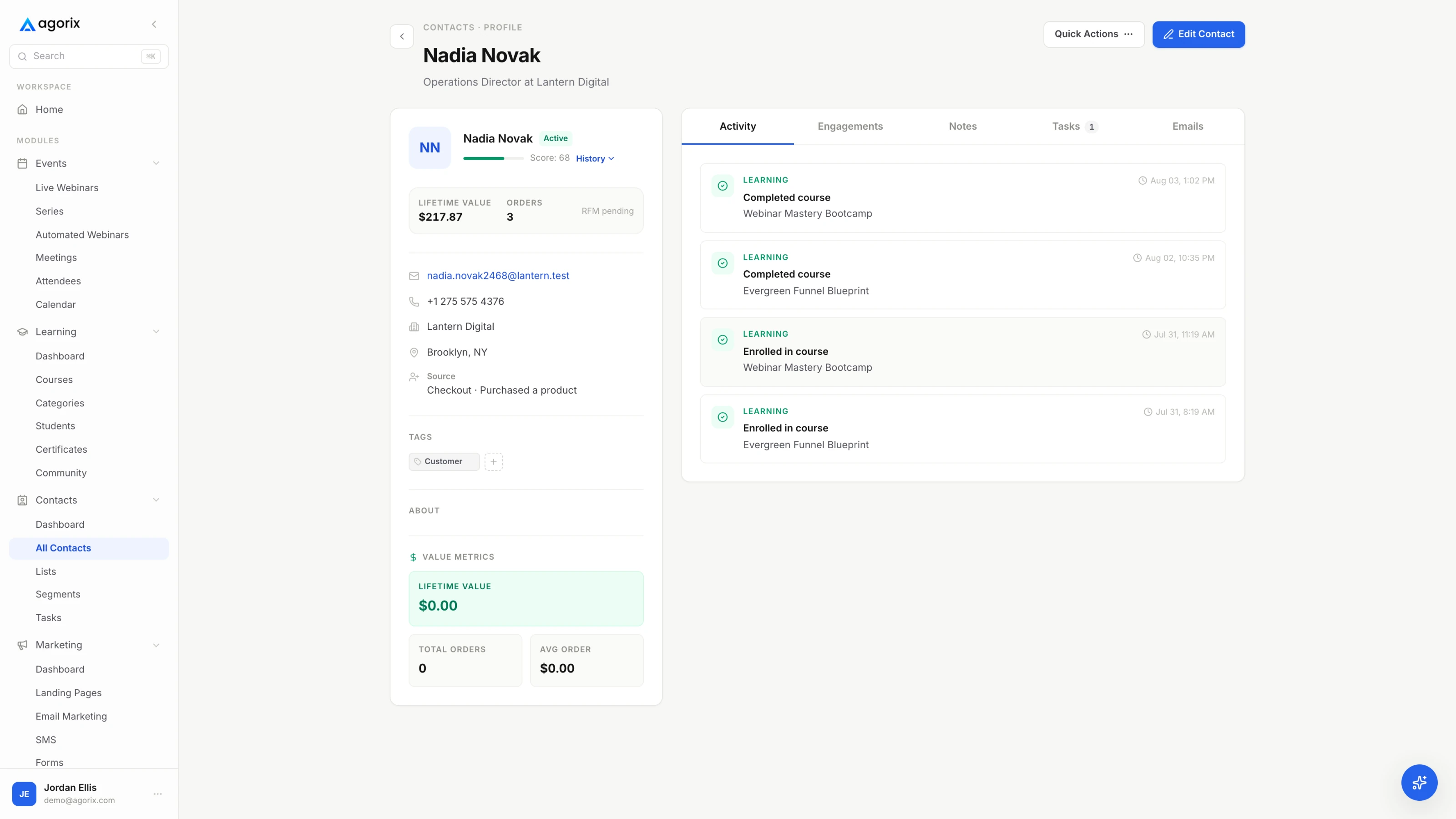
A contact record showing registration, watch time, offer clicks and purchase history on one timeline.
Fig. 01Reading a path per person: what they bought, what they declined, and what happened afterwards — the view that turns four numbers into a decision.

One last discipline: change one thing at a time. Adding a bump and rewriting the checkout in the same week produces a number that cannot be attributed to either. Simple A/B testing covers how to run that honestly at small volumes, including when not to bother.

Where a tool decision changes the plan

Attach rates are easy. Refund rate by path is the number that needs one record.

Most checkouts can tell you what was added. Comparing how upsell buyers behave months later against everybody else normally means joining a payment export to a fulfilment export by email address. In Agorix the order, the access it granted and the follow-up sit on the same customer record — see how connected commerce works.

Start your 14-day trial 14 days · $0 due today · Payment method required · Cancel before first charge and pay nothing
Common questions

Six questions about bumps and upsells.

What is the difference between an order bump and an upsell?

Position, and what the buyer has already agreed to. An order bump is a checkbox on the checkout itself, decided before payment, adding something small and adjacent to the purchase being made. A one-click upsell appears after the payment has completed and is accepted without re-entering payment details — it is the next product rather than a larger version of the one just bought. Size, price and how much explaining each can carry all follow from the position, not the other way round.

Should an order bump be related to the main product?

Yes — adjacency is the entire test. A bump should make the thing already in the cart work better, arrive faster or be easier to use, and it should be understandable in one sentence at one price. A bump pointing at a different problem asks somebody to start a second decision at the precise moment they were about to finish the first, which is also the moment your checkout can least afford the distraction.

How much should an order bump cost?

Price it as a relationship to your core offer rather than as an absolute number. A useful illustrative band is roughly a tenth to a quarter of the core price — small enough that adding it does not reopen the decision, large enough to be worth the checkout attention it costs. Above about a quarter it stops behaving like a checkbox and starts behaving like a second purchase, at which point it belongs after the payment instead.

Do order bumps hurt checkout conversion?

They can, which is exactly why the core conversion rate is one of the four numbers on this page rather than the attach rate alone. Anything added to a checkout competes for the attention the core purchase needs. Record the core conversion rate for a period before you add a bump, compare like periods afterwards, and be genuinely willing to remove it if the core number moved. No published benchmark can answer this question for your checkout, your price or your traffic.

Is a downsell necessary after a declined upsell?

No, and plenty of good checkouts do not have one. A downsell earns its place only when you can construct a genuinely smaller scope at a smaller price, or offer the same scope on a payment plan. The same offer at a discount is not a downsell — it is a lesson that your prices move when somebody hesitates, and it is expensive the next time you launch anything. If there is no honest smaller version, send them straight to the receipt.

How many upsells is too many?

Cap the path at two decisions after payment: one upsell, and one downsell only if the upsell is declined. A second upsell is defensible once the first has enough volume to have taught you something, and it should be for a different job and priced below the first. Every extra screen between paying and the receipt spends goodwill the delivery has not earned back yet — and every path has to be tested end to end before it goes live.

Keep going

The page underneath, and the price above it.

From three positions to one flow

You now have the placement. Agorix is where the flow gets built.

Branded checkout, subscriptions and order bumps on every paid plan, one-click upsells from Growth upward, and the purchase, the access it grants and the follow-up that comes next on one customer record — so refund rate by path is a report rather than a reconciliation.

14 days · $0 due today · Payment method required · Cancel before first charge and pay nothing