$47 · $97 · $497
Fits promotional pages, entry rungs, launches with deadlines, and lines where the price is part of the offer’s argument. Looks deliberate when everything around it is too.

A digital product costs almost nothing to make a second copy of, which quietly removes the anchor every other kind of business prices against. What replaces it is the buyer’s alternative: what the problem costs them to keep having, and what every other route out of it would cost. Written to work with any stack; where a tool decision genuinely changes the plan, it says so.
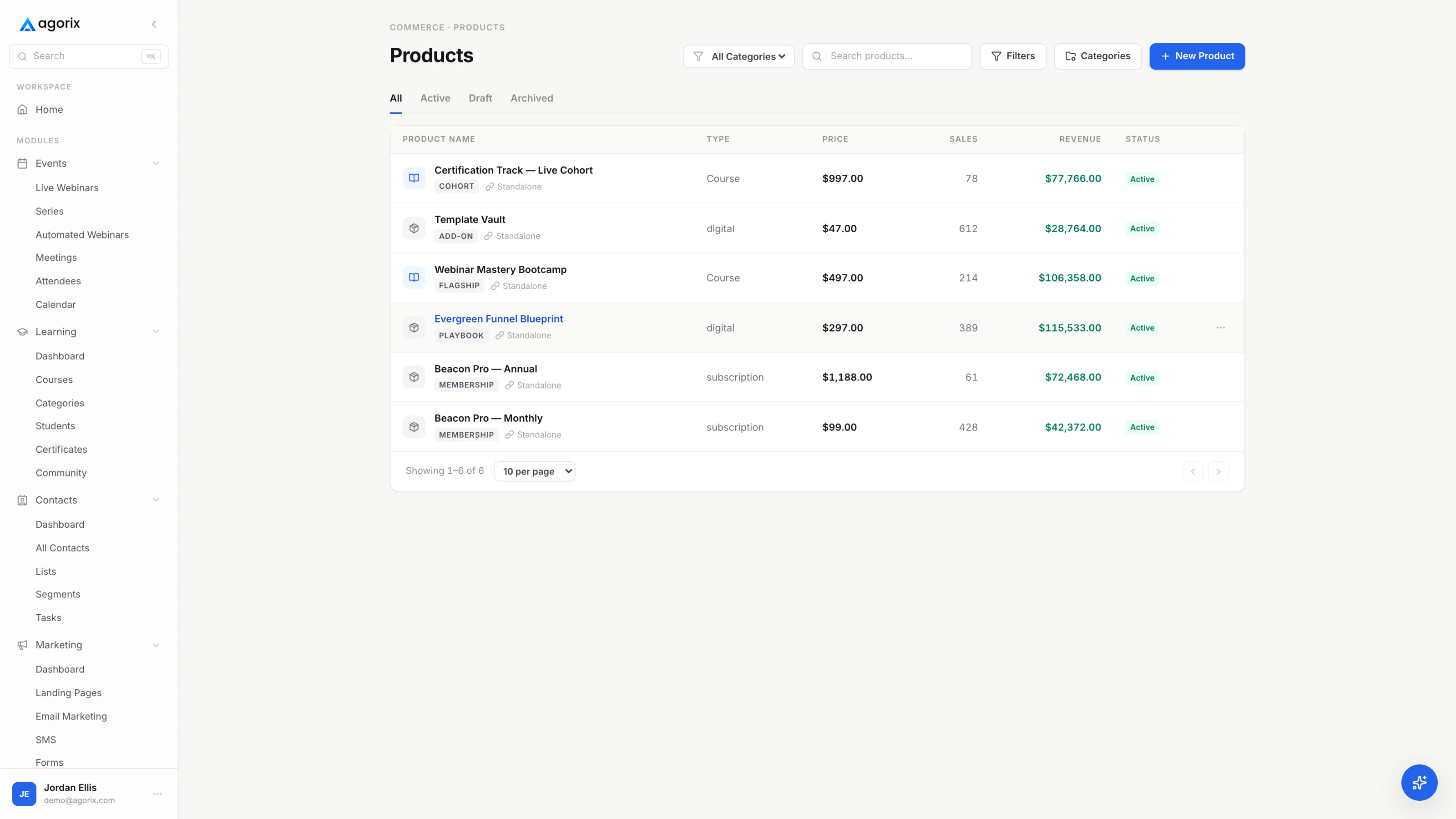
Every instinct you have about pricing came from goods that cost something to produce again. Digital products do not, which means the effort you put in is invisible to the buyer and irrelevant to the price. What remains is what changes for them, and what the alternatives to that change cost.
Start by writing the transformation in the buyer’s own words, not yours. Not “a six-module programme on operational systems”, but “you stop losing two days a month to the same reconciliation”. If you cannot write that sentence, no amount of pricing technique will help — the problem is upstream and it is a positioning problem.
Every buyer is already choosing between these. You are not inventing a range; you are locating yourself inside one that already exists in their head.
That gives you a range rather than a number, which is the correct output. Your price should sit somewhere inside it that you can defend out loud — because you will have to, on a sales page, in a reply to an email, and occasionally to somebody who asks directly.
Not “what would you pay for this” — a question nobody can answer honestly about a thing that does not exist yet. Ask what they have already done about this problem, what it cost them in money or hours, and what happened. You will get the anchor, the objections and most of your sales copy out of five conversations, and the only thing it costs you is the willingness to have them.
A ladder is not a discount structure. It is three different answers to three different levels of commitment, and its job is to let somebody buy at the level they are actually at rather than at the only level you sell.
| Rung | Its job | The test it has to pass |
|---|---|---|
| Entry | Proves you are worth listening to, and turns a reader into a buyer for the first time. | It has to solve one whole small problem by itself. A cut-down version of the core product that leaves people stuck is worse than selling nothing, because it teaches them that your work does not finish. |
| Core | The thing the business actually runs on, and the outcome you want to be known for. | You can describe the buyer in one sentence and the transformation in one more. If the core product is defined by what it contains rather than what it changes, the price will always feel arbitrary. |
| High | For the people who want you involved, or who need it faster, or who are buying for a team. | It is priced against your calendar, not against the file. Anything that consumes your hours has a hard ceiling on volume, and the price has to respect that before demand does. |
Far enough that moving up is a decision. Rungs a few percent apart make the choice arbitrary and the cheapest one wins by default; rungs with a chasm between them leave people who want more with nowhere to go. A working rule is that each rung is a multiple of the one below rather than an increment — so the buyer is choosing a different kind of commitment, not haggling.
A three-rung line is what a business that already sells one thing well grows into. If nothing has sold yet, building three products means three chances to be wrong at once and no way to tell which part was wrong. Start with one product, sell it to strangers, and let what they ask for afterwards tell you which rung to build next.
A tier only works if somebody standing in front of the page can tell which one they are. That rules out most feature lists and all module counts, and it rules in the things people already know about themselves: how much of your time they want, how fast they need it, and whether they are buying for one person or for a team.
Three is a workable default because it lets a buyer place themselves without a spreadsheet. Decide in advance which one you want most people to choose and make it obviously the best trade rather than the one with the most badges around it. Name the tiers after who they are for — solo, team, with-me — rather than after metals, which tell a buyer nothing except that somebody read the same article you did.
Two of these axes are worth singling out. Team and multi-seat licensing is the most commonly forgotten tier in digital products, and it is often the easiest revenue in the line: somebody was going to share the login anyway, and being asked plainly is a relief rather than an imposition. And cohort against self-paced is not really a tier at all — it is two products with different cost structures, and pricing it as a tier is how people accidentally sell their calendar at the self-paced price.
You will find confident claims in both directions and a great deal of borrowed research. We are not going to add to it: any lift figure we quoted would have come from somebody else’s audience, category and price point, and would tell you nothing reliable about yours.
What is reliably true is duller and more useful. A price is a piece of copy. It sits on the page next to your headline, your promise and your guarantee, and it is read in the same voice as all of them. Charmed endings — 97, 47, 197 — read as promotional, and on a page built that way they are consistent. Round numbers read as calm and settled, and on a premium page they are consistent. The error is not choosing either; it is choosing one that argues with everything around it.
Fits promotional pages, entry rungs, launches with deadlines, and lines where the price is part of the offer’s argument. Looks deliberate when everything around it is too.
Fits premium positioning, B2B buyers, anything an employer will be invoiced for, and prices you expect to hold for years. Reads as a considered number rather than a tactic.
A product line priced at $97, $500 and $1,997 reads like three businesses that happen to share a logo. Pick one convention and apply it to every rung, every tier and every bump. Consistency here does something a single clever price never can: it makes the whole line look like it was designed rather than accumulated.
A price that divides cleanly into three or twelve makes a payment plan legible at a glance; one that does not produces instalments like $166.33 and a support inbox asking why. The same goes for tax: if your buyers see a tax-inclusive total, choose the number that looks deliberate after tax rather than before it. And never publish a crossed-out “compare at” figure the product has not genuinely sold for — beyond being the fastest way to make everything else on the page look invented, reference pricing is regulated in many places.
Plans work because they move the objection from “can I afford this” to “is this worth it”, which is the argument you would rather be having. They are worth offering for exactly that reason — and they are almost always priced as though they were free to provide.
The plan total should exceed the single payment. That is not a penalty and buyers do not read it as one — it is the ordinary price of paying later, and every other industry states it openly. Show both numbers on the page: the instalment, the number of instalments, and the total collected across the plan. A plan total that only appears on the receipt is the single most reliable way to turn a buyer into a dispute.
Then decide two things before you sell anything. First, how long the plan runs relative to delivery — a plan that outlives the programme is a collections problem waiting to happen. Second, what happens to access when a payment fails: how many retries, how many days of grace, and what the customer is told and when. Publish that rule where a buyer will see it, and build the recovery path behind it before the first plan starts.
Recurring subscriptions are a different animal with a different set of trade-offs — subscription versus one-time covers when the shape of the product justifies it, rather than when the cash flow would merely be nicer.
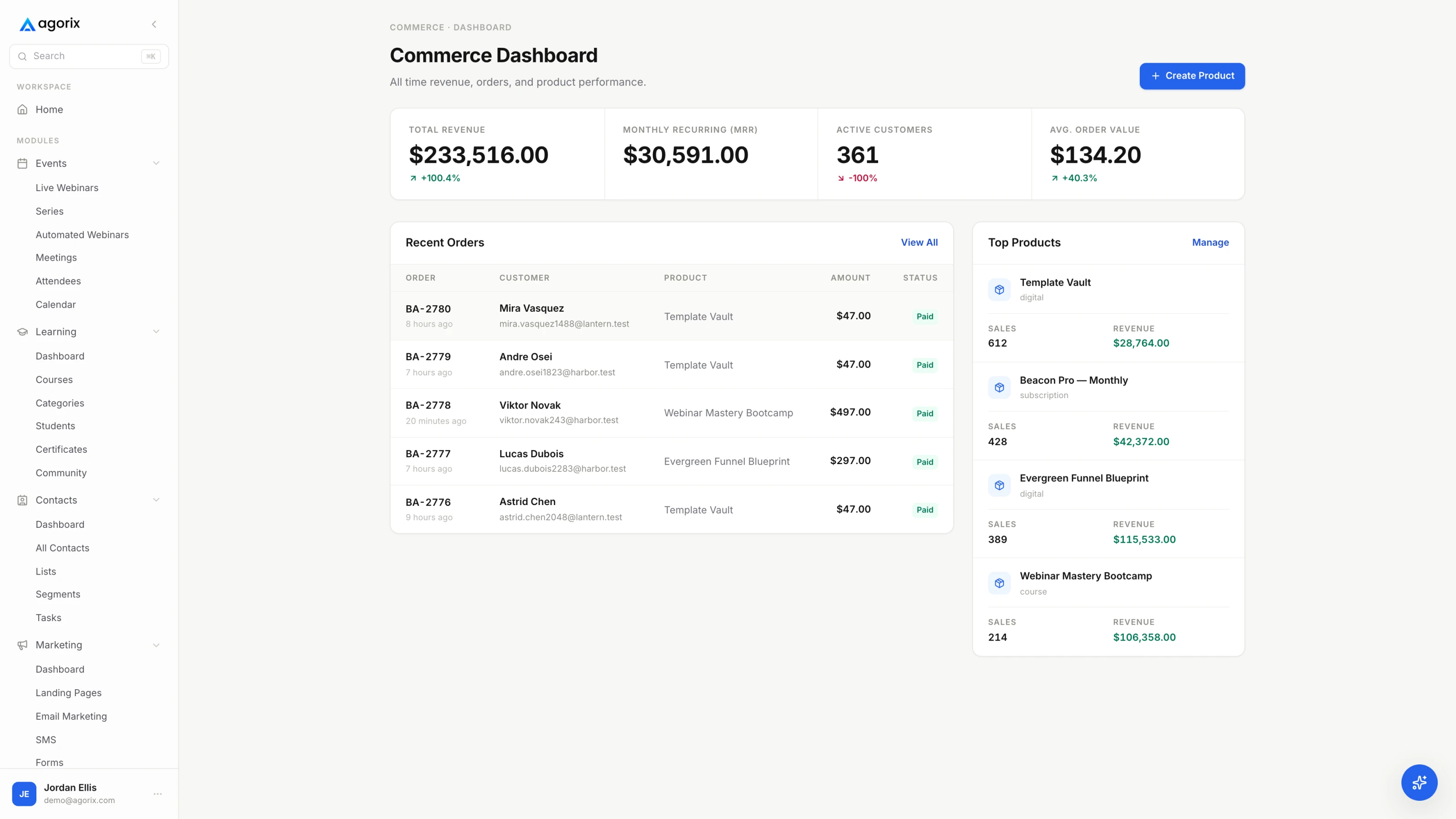
Three rungs, tiered access, a plan alongside the single payment and a bump at checkout is four billing shapes and, on a stitched stack, four places for the customer record to fork. In Agorix, checkout, subscriptions and order bumps are native on every paid plan and the purchase stays attached to the journey that produced it — see how commerce works.
Most price rises go badly for one reason: the rule for existing customers was worked out after the first complaint rather than before the announcement. Every rule is defensible if you state it and hold it. None of them survives being improvised in public.
Before raising, look at the two numbers that move net revenue without touching the number on the page: the share of buyers who refund, and the share of payment plans that finish. Both are driven by onboarding, delivery and expectation-setting rather than by pricing, and both are usually easier to improve than a price rise is to announce. Run them through the plate below and see which one your business is actually leaking through.
Price gets all the attention because it is the number on the page. What the business actually runs on is what survives payment plans that stop, refunds, and the processor’s percentage — and the gap between the two is usually larger than people expect.
The plate below is arithmetic, not advice. Change every field to your own assumptions and watch which one moves the bottom line most. For a lot of digital businesses it is not the price at all — it is plan completion or refunds, both of which are fixed by delivery rather than by pricing.
This is arithmetic, not a forecast, and the starting values are not benchmarks. They are round numbers chosen to be obviously invented, so that you replace them. We have deliberately not published a “typical” refund rate or payment-plan completion rate, because we do not have one that would be honest for your product, your price and your buyers — and neither does anybody who quotes you one. Read the output as a shape rather than as a result.
Gross of everything a real business also pays: your own time, ad spend, tools, tax, affiliate or partner shares, and disputes. It also ignores every bump, upsell and later purchase, which is where a product line makes most of the difference between two businesses charging the same headline price.
Anchor to the buyer’s alternative rather than to your costs or your audience size: what the problem costs them to keep having, what solving it alone would cost them in hours, and what hiring somebody would cost. Your price sits somewhere defensible inside that range. Then validate with money rather than opinion — pre-sell to a small number of people who genuinely have the problem, at the real price, with a real date and an easy refund. Launching without a list covers how to find those people.
Treat it as a voice decision rather than a psychology one. We are not going to quote you a lift figure — the published research is contested and context-dependent, and any number we handed you would have been borrowed from somebody else’s audience and price point. What is reliably true is that a price is a piece of copy sitting next to your promise. Charmed endings read as promotional and belong on pages built that way; round numbers read as calm and senior and fit premium positioning. Pick a convention and hold it across the whole line, because a line priced at $97, $500 and $1,997 reads like three different businesses.
Offer one when affordability rather than value is the objection, and price it above the single payment, because you are the one providing the financing. Its real costs are a lower total collected when plans stop early, the support load of failed cards, cash arriving over months against delivery that happens up front, and a longer window of refund and dispute exposure. Show the plan total as well as the instalment, decide what happens to access when a payment fails before you sell, and keep a dunning sequence behind it.
Far enough that moving between them is a decision rather than a rounding error. Tiers that sit close together make the choice arbitrary and the cheaper one wins by default; tiers with nothing between them leave buyers no way to step up. What the gap is made of matters more than its width — access to you, delivery shape, licence scope, implementation assets, assessment, access window, or speed are all things a buyer can evaluate before paying. Never tier on the part that actually produces the outcome.
Decide the grandfathering rule before you announce anything and write it down: for recurring products, keeping the old price indefinitely or for a stated number of months are both defensible, and changing your mind halfway through is not. One-time buyers already own what they bought — that was the deal — and lifetime access is a liability you accepted at the point of sale. Tell existing customers and your list before the page changes, state the date and the reason in one line, and do not manufacture a deadline you intend to run again in three months.
Because buyers pay for the outcome and the alternative cost, not for volume. A checklist that stops an expensive mistake is not cheap because it is a PDF, and forty hours that change nothing measurable are not expensive because they are long. Pricing from length or production effort is cost-plus pricing, which does not work for goods with almost no marginal cost. Courses have enough of their own structure to warrant a separate guide, but the principle underneath is the same one.
Products, tiers, subscriptions, instalments and order bumps through a branded checkout — with the purchase, the fulfilment and the follow-up on the same customer record, so what you kept per buyer is a report rather than a reconciliation.
14 days · $0 due today · Payment method required · Cancel before first charge and pay nothing