Skip to content
Agorix
Updated 29 July 2026

A newsletter system built for the busy weeks.

Newsletters rarely die of bad writing. They die of a week where three other things went wrong, then a second week that was easier to skip than the first. This is the system underneath a newsletter that keeps arriving: a repeatable format, a bank of ideas you did not have to invent, one issue written ahead, and an honest way to miss one.

03blocks per issue
01issue banked
60minutes a week

What you will have at the end

  • A repeatable issue format that removes the blank page every week
  • An idea bank fed by questions you are already being asked
  • One issue banked ahead, so a bad week costs you nothing
  • A way to skip an issue that keeps the list rather than losing it
  • One forwardable thing in every issue, and somewhere for it to land
  • A measurement habit built on replies and clicks rather than open rates
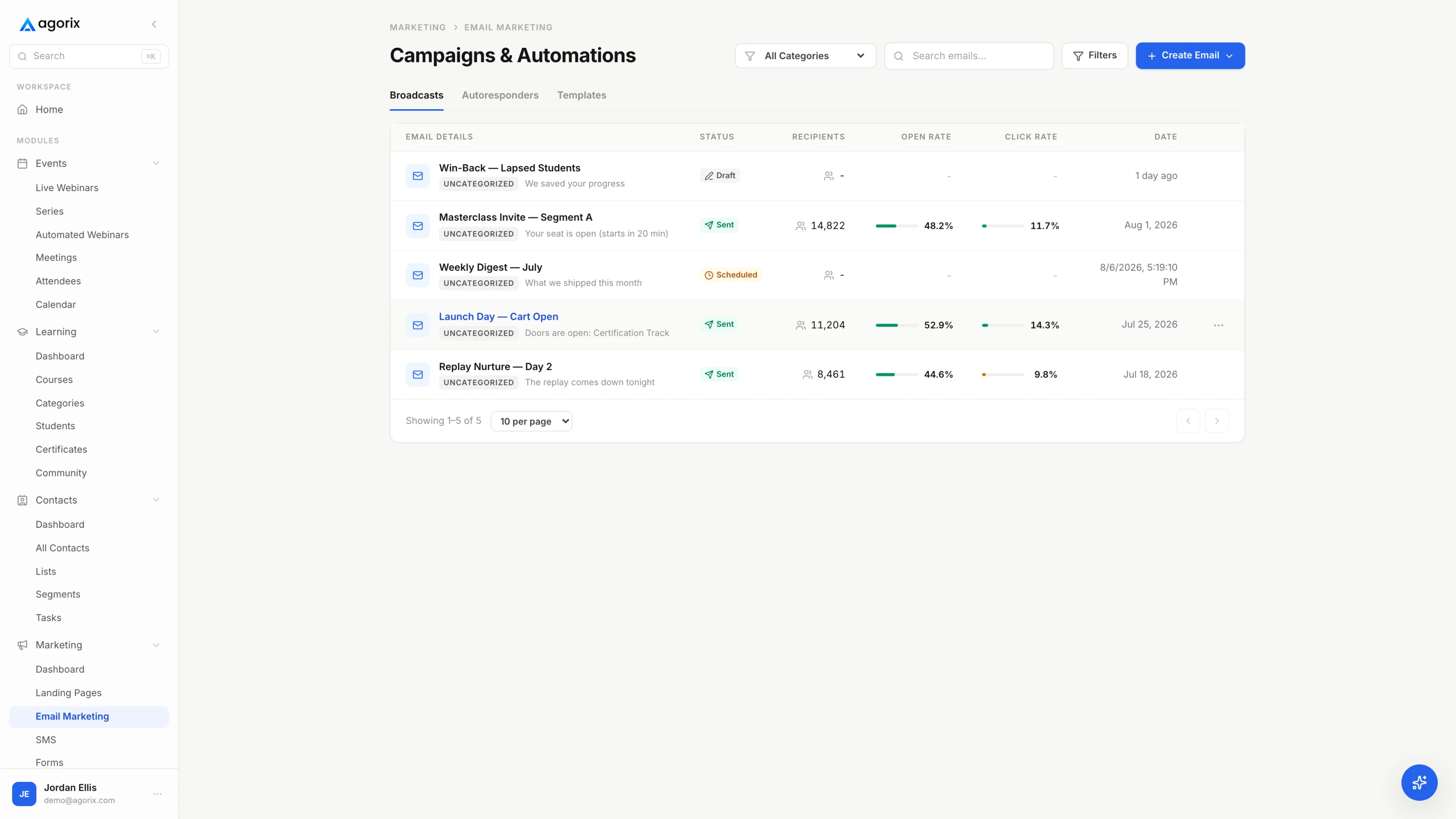
An email marketing workspace showing campaign activity and scheduled sends.
Rule 00The three-block issue

Decide the shape once, so you never decide it again.

The expensive part of a newsletter is not writing. It is deciding what this one is, how long it should be, and whether it is allowed to mention what you sell. A repeatable format makes all three of those decisions once.

Three blocks, always in the same order. The order matters as much as the contents: readers learn where to look, and a reader who knows the shape of a thing starts reading it faster.

The thing you noticed

One idea from your own week, argued rather than announced. Something you changed your mind about, a mistake you watched somebody make twice, a decision you had to explain out loud. It is the block that makes the issue yours, and it is the only one that requires thinking.

Block 01 · most of the words

One useful artifact

A thing the reader can use without you: a checklist, a script, a number worth knowing, a link with a sentence explaining why it is worth their time. This is the block that gets forwarded, so it has to make sense to somebody who has never read you before.

Block 02 · the forwardable one

The one ask

What you want them to do next, stated once and stated small: come to [the session], reply with [the one question], look at [the thing you sell]. Every issue has one. A newsletter that never asks quietly teaches its readers that nothing here requires action.

Block 03 · two or three lines

Set the length constraint yourself

One screen, or a few hundred words for the first block — pick a limit and let it hold. If the idea does not fit, it is an article and the issue can link to it. Deciding the length every week is one more decision standing between you and a send, and the weeks when you have least time are exactly the weeks when that decision goes badly.

The subject line is written last

Write it from the finished Block 01, never from the plan. A subject line written first describes what you intended to write, and the issue almost always turns into something slightly different while you are writing it.

What a format is not

Three blocks is a container, not a quota.

If Block 01 has nothing in it this week, the answer is to skip the issue and say so — not to fill the container with something you do not believe. A format makes writing faster when you have something to say. It does not make having nothing to say acceptable, and readers can tell the difference on the first line.

DailyThe idea bankFive minutes a week

Capture beats brainstorming, every time.

The blank page on send day is not a creativity failure. It is a retrieval failure — you had four good ideas this month and none of them was written down anywhere you would look on a Wednesday evening.

A newsletter run by a working business has an enormous advantage over one run by a writer: the material arrives on its own. People ask you things all week. The job is to catch it, not to invent it.

SourceWhat to captureWhen
Questions from customers and studentsThe question in their words, not your answer to it. The phrasing is the part you cannot reinvent later.As they arrive
Live session Q&AEvery question asked in the room, plus the two that got asked in different words by different people.Same day
Support threadsAnything you have now explained twice. The second explanation is the signal; the third is overdue.Weekly sweep
Sales calls and demosThe objection, and the sentence that answered it. Both are newsletter blocks with a different opening.After the call
Replies to previous issuesThe reply itself. A reader who answers has just told you what the next issue is about.As they arrive
Your own working notesDecisions you made and why. The reasoning is the content; the outcome is just the headline.When it happens

Three rules that keep a bank usable

  1. Capture the question, not your answer. The answer is the easy part and you will still have it next week. The exact words somebody used to describe their problem are the part you cannot reconstruct, and they are usually the subject line.
  2. One place, no sorting. A single list you can add to in ten seconds from anywhere. The moment capture requires choosing a category, capture stops happening — and a messy bank you actually use beats an organised one you do not.
  3. Never judge at capture time. Write it down even when it seems obvious. The things you consider too basic to say are, reliably, the things people ask you most often — and obvious-to-you is the definition of the expertise you are selling.

Two existing habits feed this bank almost for free. Sessions where people ask questions out loud produce a month of issues in an hour — office hours covers how to capture them as they happen. So does any structured feedback loop you already run with customers or students.

WeeklyOne issue ahead

Write next week’s issue, not this week’s.

One finished issue banked behind the one scheduled is the single change that separates a newsletter from a streak of luck. Everything else in this guide makes the writing easier; the buffer is what makes the arrival reliable.

Building it costs one extra sitting. Write two issues the first time, send one, and keep the other. From then on the rule is simple: you are always drafting the issue after the one that goes out next, and if you ever spend the buffer you refill it that same week rather than promising to.

SlotWhat happensTime
Across the weekCapture into the bank. One line each time, wherever the question was asked. No editing, no formatting, no deciding whether it is any good.5 min
MondayRead the bank and pick the idea for the issue you are drafting this week. Picking early means the idea gets a few days of background thinking for free.5 min
WednesdayDraft next week’s issue — not this week’s. Block 01 first, then the artifact, then the ask. Do not stop to edit.30 min
ThursdayEdit, write the subject line from Block 01, schedule. The subject line is written last, from the finished issue, and never from the plan.15 min
FridayBuffer check: is there still one finished issue in the bank behind the one scheduled? If not, next week’s Wednesday is not optional.5 min

That is a working default rather than a prescription — an hour, split so that no single block of it is large enough to be cancelled by a meeting. Move the days to suit your week; keep the shape, which is capture continuously, decide early, draft in one pass, edit separately.

One issue ahead, not four

A deep buffer sounds better than it reads. A newsletter written a month early loses the thing that makes it worth subscribing to — the sense that somebody is writing to you from inside this week. Keep the buffer at one, occasionally two around a known absence, and let the rest of the bank stay as ideas rather than drafts.

What the buffer buys

A bad week stops being a missed issue.

Illness, a launch, travel, a client emergency, an idea that fell apart halfway through drafting: every one of those becomes survivable, and none of them becomes visible to a reader. The buffer is also what lets you kill a weak draft without panic, which quietly raises the standard of everything that does go out.

The issue checklist0 / 10 done

This issue

The system behind it

If you slipThe honest skip

Skip loudly. Never fade out.

One missed issue is a small thing. Three missed issues with no word about any of them is how a list turns into a list of strangers, and strangers do not open the thing you send when you finally come back.

The mechanism is worth understanding, because it explains why the fix is so cheap. A newsletter works on expectation: readers know roughly when it arrives and have already agreed to it. Silence dissolves that expectation slowly and invisibly. When you send again after months, the message reaches people who no longer recall subscribing — so more of them unsubscribe, more of them report it, and both of those make your next sends land worse for everybody else on the list. That is the part a deliverability problem is usually made of.

The one line that costs you nothing

It goes at the very top of the next issue, above Block 01, and it is one line. Name the reason plainly, then get on with the issue. No apology paragraph — an apology makes the reader responsible for your week, and they almost certainly did not notice.

No issue last week — [the plain reason, one clause]. Back to the
usual from here.

If you already know the gap will be long

Announce a pause instead of accumulating silence. A pause with a date is a promise kept in advance; four quiet months is a promise broken quietly. Say when it returns, return then, and give people the door on the way past — the ones who take it were leaving anyway, and the ones who stay are worth more than the count you protected.

[Newsletter name] is pausing until [date].

[One sentence on why, in plain language.] It will start again on
[date], in exactly the format you know. If you would rather not be
here when it does, the unsubscribe link is at the bottom and there
are no hard feelings.

Skip like this

  • One line at the top of the next issue, naming the reason plainly
  • The format kept identical, so the issue reads as normal rather than as a comeback
  • A pause announced in advance when you already know the gap will be long, with a return date in it
  • The return date honoured, because a second broken promise costs more than the first
  • Something small sent on time in preference to something ambitious sent late

Not like this

  • A three-paragraph apology that makes the reader responsible for your week
  • A relaunch announcement that makes the gap itself the subject line
  • Four silent months, then a full-length issue to a list that has forgotten subscribing
  • Deleting the archive and starting a new newsletter with the same readers
  • A reason that is not the real one — readers who have met you can tell

Every issueThe growth loop

One forwardable thing, in every issue.

Newsletters grow in two ways: places you own pointing at them, and readers handing them to somebody else. The second only happens if an issue contains something that survives being taken out of context.

That is Block 02’s real job. The essay is what makes people subscribe; the artifact is what makes them send it on. Design for the forward deliberately rather than hoping for it.

  1. Make Block 02 self-contained. The forwardable thing cannot depend on last week’s issue, an in-joke, or knowing who you are. If it needs context to make sense, it will not survive the forward, and the forward is the whole mechanism.
  2. Ask for the forward once, specifically. “If you know somebody dealing with [the specific problem], send them this” outperforms “please share” because it names a person the reader can actually picture.
  3. Put the subscribe link in the body. A forwarded issue arrives with no footer that anybody reads. One line near the artifact — “this arrives every [day]; you can get it here” — is what converts the second reader.
  4. Give every issue a public URL. An archive page means an issue can be linked from a session, a course lesson, a support reply or a social post months later. Without it, your best writing is only ever reachable by people who already subscribe.
  5. Point the surfaces you already own at it. The thank-you page after a download, the last lesson of a course, the confirmation after a session, the footer of the emails you already send. Steady arrivals from places you control beat a launch spike.

The owned surfaces matter more than they look. A thank-you page after a download, the delivery email of a lead magnet, the final lesson of a course, the confirmation after a session: each one is a moment where somebody has just decided you are worth their attention. A steady trickle from those beats a launch spike, because the trickle keeps arriving on the weeks you are not promoting anything.

If you are starting with almost nobody on the list, the newsletter is the asset rather than the afterthought — launching without a list treats it that way, and the first fifty readers usually come from places that have nothing to do with your website.

Where a tool decision changes the plan

The issue is easy to send. What the reader did next is the hard part.

A newsletter earns its keep somewhere other than the newsletter: a reader who books a call, turns up to a session, or buys three months later. In most stacks the issue and that later action live in different systems and are never reconnected. In Agorix the campaign, the click and the customer’s subsequent activity stay on one record, so the question is a report rather than an afternoon of exports — see how marketing works.

Start your 14-day trial 14 days · $0 due today · Payment method required · Cancel before first charge and pay nothing
QuarterlyWhat to measure

Replies and clicks. Not the open rate.

The open rate is the number everybody quotes, and it is the one that answers the fewest questions. It is worth being precise about why, because the reason is mechanical rather than ideological.

An open is recorded when a hidden image in the message loads. Whether that happens depends on the recipient’s mail client and its privacy settings: some fetch images automatically on delivery, whether or not anybody ever reads the message, and some never fetch them at all. So the figure counts events that were not reading, misses reading that produced no event, and can move because a mail client changed a default rather than because anything you did changed. As a slow trend on your own list it is mildly informative. As a target it steers you with a number that is not measuring the thing its name suggests.

Read every issue

Replies, clicks, unsubscribes

Replies are the strongest signal a small list produces. Clicks on the one artifact tell you whether Block 02 was worth the space. Unsubscribes per issue are the cost line — a spike is information about that issue, not about newsletters in general.

Read quarterly

Growth by source, and after

Where new subscribers came from, so you know which owned surface is working. Which three issues produced the most replies, and what they had in common. And, where you can trace it, what readers did later — booked, attended, bought.

Ask for the reply

Replies do not arrive by accident. End Block 01 or Block 03 with a question somebody can answer in one line without thinking hard — “which of these two is the problem for you?” gets answered; “what do you think?” does not. Every reply is worth more than a click on a list this size: it tells you something in the reader’s own words, it goes straight back into the idea bank, and a conversation is the clearest signal a mailbox provider can see that somebody wants your mail.

Read replies as signal, not as a survey. The people who write back are self-selecting and will never be a majority, so they tell you what is landing rather than what everybody thinks. That is still the most useful thing you will get all week.

The quarterly hour

Three issues, and what they had in common.

Once a quarter, list the three issues that produced the most replies and clicks and look for the pattern — a subject, a format, a level of specificity, a particular kind of artifact. Then write more of that. It is a better use of an hour than any dashboard, and it is the only review this system needs.

Common questions

Six questions about keeping a newsletter going.

How often should a newsletter go out?

Pick the frequency you could still hit in your worst month, then hold it. Weekly builds the strongest habit and costs the most; fortnightly is the honest answer for most people running a business alongside it; monthly works if the issue is substantial and the date is fixed. Consistency matters more than frequency — the promise a newsletter makes is that it arrives. The wider decision, including what happens when a campaign and a newsletter land in the same week, is in email frequency.

What do I write about when I have nothing to say?

You almost always have something and cannot retrieve it, which is a capture problem rather than a creativity one. The blank page at 9pm on send day is the predictable result of trying to think of an idea rather than reaching for one. Keep an idea bank fed by customer questions, live session Q&A, support threads, sales objections and replies to previous issues. If the bank is genuinely empty, the honest move is to skip and say so in one line, not to publish filler that teaches people to stop opening.

Should I pay attention to open rates?

Treat them as a rough trend, not a target. Whether an open gets recorded depends on how the recipient’s mail client handles a hidden tracking image — some load it automatically whether or not anybody read the message, and some never load it at all — so the number can move because a mail client changed a default rather than because your writing changed. Replies, clicks on the one artifact, unsubscribes per issue and subscriber growth are harder to fake and easier to act on. The same caution applies when you use engagement to build segments.

How long should a newsletter issue be?

As long as one idea, argued once. Set the constraint yourself — one screen, or a few hundred words for the first block — and let the format enforce it rather than deciding again every week. If the idea does not fit, it is an article and the newsletter can link to it. A predictable length is part of what makes an issue easy for a reader to start, and starting is most of the battle.

What should I do if I miss a week?

Skip loudly. One line at the top of the next issue naming the reason plainly, then straight into the normal format. Never fade out silently: three missed issues without a word is how a list becomes a list of strangers, and a full-length send after months of silence arrives at people who no longer expect it, which costs unsubscribes and complaints — deliverability basics covers why that matters beyond the one send. If you already know the gap will be long, announce a pause with a return date and honour it.

Should a newsletter sell anything?

Yes, in the third block, in every issue, and small. One ask, stated in two or three lines: come to the session, reply with a question, look at the thing you sell. A newsletter that never asks trains its readers that nothing here requires action, and then the one issue that does ask reads as an intrusion. Asking every week in the same place, at the same size, is how the ask becomes part of the format instead of an event.

Keep going

What sits either side of a weekly send.

From a weekly send to a system that compounds

You now have the system. Agorix is where it runs.

Sign-up forms, the archive page, the send itself, the audiences it goes to and the sessions and checkouts it points at — connected to the same customer record, so an issue is part of the relationship rather than an isolated broadcast.

14 days · $0 due today · Payment method required · Cancel before first charge and pay nothing