Skip to content
Agorix
Updated 29 July 2026

How often to email your list: the cadence you can actually hold.

There is no optimal frequency, and any page that gives you one has averaged businesses with nothing in common with yours. What exists instead is a set of decisions: which model your business shape calls for, what your buyers and your subscribers have each agreed to, what happens in a campaign week, and what production system makes the cadence survive month four.

03cadence models
02rhythms
18contract items

What you will have at the end

  • A cadence chosen from what you can sustain for six months, not from somebody else’s average
  • The model that matches your business shape — launch-led, evergreen, or newsletter-first
  • Two rhythms instead of one, because buyers and subscribers have not agreed to the same thing
  • A rule for campaign weeks that stops a launch from eating the baseline that feeds it
  • A batch-writing system that puts the writing somewhere other than the night before
  • The difference between an unsubscribe spike and silent decay, and what each one is asking for
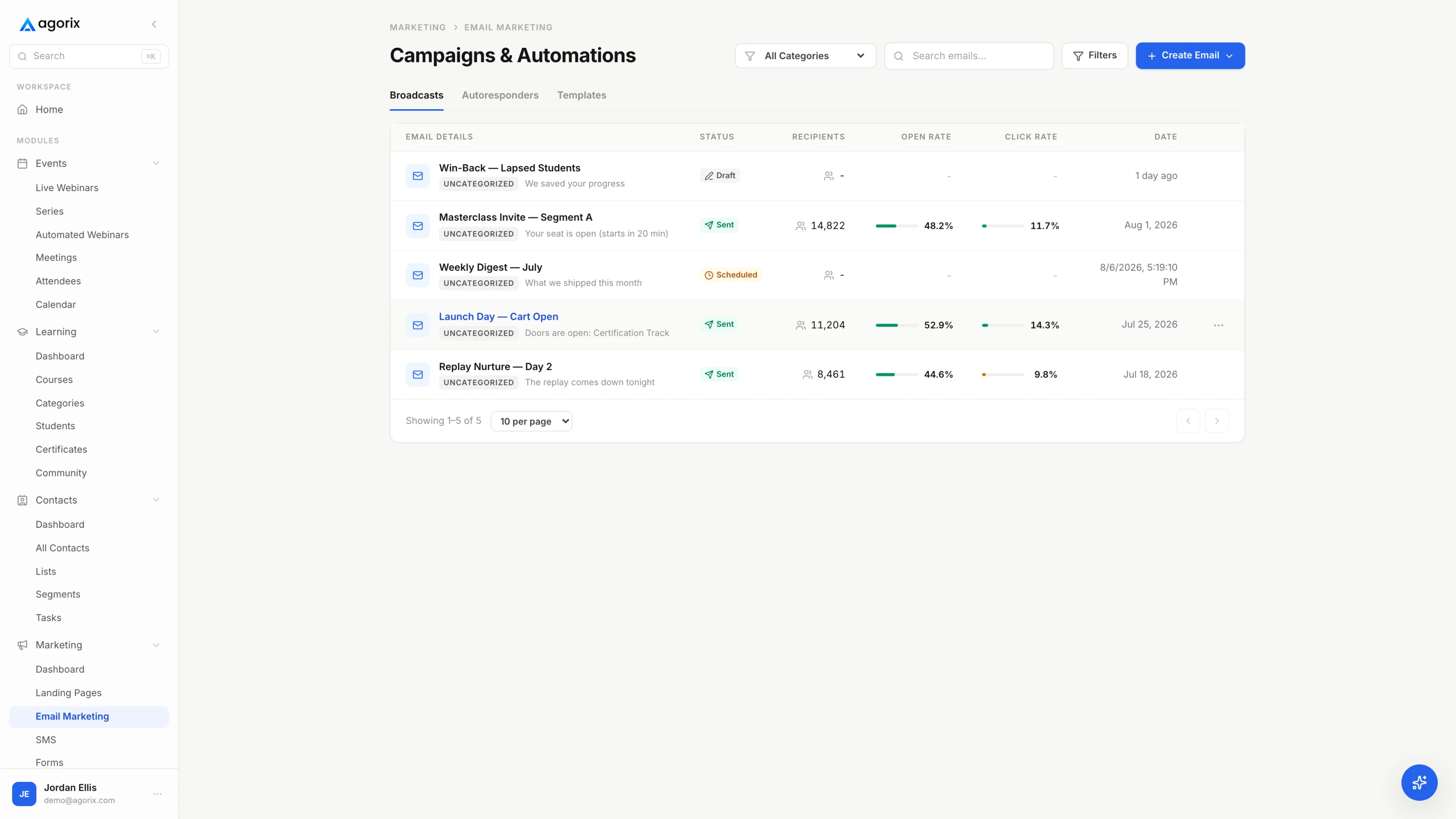
A campaign list showing each email's status, recipients, open rate and click rate.
StartThe wrong question

“How often should I email?” has no answer worth having.

It gets answered with an average anyway — usually a number pulled from a study that pooled retailers, software companies, charities and newsletters, all with different lists, offers and relationships. An average across those is not a recommendation. It is arithmetic performed on strangers.

The reason no universal number exists is that frequency interacts with three things that vary completely between businesses. What you send: an email that gives something is tolerated at a rate an email that asks for something is not. Who is on the list: recent buyers and eleven-month-old lead-magnet downloads have different patience. And what you can sustain: the cadence you can produce at a quality worth opening, in your worst month rather than your best.

Three claims about frequency do survive contact with real lists, and this whole guide is built on them.

  1. Irregularity costs more than volume. People forgive being emailed often. They do not forgive being emailed by somebody they have forgotten, which is what a three-month gap turns you into. The gap is also where deliverability damage comes from, not the volume.
  2. Relevance buys tolerance. The same three emails a week are generous to somebody in the middle of a problem you solve and intolerable to somebody who downloaded a checklist last year. Frequency questions are usually segmentation questions in disguise.
  3. An unsustainable cadence ends in silence. And silence is the expensive failure — worse than a cadence that was slightly too high, because you cannot recover a list you disappeared from without effectively re-earning it. Nobody optimises their way out of not sending.
The question that does have an answer

What can I commit to and keep, and what does each send have to earn?

That question is answerable this afternoon, with no benchmark required. The rule that follows from it is the one worth writing down: never announce a cadence you have not already written four of. Four is enough to discover whether the format works, whether the ideas exist, and whether the writing takes twenty minutes or three hours — which is the thing that actually decides whether you are still sending in November.

Rule 01Consistency over volume

A weekly email you keep beats a daily one you abandon.

This sounds like a platitude until you look at what consistency is actually doing. It is working on four separate systems at once, and three of them are not about the reader at all.

  • It builds an expectation, and expectation prevents complaints. What produces a spam report is surprise. Somebody who knows a message arrives on Tuesdays does not report Tuesday’s message; somebody who has not heard from you since February reports the one that arrives in June. Predictability is a complaint-suppression mechanism dressed as a courtesy.
  • It reads as normal to the receiving systems. Mailbox providers watch sending patterns. Regular volume looks like a business. Silence followed by a spike looks like a compromised account, which is handled far less generously — see the deliverability basics for why.
  • It compounds into a writing habit. The fourth email is easier than the first and the fortieth is easier than the fourth, because the format stops being a decision. Irregular sending never reaches that point — every send is a fresh negotiation with yourself about what to write.
  • It makes measurement possible. You cannot read the effect of any change against a baseline that moves. A steady cadence turns your unsubscribe and click data into something you can actually interpret, which is what lets you adjust the cadence on evidence rather than on mood.

Not sending is not the safe option

The instinct when unsure is to hold back: fewer emails feels respectful and low-risk. It is neither. A list you have not written to for months behaves like a list of strangers when you return — engagement falls, complaints rise, and the reputation you believed you were protecting takes the damage you were trying to avoid. The cost of silence is paid later and all at once, which is exactly why it does not feel like a cost at the time.

There is also a commercial version of the same error. The business that emails quarterly is not being restrained; it is training its audience to buy from whoever they heard from last week. Attention is not stored.

State the cadence, then keep it

Tell people what to expect in the first email they receive, in the plainest words you have. Something like the block below, adapted to your own voice, does more for both tolerance and deliverability than any amount of subject-line craft — because it converts a future complaint into either an early unsubscribe or an informed reader.

You will hear from me every [Tuesday]. One email, one idea you
can use that week, and roughly once a [month] I will tell you about
something I sell.

If that is not what you wanted, the unsubscribe link at the bottom
works in one click and I will not take it personally.

Then keep it. A promise about frequency is the only promise in marketing that gets tested every single week, and the welcome sequence is where it belongs.

Ch. 01Three cadence modelsModel 01–03

Pick the shape first. The number falls out of it.

Most cadence arguments are really arguments between people running different models. Naming which one your business is gets you most of the way to the answer, because each model has a rhythm that works and a specific part that fails first.

ModelThe rhythm that holdsWhat breaks first
Launch-ledA light baseline that never stops — one useful email every week or fortnight — plus an intense, finite campaign window a few times a year.The baseline. It gets dropped during the busy quarter that precedes the launch, so the launch arrives at a list that has not heard from you in three months and behaves like a cold one. The campaign is the easy part to keep; the baseline is the part that decides whether the campaign works.
EvergreenMost volume is automated and runs per person — welcome, nurture, behavioural follow-up — with a small broadcast layer on top.Overlap. Nobody plans for the person who is halfway through a welcome sequence, inside a behavioural follow-up, and on the broadcast list at the same time. They receive five emails in a week that no single decision authorised, and the complaint that follows looks like a frequency problem when it is a coordination problem.
Newsletter-firstOne unbreakable slot — weekly or fortnightly — that people subscribed specifically to receive. Selling happens inside it rather than around it.The writer, usually in month four. A newsletter with no repeatable format and no buffer becomes a weekly emergency, and the first symptom is a skipped week, followed by a filler week, followed by silence.

Launch-led: protect the baseline, not the campaign

If your revenue arrives in bursts — a course opening twice a year, a seasonal offer, a live event — the temptation is to treat the quiet months as time off from email. That is the one thing you cannot afford, because the campaign borrows against a relationship that the quiet months are supposed to build. A light baseline through the gaps is what makes the launch week land as a message from somebody they know rather than an interruption from somebody who only writes when they want money.

Practically: one useful email a week or fortnight between campaigns, and a bounded campaign sequence during them. The launch email sequence is the campaign part; this guide is about the other forty-eight weeks.

Evergreen: count what one person receives

When most of your volume is automated, the number you plan is not the number anyone experiences. You schedule a broadcast and think “one email this week”; the person who signed up on Monday is also in a five-part welcome sequence and a behavioural follow-up triggered by the page they visited. Their week contains seven emails, and no individual decision created that.

The fix is a habit rather than a feature: before adding any automated sequence, look at the timeline of one real person who would qualify for all of them, and count. The first automations guide covers which sequences are worth having at all before you worry about how they stack.

Newsletter-first: the format is the survival mechanism

When the newsletter is the product, cadence is not a marketing decision — it is a publishing commitment, and it fails for publishing reasons. A repeatable format, an ideas file with a queue in it, and a buffer of finished issues are what keep a weekly slot alive past month four. The newsletter system guide is the full version of that argument; the batch-writing section further down is the short one.

Most businesses are a hybrid of two of these. That is fine — the exercise is not to fit a category but to name which model is the spine, because the spine is the part you protect when the quarter goes badly.

Ch. 02Buyers and subscribers

You do not have one list. You have at least two, and they have agreed to different things.

Frequency is a property of a relationship, not of a business. Somebody who paid you last month and somebody who downloaded a checklist last year are not the same audience, and the single cadence you set is either too much for one of them or too little for the other.

Buyers

A live relationship with obligations in it

They expect mail about what they bought, and most of it is welcome because it is useful: access, progress, sessions, renewals, what to do next. Higher volume is not only tolerated, it is often the service they paid for.

Subscribers

A thin claim that has to be renewed

They exchanged an address for one specific thing, possibly a long time ago. Every send has to justify itself again, and the tolerance for being sold to is a fraction of what a buyer extends you.

Most businesses run this backwards. The cold list gets hammered because it is the one that looks like it needs converting, and the buyers — the people with a demonstrated willingness to pay — get a quarterly newsletter and no particular attention. Reversing that is usually the highest-return frequency change available, and it does not require sending more mail in total.

Three divisions, in order of value

  1. Recently engaged versus dormant. The most valuable split, and the one with deliverability consequences. Routine broadcasts go to people who have shown a sign of life; the dormant part gets a re-engagement sequence rather than more of what it is already ignoring.
  2. Bought versus never bought. Different cadence, different tone, different ask. A customer does not need to be sold the thing they already own, and being sold it anyway is the most common reason a good customer stops opening.
  3. Interested in this versus interested in that. Worth doing when you have more than one offer and a way to tell who cares about which. Below that it is elaborate for no return — two well-kept divisions beat six that nobody maintains.

None of this requires a large list or a data team; the segmentation guide for a small list covers how to build these divisions with a few thousand contacts. What it does require is that the divisions update themselves, because a segment maintained by hand is a segment that is wrong within a week.

Give people the dial before they reach for the exit

A preference option — “fewer emails”, “only product news”, “pause for sixty days” — next to the unsubscribe link converts some departures into a lower cadence. Two conditions make it honest: only offer options you will genuinely honour, and never make the full unsubscribe harder to find than the alternatives. A preference centre used to hide the exit is a complaint generator, and complaints cost far more than the subscriber you were trying to keep.

Ch. 03Campaign weeks

A launch week is not a frequency violation. An unbounded one is.

Eight emails in a week during a launch is normal and works. The same eight arriving with no visible reason, no end, and no way out of the campaign specifically is what generates the complaints people blame on frequency.

Four properties separate the acceptable version from the damaging one, and they are all decided before the first send.

  1. It is finite, and the reader can see the end. A campaign with a stated close date reads as an event. The same volume with no horizon reads as a change in your behaviour, and people opt out of changes they did not agree to.
  2. Buyers leave the sequence the moment they buy. Nothing damages a new customer relationship faster than three more “last chance” emails after they paid. This is a mechanical requirement, not a nicety — it has to happen automatically, because it will not happen manually at eleven at night.
  3. Opting out of the campaign is not opting out of everything. A “no thanks, not this one” link that removes somebody from the launch and leaves them subscribed is one of the highest-return links you can add. Without it, the only tool available to a person who is not interested in this offer is the one that removes them permanently.
  4. The baseline is decided, not forgotten. Either pause the regular send during the campaign or keep it deliberately. What you must not do is let it lapse by accident and then never restart it, which is how a launch quietly ends a newsletter.

Count what one person receives, not what you send

This is the single most useful audit in the whole subject and it takes ten minutes. Pick one real contact who qualifies for as much as possible — recently subscribed, recently active, in your target audience for the campaign — and list every message they will receive over the campaign week from every source: broadcasts, the welcome sequence, behavioural triggers, the campaign itself, the event reminders, the abandoned-checkout follow-up. Almost everybody who does this finds a day with three emails on it that nobody intended.

Set a ceiling per person per week and enforce it, or at minimum know what the number is before you launch. Event follow-up is the common case where the burst is justified and the coordination matters most — the webinar email sequences and the follow-up window both assume a deliberately dense few days that then stops cleanly.

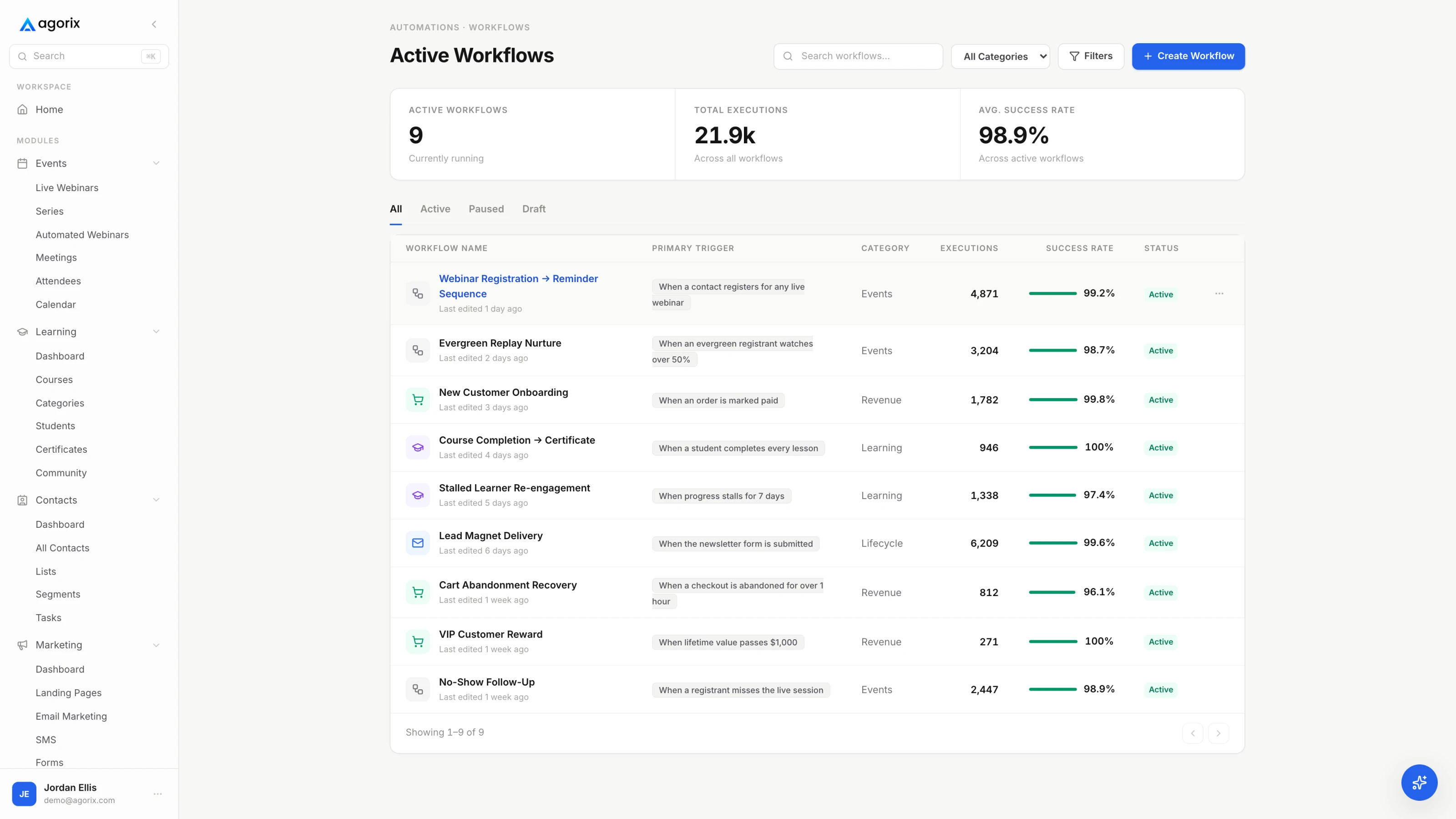
A list of active workflows showing the trigger that starts each one.
Fig. 01Each of these is a sensible sequence on its own. The frequency somebody experiences is the sum of the ones they qualify for at the same time.
Where a tool decision changes the plan

Deciding the cadence is the easy half. Knowing what one person actually receives is the other.

Broadcasts live in one place, sequences in another, event reminders in a third, and nothing adds them up per person — which is how a customer gets a sales email an hour after buying. In Agorix the sends, the behaviour and the purchase sit on one customer record, so a purchase can remove somebody from the sales path and the whole week is visible on one timeline — see how marketing works on a shared record.

Start your 14-day trial 14 days · $0 due today · Payment method required · Cancel before first charge and pay nothing
Rule 02The skipped week

Skip one. Do not announce it, and do not replace it with filler.

Nothing dramatic happens when you miss a single send. What does damage is the pattern that usually follows: the guilty apology, the filler issue written to preserve a streak, and then the quiet decision that the whole thing was too ambitious.

Three rules cover almost every case, and they are worth agreeing with yourself in advance — because the moment you need them is the moment you will be least inclined to think clearly about it.

  1. Do not apologise at length. A paragraph explaining where you have been makes the gap the subject of the email and tells people who had not noticed that something was missing. Send the next one on schedule, as though it were an ordinary week, because to almost every reader it was.
  2. Never send filler to protect a streak. A bad email costs more than a missing one. The missing one costs you a week of attention; the bad one teaches people that opening you is not reliably worth it, and the open habit is the entire asset. If there is nothing worth sending, that is information about your ideas file, not a reason to publish anyway.
  3. If you skip more than you send, change the published cadence. Two months of missing half the sends means the cadence you announced is not the cadence you have. Move to fortnightly and hold it, rather than continuing to fail at weekly. Nobody is keeping score except you; what people notice is unpredictability, and moving to a rhythm you keep removes exactly that.
The real fix

A skipped week is a production problem, not a discipline problem.

People treat missed sends as a failure of will and respond by resolving to try harder, which works for about three weeks. The reliable fix is structural: two finished emails held in reserve at all times. With a buffer, a bad week costs you a slot in the queue instead of a gap in the schedule, and the cadence survives the thing that would otherwise have ended it. Building that buffer is what the next section is for.

When the gap is months rather than weeks

Different problem, different treatment. After a long absence the list is not waiting for you — it is a list of people who have forgotten they subscribed, and a broadcast to all of them will produce complaints out of proportion to anything you did wrong. Return to the recently-active portion first, at a normal cadence, and give the dormant part a proper re-engagement sequence that reminds them who you are and makes leaving easy.

SystemBatch writing

The cadence is decided by the production system, not by the plan.

Everybody can send weekly for a month. Sending weekly for a year is a manufacturing question, and the answer is to stop treating each email as a project that begins with a blank page on the day it goes out.

The job splits into four different activities that use different states of mind: collecting ideas, drafting, finishing, and scheduling. Doing all four in one sitting, once a week, is the most expensive possible arrangement — and the one that produces the sentence “I did not have anything to say this week”, which is almost never true and almost always means the ideas step never happened.

  1. Keep a running ideas file, fed by other people. Replies to previous emails, support questions, objections from sales calls, anything you have explained twice, anything you wrote out at length in a message to one person. The rule that saves the cadence: never sit down to think of something to write. That step is where most newsletters die, and it is avoidable by collecting rather than inventing.
  2. Draft several in one block. One session that produces a month of drafts is dramatically cheaper than four sessions producing one each, because the expensive part is getting into the work rather than the writing itself. Book it as a recurring appointment and treat it as unmovable as a client call.
  3. Finish and schedule at least two ahead. A draft is not a buffer. Two finished, scheduled emails is what turns a bad week into a non-event, and it is the difference between a cadence that survives illness and one that does not.
  4. Use a format so the structure is never the decision. One idea, one example, one thing to do. Or a question, an answer, a link. Anything repeatable removes the blank page, and readers benefit from the predictability as much as you benefit from the speed.
  5. Keep one slot loose. Batching trades topicality for reliability, which is usually the right trade — but leave room to swap in something time-sensitive without dismantling the queue. One flexible slot a month is enough.

What to do with the ten minutes after a send

Read the replies, look at which links were clicked, and glance at who unsubscribed. Not to optimise — to collect. Every reply is a line for the ideas file, every clicked link is a signal about what that audience actually wants more of, and the pattern in unsubscribes is the earliest version of the signals in the next section. Ten minutes of this per send feeds the system that produces the next four.

The honest trade

Batched email is slightly less timely and substantially more likely to exist.

Written-on-the-day email is fresher, and for a small number of writers that freshness is the whole appeal. For everybody else it is a cadence with a single point of failure — the day itself. If you can genuinely write well under deadline every week for a year, do that. If you have already discovered that you cannot, the buffer is not a compromise; it is the reason the newsletter will still be running next year.

The cadence contract0 / 18 agreed

Before you announce it

The weekly loop

Before a campaign week

Every quarter

ReadUnsubscribes vs decay

The loud signal is rarely the important one.

Unsubscribes get all the attention because they arrive as a number with a minus sign in front of it. The pattern that costs you far more makes no noise at all, and by the time it is visible in a headline metric it has been running for months.

Loud

Unsubscribes

Mostly healthy, and mostly about a specific email rather than your cadence. Somebody deciding they are not your audience is a list getting more accurate. The version to worry about is a sustained rise across every send after a change you made.

Silent

Decay

Clicks drifting down over months with no unsubscribe spike. People stop reading long before they leave, so the list size stays flattering while the audience quietly stops existing. This is the expensive one.

The metric that catches decay is a ratio, not a count: what share of your list has done anything at all in the last ninety days. A contact count that grows while that ratio falls means you are adding people faster than you are keeping them, and no amount of subscriber growth fixes it — it accelerates it.

What you seeWhat it usually meansWhat to do about it
An unsubscribe spike on one sendThat email, or that audience for that email. A single message asked for something the list was not ready to be asked for, or landed with a segment it was never meant for.Read the email again as a recipient, check which segment it went to, and change the message. Do not change the cadence on the evidence of one send.
Unsubscribes rising across every send since a changeThe change. If the change was frequency, this is the one signal that genuinely is about frequency — particularly when it is concentrated among people who joined before you raised it.Return to the previous cadence for the people who joined under it, or make the increase opt-in. Give it four sends before deciding it worked.
Flat unsubscribes, falling clicksRelevance decay, which is the more expensive pattern because nothing alarms. People stop reading long before they bother to leave, and the list size keeps looking healthy while the audience quietly is not.Segment before you slow down. A more specific email to fewer people usually recovers clicks that a less frequent generic email will not.
Complaints risingAn urgent version of any of the above. Somebody is surprised — by the volume, by the sender, or by the ask — and reaching for the button that costs you the most.Reduce volume to the recently-engaged segment now, verify the unsubscribe works in one click, and treat it as a deliverability event rather than a marketing one.
Almost nothing at allPossibly under-sending. A list that never unsubscribes and never clicks is frequently a list that has forgotten who you are, and silence is the only failure mode with no alarm attached.Send more often, not less — but send the useful thing, and expect the first few weeks to shake out people who were never going to read you.

Two reading rules make that table usable. Never draw a conclusion from one send — compare the same segment across at least four of them, because a single email can move any of these numbers for reasons that have nothing to do with cadence. And treat opens with suspicion: mail privacy features pre-fetch images and inflate the number unevenly across providers, which makes clicks and replies the more honest evidence.

Signals you can add a send

  • Clicks holding steady across the last four sends within the same segment
  • Replies arriving, and arriving from more than the same three people
  • An ideas file with more in it than you can currently publish
  • Two finished emails in reserve, consistently, for a month
  • People asking where the last one was when you miss a week

Signals to hold or cut

  • Writing the send on the day it goes out, most weeks
  • Clicks drifting down for a month among people who used to click
  • Complaints appearing at all on routine broadcasts
  • A campaign week just ended and the list has not had a normal one since
  • Any send you would describe to a colleague as “something to keep the streak”
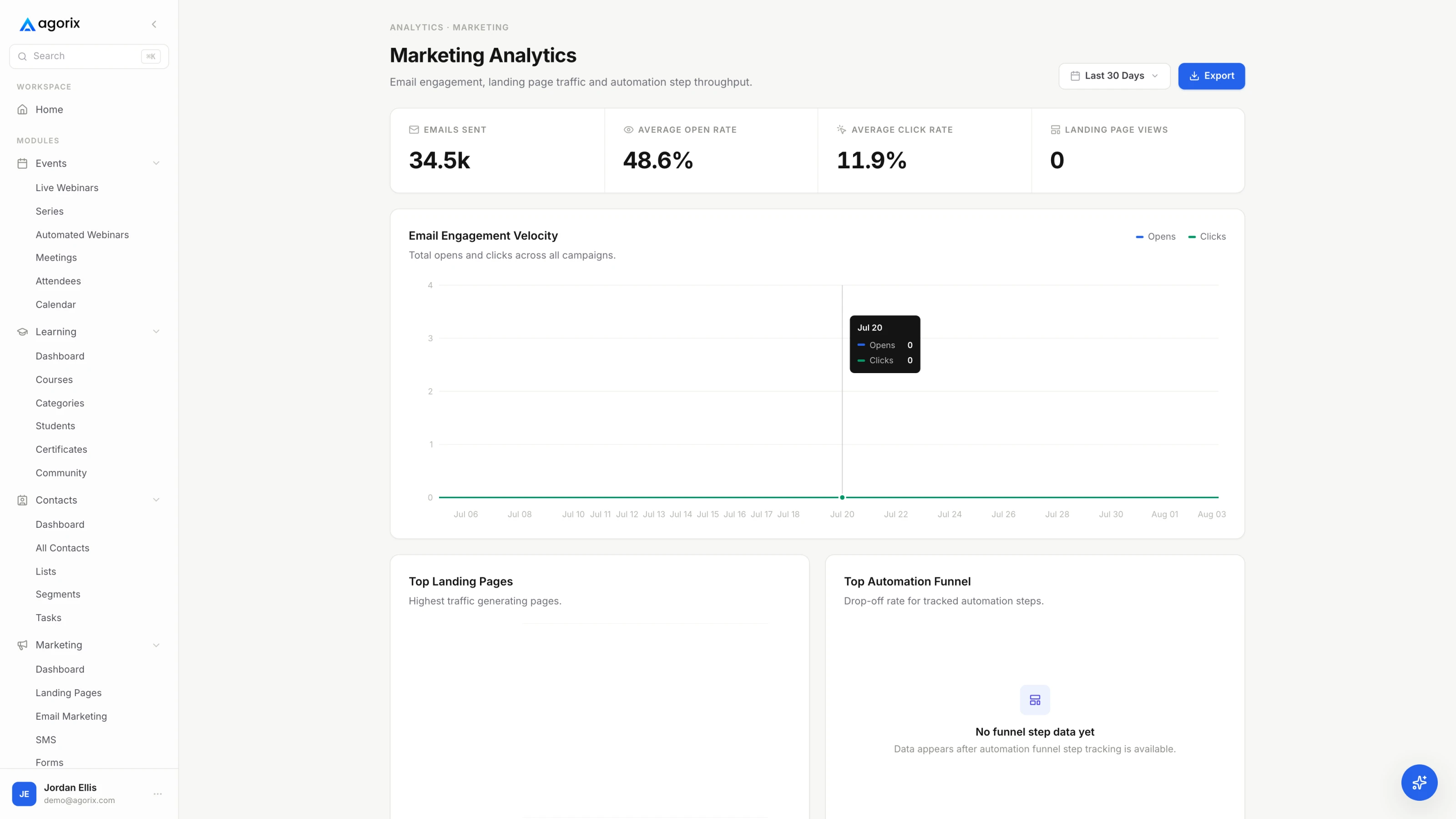
A marketing analytics view showing emails sent, open rate, click rate and engagement over time.
Fig. 02Read the trend within one segment across several sends. A single campaign moves every number on this screen for reasons that have nothing to do with your cadence.
ChangeChanging cadence

Change one thing, on the engaged half, and wait four sends.

Cadence changes are usually made in a bad mood — after one disappointing send, or one week of feeling behind. That is the worst possible input, because both of those things are noise and the change you make in response becomes the new baseline you cannot read anything against.

  1. Move one variable. Frequency, or content, or audience — never two at once. A cadence increase combined with a content change tells you nothing about either, and you will attribute the result to whichever one you were already inclined to believe.
  2. Increase on the engaged segment first. The people who open reliably are the ones most likely to tolerate more, and they are also the group where a negative reaction is most informative. If clicks hold and complaints stay flat there, widen. If they do not, you have learned it cheaply.
  3. Announce increases; do not announce decreases. Telling people you are adding a send sets an expectation and gives them a chance to opt down. Telling people you are sending less invites them to reconsider whether they want any of it, which is a question nobody was asking.
  4. Never raise frequency and ask rate together. If the extra send is another pitch, the answer will be complaints. Extra volume has to arrive as extra value, at least until the higher cadence is established and normal.
  5. Give it at least four sends, preferably eight. Long enough for the novelty to wear off and for the people who were going to leave to have left. Judging a cadence change on the first send after it measures surprise, not the cadence.

Where the ceiling actually is

There is a point where the next email costs more attention than it returns, and it is specific to your list, your offer and your writing. You find it by moving one step and reading four sends, then repeating — not by reading a benchmark, and not by copying somebody whose business you can see the output of but not the list behind. Two businesses in the same market can be correct at daily and at monthly, and the difference between them is what they send and who agreed to receive it.

The spine of this whole page, one more time: the right cadence is the one you can hold. Every technique here — the models, the two rhythms, the campaign rules, the buffer — is in service of holding it, because a cadence you keep for two years beats an optimal one you abandon in month four, and there is no published average that will ever tell you that.

Common questions

Six questions about how often to send.

How often should you email your list?

The most frequent cadence you can hold for six months while every send is still worth opening. For most small businesses that lands on weekly or fortnightly, but the number matters much less than the two things around it: regularity, because irregularity costs more than volume, and relevance, because relevance is what buys tolerance. Published averages across industries are not a benchmark for your list — they average businesses with nothing in common with yours. Pick a cadence, write four before you announce it, hold it for at least eight sends, and let your own data adjust it.

Is emailing every day too much?

It depends entirely on what the daily email is and what people knowingly agreed to. Daily works when the email is itself the product and subscribers opted in for exactly that. It fails immediately when the daily email is daily selling. Two tests decide it: could you write this two hundred times without repeating yourself, and did the people receiving it sign up for something daily? If either answer is no, daily is a fast way to shrink a list.

Will emailing more often hurt my deliverability?

Not by itself. Sending more mail to people who do not engage with it will. Providers weigh engagement as a proportion, so volume with engagement is fine and volume without it damages placement for everybody on the list — including the people who were reading you happily. Irregularity carries its own risk: a domain silent for two months that suddenly sends twenty thousand messages looks like a compromised account. The deliverability guide covers the mechanism.

Should customers and subscribers get the same number of emails?

No. A customer has a live relationship with you and both expects and benefits from mail about what they bought. Somebody who downloaded a checklist eleven months ago and has never purchased has a thinner claim and much less tolerance. Most businesses run this backwards: they hammer the cold list to make sales and neglect the buyers who would happily buy again. Run at least two rhythms, split as described in the segmentation guide, and keep a third division between recently-engaged and dormant.

I skipped three weeks. Should I apologise?

No. Send the next one on schedule and do not make the gap the subject — a long apology draws attention to an absence most readers did not register. The exception is a genuinely long silence of several months, which should be treated as a re-engagement rather than a resumption: return to the recently-active people first, and give the dormant part of the list a proper sequence instead of a broadcast that arrives from a stranger.

How do I know if I am emailing too often?

Look for unsubscribes rising across every send since you increased frequency, concentrated among people who joined under the old cadence, and for complaints appearing on routine broadcasts. An unsubscribe spike on a single email is about that email, not about your cadence. The harder pattern to see is silent decay: clicks drifting down over months with no unsubscribe spike at all, on a list whose size looks perfectly healthy. And remember that under-sending sets off no alarm whatsoever, which is why it is the more common of the two failures.

Keep going

The systems a cadence depends on.

From a chosen cadence to a kept one

You have picked the rhythm. Agorix is what keeps it.

Broadcasts and sequences on the same customer record as the purchases, audiences that update themselves as behaviour changes, and buyers who leave the sales path the moment they buy — so the cadence somebody experiences is the one you actually designed.

14 days · $0 due today · Payment method required · Cancel before first charge and pay nothing