
Launch a digital product without an audience: twenty conversations.
Launch advice assumes a list, and every tactic in it is a way of speaking to many people at once. With no audience, none of that applies — and the thing that replaces it is not a smaller broadcast. It is twenty specific people, one at a time, and a room somebody else built. Written to work with any stack; where a tool decision genuinely changes the plan, it says so.
What you will have at the end
- Twenty named people who genuinely have the problem, and why each one is on the list
- A direct message that is specific, small and easy to decline — and is not spam
- A way into rooms other people built, and what to offer when you have no reach to trade
- A small-room session that tests the offer rather than performing to an audience
- A pre-sale with a real date, a real refund and a threshold you decided in advance
- A plan for the first ten customers: what to ask, what to fix, what you may quote later
Twenty people who have the problem, and a reason for each one.
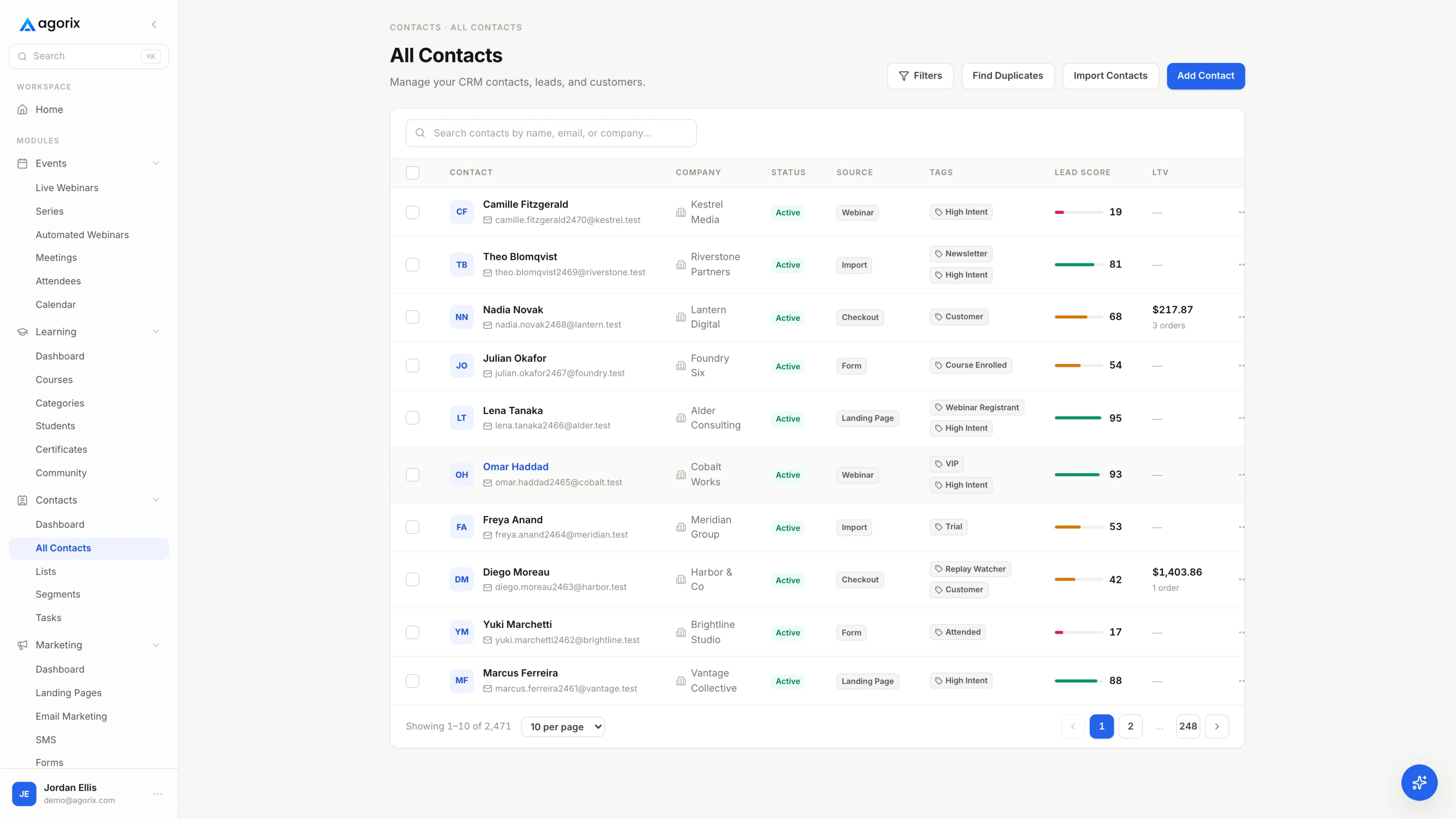
Before any of this becomes a launch, it has to become a list of names. Not a persona, not a segment — twenty humans you could write to this afternoon, each with one line beside them explaining why they specifically have this problem.
That one line is the whole discipline. If you cannot write it, the person does not go on the list, and you have just learned something important for free: either you do not know who this is for, or you do not know twenty of them yet. Both are solvable, and both are much cheaper to discover now than after you have built the thing.
Where twenty names come from when you think you have none
- People who have already asked you about this. Anybody who has ever sent you a question on this topic has self-identified as having the problem. This is the highest-quality group you have and most people forget it exists because the messages are eight months old.
- Your last job, and the one before it. Former colleagues, former clients, the people whose work you know in detail. You are not asking them for a favour, you are asking the people best placed to tell you whether the problem is real.
- Communities where the question keeps getting asked. Not to post an advert in — to read. The exact wording of a question asked in public five times is worth more than a month of keyword research, and the people asking it are named.
- People who publicly do the thing badly. Handle with care and only where the relationship allows it. A specific, generous, unsolicited observation is a legitimate opening; a critique attached to a sales pitch is not.
- The people who run the rooms. Community owners, newsletter writers, podcast hosts, meetup organisers. They belong on the list for a different reason, covered three sections down — but they belong on it.
You are not trying to make twenty sales.
A reasonable outcome from twenty messages is a handful of conversations, a few pre-orders, and a much better product than the one you were about to build. Judged as a sales channel this looks inefficient. Judged as the research, positioning and copywriting phase — which is what it actually is — it is the fastest thing available to you, and every later channel gets cheaper because of it.
The difference between outreach and spam is not subtle.
People are not annoyed by receiving a message from a stranger. They are annoyed by receiving a message that was obviously sent to hundreds of strangers, from somebody who did not look, with no way out of it. Fix those three things and the same channel becomes welcome.
What makes it a message
- One person, one send, written after you looked at what they are actually doing
- A first line that could only have been sent to them
- The reason you are writing to them specifically, inside the first two sentences
- A small ask — fifteen minutes, or a reply — rather than a purchase
- An exit that costs them nothing to take, offered before they have to invent one
- One follow-up, about a week later, and then silence
- Your real name, from an address a reply actually reaches
What makes it spam
- A list you bought, scraped, or exported from somewhere it was not given to you
- A mass send with a merge field where the personal line should be
- A calendar link before anybody has agreed to a call
- Three follow-ups, each one slightly more disappointed than the last
- Pretending you found them organically when you found them on a list
- An opening paragraph about yourself and what you have built
- Sending any of it from the domain you will later need for real email
The first message asks for nothing
Send this before there is anything to buy. It is easier to write, easier to answer, and the replies are worth more than the sales would have been — because a person who told you what they already tried has handed you your pricing anchor, your objections and most of your copy.
[Name] — you mentioned [the specific thing they said, or the
problem you know they have] a while back, and I have spent the
last few weeks on [one line, plainly, no adjectives].

I am not selling you anything today. I am trying to work out
whether the version in my head matches the version people
actually have. Would you be up for fifteen minutes so I can ask
what you have already tried and what it cost you?

If it is a no, or the timing is wrong, that is a completely
fine answer and I will not ask twice.
The second message, once there is something
Written to the same people, weeks later, with the thing their answers shaped. It earns the right to be a sales message because of the first one.
[Name] — this is the thing I asked you about in [month]. It is
finished on [delivery date], and I am opening it first to the
handful of people whose answers shaped it.

[One sentence: what it does, in the words they used when they
described the problem to you.]

It is [full price]. Because it is not built yet, the first
[number] people pay [pre-sale price] and take the risk with me.
If it is not what you expected when it lands, say so and I
refund you — no form, no conversation.

[Checkout link]

If it is not for you, no explanation needed. I will send you
the finished thing to look at either way.
Send five a day rather than twenty in an afternoon — partly because quality collapses after the fifth, and partly because twenty identical timestamps look like exactly what they are. And follow up once, about a week later. One. The second follow-up converts almost nobody and costs you the relationship you were building.
Before you send anything
During the window
Somebody already built the room. Ask to speak in it.
Twenty conversations reach twenty people. The only fast, legitimate way past that ceiling without an audience of your own is to borrow someone else’s trust — a community, a newsletter, a podcast, a membership, a co-hosted session.
The instinctive objection is that you have nothing to trade. You have no list to swap and no reach to reciprocate with, which is true and not the obstacle it appears to be. What owners of rooms actually run short of is good material and other people’s preparation time — and both of those you have.
What you pay with instead of reach
- Weeks of being useful first. Answer questions in their community before you want anything. It is slow, it is unglamorous, and it is the reason the eventual ask gets a yes instead of a polite non-answer.
- A session you prepare entirely. You write it, you rehearse it, you bring the questions, you handle the follow-up. Their cost is a calendar slot and an announcement.
- The kit, made before you ask. A paste-ready email, three short posts, a one-paragraph description in their voice, a link with their source tag already in it, and the date and time written out in every asset.
- An ask framed around their audience. One line on what their people get, which is not a line about you. A request framed around what you need is the easiest kind in the world to decline.
- Terms in writing, before. Whether there is a revenue share and what it applies to — the offer only, or the bumps too — agreed and written down before the promotion runs. Every payout dispute in this format started as an assumption.
Who to ask: people serving the same audience with something that does not compete for the same purchase, and ideally people who have seen you teach. A partner who has not is being asked to lend credibility they cannot verify. The partner webinar playbook covers the whole arrangement, including the version where you both co-host.
Twelve people in a room is a test you cannot run any other way.
A live session compresses twenty conversations into one hour and lets you watch, in real time, where you lose people and which objection arrives first. Nothing else in a first launch does that.
The number in the room is almost irrelevant. Eight people who genuinely have the problem will teach you more than four hundred who turned up because it was free — and eight is a realistic outcome of twenty messages and one partner announcement. Run it in a partner’s room wherever you can, because borrowed trust puts different people in the seats.
Make an actual offer
This is the part first-time hosts skip, and skipping it wastes the session. A teaching hour with no offer in it tells you people enjoyed the hour. It tells you nothing about whether anybody will pay, which is the only question this stage exists to answer. Make the offer, watch what happens when you do, and write down the first objection out loud in the room.
- Record it, with consent. You will not remember the exact phrasing of the question that stopped the room, and the exact phrasing is the valuable part.
- Note where attention drops. The section people leave during is the section that is not doing its job — in the session, and almost certainly on the sales page too.
- Write down every “does it include…”. Each one is a tier decision, a scope decision or an FAQ entry. Three of them together are usually a product change.
- Ask what nearly stopped them. To the people who bought, in the follow-up. To the people who did not, in a single message that does not try to rescue the sale.
The mechanics of running one — registration, reminders, the room itself, the follow-up window — are covered in how to host a webinar, and filling it from nothing is the promotion guide. Neither assumes you have an audience.
With twelve people, you can afford to know everything about all of them.
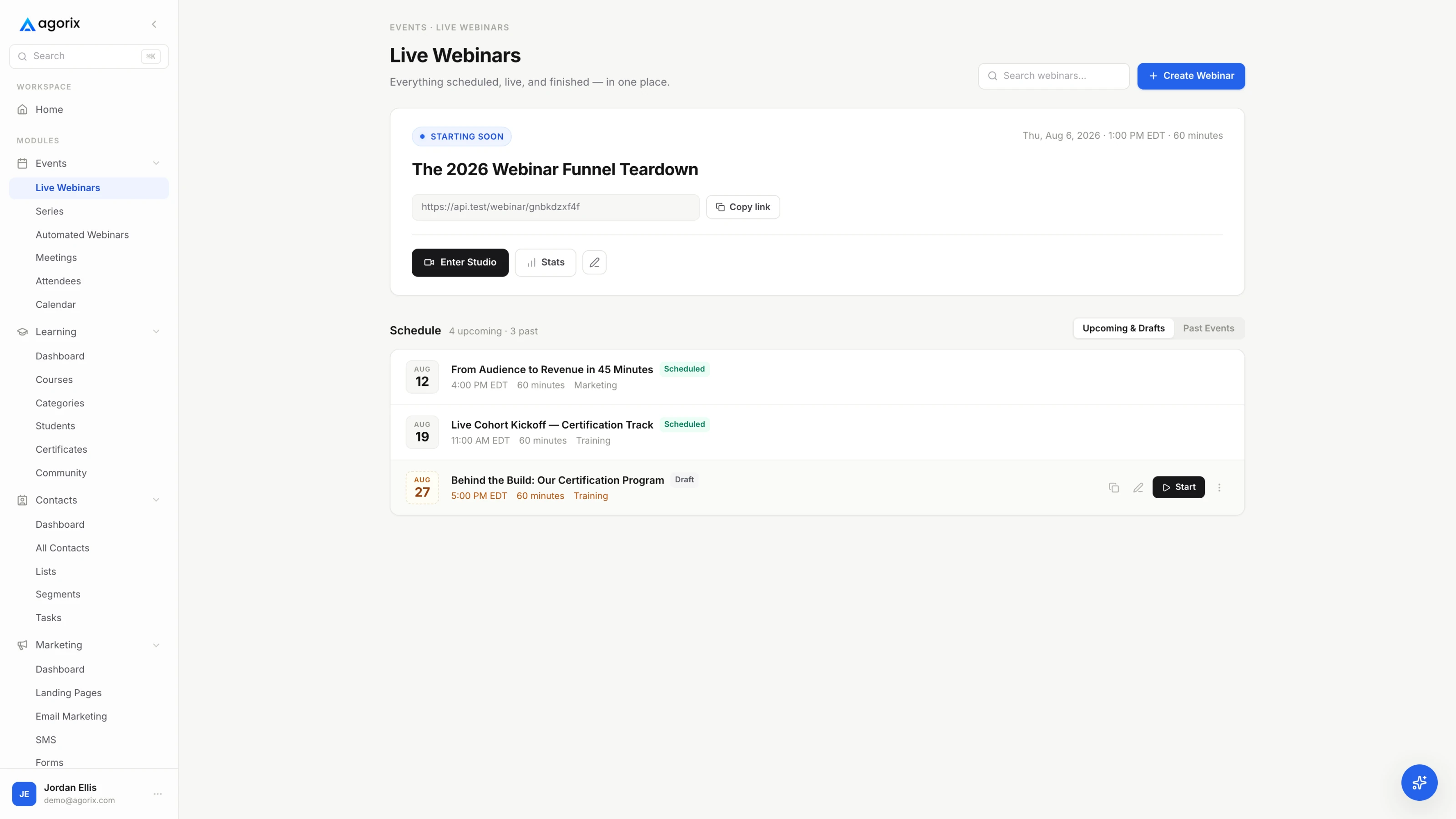
At this size the whole advantage is knowing which partner sent someone, whether they stayed for the offer, and whether they bought — and on a stitched stack that is three exports and a spreadsheet join for a room you could have counted by hand. In Agorix the registration source, the attendance and the purchase sit on one customer record — see how live webinars work.
Validation is money. Everything else is politeness.
“That sounds great, send me the link when it is ready” is the most encouraging sentence in business and it predicts nothing. People are kind, and kindness is free. A payment is not, which is why it is the only signal worth building six months of work on.
Pre-selling means taking money for something that is not finished. Done honestly it is the fastest validation available to anyone without an audience; done carelessly it is how people end up owing strangers a product they have lost interest in. The difference is four commitments, made in public, at the point of sale.
- Say plainly that it is not built yet. On the page, in the message, and in the order summary. A buyer who discovers this after paying has been misled, whatever the small print said.
- Give a delivery date, not a season. A specific date you intend to keep. “Early next year” is not a commitment, and it is the phrase that turns pre-orders into refund requests six months later.
- Offer a refund that is genuinely easy. One email, no form, no conversation about why. They took a risk on you and the refund is what makes that risk reasonable to take.
- Deliver on the date, or refund without being asked. If it slips, you tell them before the date rather than after it, and you offer the money back in the same message. Doing this well is worth more than the launch.
Decide the threshold before you start
Write down, before the first message goes out: “if fewer than [number] people have pre-ordered by [date], I refund everybody and build something else.” Then hold it. The threshold is not there to be motivating — it is there to protect you from spending six months building for people who were being polite, which is the single most expensive mistake available at this stage.
Price the pre-sale below the eventual price and say what the eventual price will be. That discount is honest because the risk is real: they are buying something they cannot inspect from somebody without a track record. Pre-selling covers the mechanics in full, and refund policies covers writing a promise you can afford to keep.
The first ten customers are not revenue. They are the asset.
Whatever these ten paid, it is not the valuable part of the transaction. They are the only people in the world who have both the problem and evidence that you can solve it, and everything you need for the second launch is inside their experience of the first.
- Book twenty minutes with each of them. Ask what they were doing about this before, what made them buy on that particular day, and what they expected to happen. Three questions, twenty minutes, and it is the most valuable research your business will ever do because it is the only research where the person has already paid.
- Keep the words, not the summary. The phrases they use for the problem become your sales page, your subject lines and your FAQ. Paraphrasing them into your own vocabulary is how a page ends up sounding like every other page in the category.
- Watch where they get stuck, and fix that first. The point at which the first ten stall is the point at which the next hundred will. It is also the cheapest moment to change the product, because ten people can be told personally that you have changed it.
- Over-serve them deliberately. Answer faster than you can sustain at scale, and be explicit with yourself that it is temporary. You are buying information and proof at a price you will never see again.
- Ask for testimony only after there is a result. A quote given on day one is enthusiasm, and everybody reading it knows that. A quote given after something changed is evidence. Ask in writing, keep the permission, publish only what they actually said, and never attach an outcome you cannot substantiate.
- Then ask for one introduction each. Not a review, not a share — one person they know who has the same problem. It is easier to give than a testimonial and worth considerably more at this stage, because it restarts the twenty conversations with a warm first line.
Ask in writing, and publish only what they wrote.
The rules are simple and there is no version of this where breaking them works out: never write the quote for them, never publish a claim they did not make, never attach a number you cannot substantiate, and keep the permission somewhere you can find it. Ask after a result rather than after a purchase — “I am so excited to start” is not testimony, and every reader already knows it.
[Name] — you mentioned [the specific result, quoted back to them
in their words]. Would you be willing to let me use that?

What helps most is a sentence or two in your own words on [what
was true before] and [what is true now]. I will not edit it
beyond trimming, and I will send you the exact wording before it
goes anywhere.

If you would rather I did not use your full name or your
company, say so and I will use [first name and role]. And if you
would rather I did not use it at all, that is genuinely fine —
you already did the harder part by telling me it worked.
Then close the loop properly. A short onboarding sequence, one genuine check-in partway through, and one honest request for what did not work are worth more at ten customers than any analytics you could install — feedback loops and onboarding emails cover both, and both are small enough to build in an afternoon at this size.
Paid traffic is a multiplier, and you have nothing to multiply yet.
This is the same principle the promotion guide applies to webinars, and it applies harder here. Buying traffic for an offer that has never sold buys you a more expensive way to discover that it does not: you learn what a click costs, which is the number that does not matter, and nothing about what a customer costs, which is the one that does.
Without an audience there is a second problem stacked on top. You have no retargeting pool, no list to build audiences from and no purchase data for the platform to learn from — so you would be starting on the most expensive rung, cold, with the least information anyone has ever started with.
What has to be true before you spend
- The offer has sold to strangers at least once. Not to friends and not to your network — people who found you through a partner’s room or a direct message and bought anyway.
- You know what a buyer is worth. Revenue per registrant, or per visitor, traced through to an actual purchase. Without it a cost-per-click target is a number with nothing on the other side of it.
- The follow-up runs without you. Paid traffic arrives at all hours and mostly does not buy on the first visit. If nothing happens after the visit, you are buying strangers a page view.
- You can tell which spend produced which customer. Tracked links from the first day, and a way to follow the same person from click to purchase. Retrofitting this is not possible, which is why it belongs before the first pound rather than after it.
Then start where it is cheapest and warmest: retarget the people your organic launch already produced, then your own list and past attendees, then audiences built from people who actually bought — and cold interest targeting last, smallest, and only against an offer you have already watched convert. The follow-up funnel is what makes any of that worth paying for.
Six questions about launching from zero.
How do I launch a digital product without an email list?
Stop treating it as a smaller broadcast and treat it as twenty conversations. Twenty named people who genuinely have the problem, messaged individually with a small ask rather than a pitch; one or two rooms somebody else already built; a small live session with a real offer in it; and a pre-sale that validates with money rather than enthusiasm. The goal of a first launch is not a revenue figure — it is a product shaped by real buyers, a page written in their words, and the first ten customers you can learn from.
Is cold outreach the same as spam?
It depends entirely on how it is done, and the difference is not subtle. One person, something specific about them, a stated reason you are writing to them in particular, a small ask and an easy way out is legitimate. A bulk send to a list you bought or scraped, with a merge field where the personal line should be and three escalating follow-ups behind it, is spam — it also damages your sending domain, which you will need later, and in many jurisdictions it is unlawful. Deliverability basics covers what that costs you.
How many pre-sales do I need to validate an idea?
Decide your own threshold before you start and write it down, because the number that matters is the one that makes building worthwhile for you rather than one borrowed from somebody else’s launch. State it as a rule with a date attached: below that number by that date, everyone is refunded and you build something else. And be strict about what counts — validation is money from people who genuinely have the problem, not enthusiasm from people being kind to you. A pre-sale only counts if the offer was honest about not being built yet, carried a real delivery date, and came with a refund that is easy to use.
Should I run ads for my first launch?
No — for the same reason the promotion guide puts paid traffic last. It buys volume for a machine that has not been shown to produce customers yet, so you learn what a click costs without learning what a customer costs, and only the second number tells you whether to keep spending. Without an audience you also have no retargeting pool, which means starting on the most expensive rung with the least information. Sell to strangers organically once, work out what a buyer is worth, then start with retargeting.
How do I get testimonials when I have no customers yet?
You do not, and you must not invent them — a fabricated quote is the one mistake on this page that cannot be undone by a better second launch. What you can do is create the conditions for real testimony quickly: sell to a first ten, over-serve them deliberately, and ask once something has actually changed for them rather than on the day they bought. Ask in writing, keep the permission, publish only the words they wrote, and never attach a number or an outcome you cannot substantiate. Until then, sell on the specificity of the problem and the clarity of the promise — which is what those first ten bought on anyway.
How do I find partners when nobody knows who I am?
Pay with work rather than reach, because reach is the one thing you do not have to trade. Answer questions in somebody’s community for weeks before asking for anything, offer to teach a session and prepare all of it, write the guest piece, do the editing, bring the questions. Then make the ask specific, small and framed entirely around what their audience gets, and hand over a complete kit so that saying yes takes five minutes. The partner playbook covers the terms, and they go in writing before the promotion runs rather than after it.
The four stages, each in full.
You now have the plan. Agorix keeps what it produces.
Registration pages, the live room, the emails, the checkout and the follow-up on one customer record — so the twenty conversations, the partner who sent them and the first ten customers are still connected when you come to do it again with an audience.
14 days · $0 due today · Payment method required · Cancel before first charge and pay nothing