Registrations by source
Read it once, at T−6d. It answers one question: is the channel that was supposed to carry this actually carrying it. Checking daily produces anxiety, not decisions.

Five channels in the order they pay back, a calendar you can put straight into a task list, and source tracking from day one so the third session is easier than the first. Written to work with any webinar tool; where a tool decision genuinely changes the plan, it says so.
Promotion advice usually starts with tactics. Start instead with arithmetic, because it tells you within ten minutes whether the plan you are about to make can possibly produce the room you want.
Write down, per channel, the number of people you can genuinely put this in front of: the portion of your list that opens things, the partners who have actually said yes and what each of them reaches, the size of any community you run, and the individuals you are willing to message personally. Not the theoretical audience — the reachable one.
Then resist the urge to apply a conversion rate you read somewhere. Published webinar benchmarks average across industries, price points and traffic sources that have nothing to do with yours, and borrowing one produces a forecast with false precision. For a first session, the useful question is not “what percentage will register” but “if this performs poorly, is the room still worth running?” If the honest answer is no, the fix is upstream: more partners, a longer window, or a smaller expectation.
Every channel below points at one page. If that page does not make the trade obvious — a specific title, the date and time in the visitor’s timezone, three to five things they will be able to do afterward, and a form asking for as little as you can defend — then promotion multiplies a problem rather than solving one. Build it before you send anything; the Build stage of the pillar guide covers what belongs on it.
Your list is the channel you control completely, which is exactly why it gets used carelessly. Three sends, each with a distinct job, with registrants removed before every one.
One resend of the second email to non-openers, with a different subject line, is a reasonable fourth touch. A fourth distinct email is usually not — by then you are adding volume rather than argument.
Anyone who registers should stop receiving invitations immediately and start receiving the confirmation and reminder sequence instead. Two clocks, two audiences. Nothing reads as careless faster than being invited to something you already signed up for, and on a list of any size this has to be automatic rather than a manual export the night before.
One more piece of hygiene: if a large part of your list has not opened anything in months, sending all three invitations to all of them can cost you more in deliverability than it returns in registrations. Send to the people who open things, and treat the dormant segment as a separate decision.
All three sends, plus the confirmation and reminder sequence that follows a registration, are written out in full in the webinar email sequence templates.
Owned surfaces cost nothing and are usually worked hardest by the people who need them least. The trick is not to post more — it is to place the link on the surfaces that already get traffic for other reasons.
Two posts over fourteen days is a sensible default per surface: the announcement, and one later post that teaches something and mentions the session at the end. The second post is the one that works, for the same reason the second email does.
For a session without an audience behind it yet, this is the channel with the most room in it — a recommendation from someone the reader already trusts does work that no amount of your own copy can.
It also has the longest lead time, because it runs on somebody else’s calendar. Ask before the fourteen-day window opens. A partner who would happily have promoted you cannot rearrange their sends on three days’ notice.
People who have seen you teach. A partner who has not is being asked to lend credibility they cannot verify, which is why those asks get polite non-answers. Serve the same audience without competing for the same purchase, and be specific about what their audience gets — a promotion request framed around what you need is the easiest kind to decline.
Offer the reciprocal, and mean it. The partners worth having are the ones you will still be trading with at session six.
Almost every partner who says yes and never sends had every intention of sending. What stopped them was a blank page. Send a kit that reduces their side of the job to a paste and a click, and ask for a window rather than a date so it can slot into their calendar rather than fight it.
The least scalable channel and the one that most reliably fills a first room. It also produces the attendees who ask the questions worth answering live, which makes it an input to the session and not just to the registration count.
The rule that makes it work: if you cannot say in one line why this specific person should come, do not send it. That single constraint is the difference between a direct invitation and a template blast with a first name at the top, and people can tell the difference immediately.
Send them wherever the existing relationship already lives — email, DM, the thread you were already in. Five a day for a week is manageable; twenty in one afternoon reads like what it is.
[Name] — you mentioned [the specific thing they said, or the
thing you know they are working on].

I am running a live session on [Day] at [Time] [Timezone] about
[the topic], and [the specific part] is most of it. Thought of you.

[Registration link]

No pressure either way — if the timing is wrong I will send you
the replay.
Keep the replies. Every “sounds useful, will you be covering X” is a question to answer in the room and a line of copy for the follow-up. This channel hands you the session’s content as a side effect of filling it.
Buying registrations for a session that has never produced revenue buys you a more expensive way to find out that it does not. You learn what a registration costs, which is the number that does not matter, and nothing about what a customer costs, which is the one that does.
Run the first two sessions on the four channels above. If the session converts — people stay through the offer, click it, and some of them buy — you now have a revenue per registrant figure, and that is what tells you what a registration is worth paying for. Without it, a cost-per-registration target is a number with nothing on the other side of it.
Judge the spend against attributed revenue, not against registrations. A campaign that fills the room with people who never attend is worse than one that fills half of it with people who do — and it will look better on every dashboard that stops at signups.
The channels above become a plan when they have dates attached. This is a working default to adjust against your own source data, not a schedule to obey — but running it once as written gives you the data to adjust it with.
| When | What goes out | Channel |
|---|---|---|
| Before T−14d | Ask partners. Confirm who is in, what they will send, and roughly when. This is the only item that has to happen before the window opens, because it is the only one that depends on somebody else’s calendar. | Partners |
| T−14d | Registration page live and tested. Tracking links built for every channel and every partner. Announcement email to your list. | List · Owned |
| T−13d | Pin the post, update the email signature, add the site banner, post in the community you run. Ten minutes of work that runs for two weeks. | Owned |
| T−12d → T−8d | Direct invitations, five a day. Written individually, not pasted. Keep the replies — they are your question bank for the session. | Direct |
| T−10d | Partner window opens. Send the kit again to anyone who said yes and has not scheduled anything. | Partners |
| T−7d | Second send to your list: different angle, leads with the problem, registrants segmented out. | List |
| T−6d → T−4d | Read the source report. Decide whether a channel needs help or a new one needs adding. This is the decision point — earlier is noise, later is too late to act. | Review |
| T−3d | Individual nudge to partners who have not sent yet. Second post on owned surfaces, with something useful in it rather than another announcement. | Partners · Owned |
| T−2d | Resend the second email to non-openers with a new subject line. One extra send, not a fourth email. | List |
| T−1d | Last call to your list. Last call from any partner who offered a second send. This is the day most of the remaining registrations arrive. | List · Partners |
| T−0 | Morning-of post on owned surfaces. Then stop promoting and go and run the session. | Owned |
Two things in that table do most of the work and are the two most often skipped: the partner ask before the window opens, and the source review at T−6d. The first is the only task with a dependency on another human. The second is the only moment where you still have time to act on what the data is telling you.
Source tracking is worth almost nothing for the first session and everything by the third — which is precisely why it has to be set up on day one, when it costs ten minutes, rather than reconstructed afterwards, when it cannot be.
Use whatever tagging your tools already understand — campaign parameters on the URL are the universal option — and pick a naming convention you will still be able to read in three months. Something like list-announce, list-lastcall, partner-name, owned-pinned, direct. Boring and consistent beats clever, because the value comes entirely from being able to compare this session to the next one.
Registrations by source is the easiest report to produce and the easiest to be misled by. A partner who sends forty registrations who never attend is worth less than one who sends eight who buy. Judge channels on attendees at minimum, and on attributed revenue wherever you can trace it that far.
Read it once, at T−6d. It answers one question: is the channel that was supposed to carry this actually carrying it. Checking daily produces anxiety, not decisions.
The report that changes next session’s plan. It requires the registration, the attendance and the purchase to sit on one record; if they do not, it is an estimate and should be labelled as one.
Three sessions of this and you will know which channel to stop working — which is the whole point, and the reason the first session’s tracking matters even though its numbers are too small to mean anything on their own.
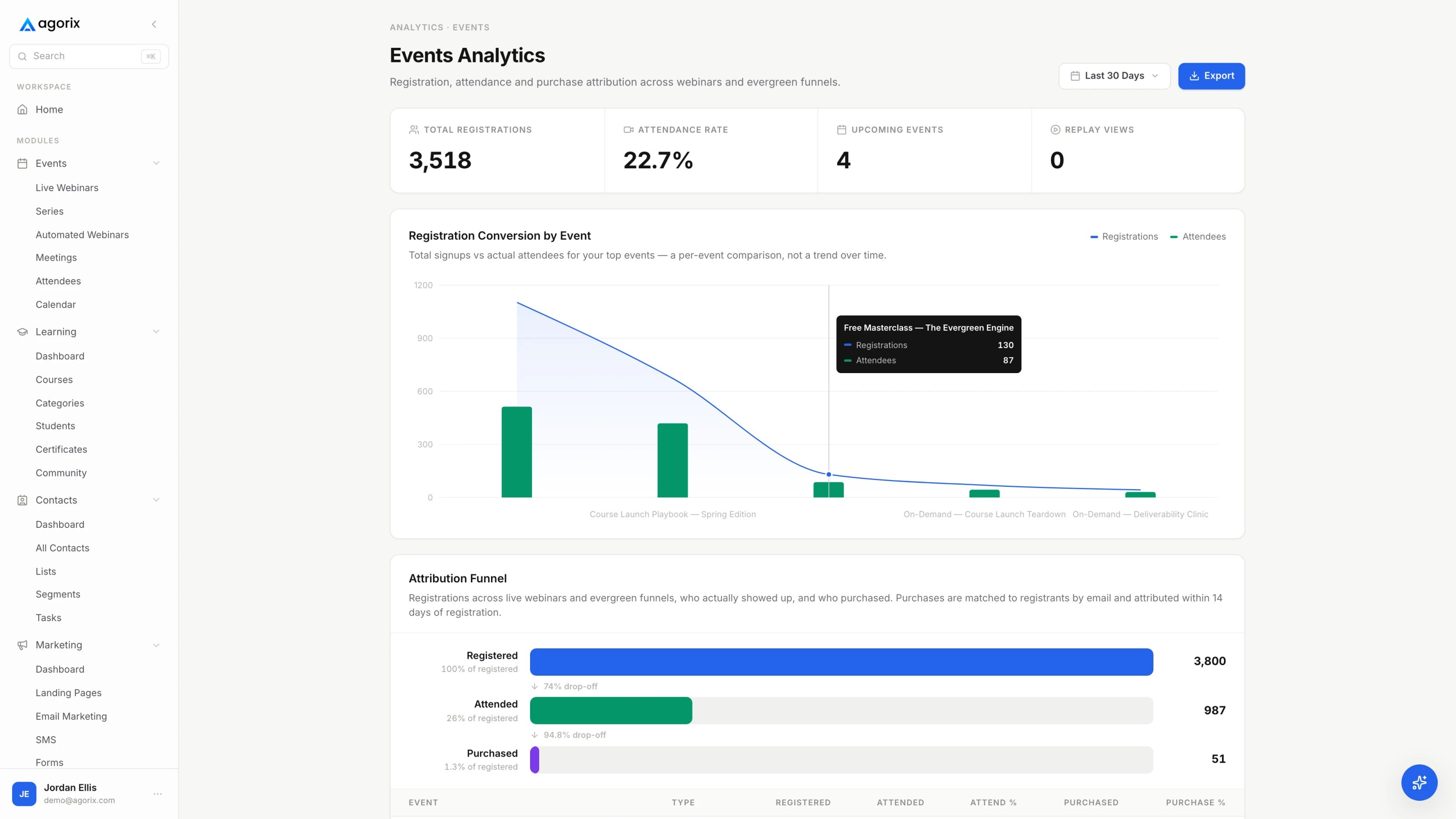
Tagged links get you registrations by channel in any stack. Following the same person through to attendance and a purchase normally means reconciling three exports by hand. In Agorix the registration source, the attendance behaviour and the checkout sit on one customer record — see how live webinars work.
Halfway through the window the numbers flatten and the instinct is volume — another email, another post, maybe some ad spend. Volume is the right answer to exactly one of the three possible causes. Work the questions in this order.
Only after those three does it make sense to act. The list below is ordered the same way — by how likely it is to change the outcome, not by how much it feels like doing something.
Twelve attendees who ask real questions is a better input to session two than eighty people who wander off at minute six. You get the objections in their own words, you find out which part loses the room, and you get to test the offer for real — all of which makes the next promotion window easier to plan and the next session easier to sell. Run it, record everything, and let the six numbers in the pillar guide tell you what to change.
Ten to fourteen days of active promotion is a reasonable working default, with partner asks going out before that window opens because they depend on somebody else’s calendar. Shorter windows tend to produce higher show-up rates and smaller rooms; longer ones produce the reverse. Run it both ways across a few sessions and compare attendees, not registrations — registrations are the number that flatters you. The pillar guide covers where this sits in the wider timeline.
Three: an announcement, a mid-window send that leads with the problem rather than the event, and a last call the day before. Add one resend of the second email to non-openers with a different subject line — that is one extra send, not a fourth email. Segment out anyone who has already registered before every one of them. All three are written out in the email sequence templates.
No. Paid traffic buys registrations for a machine that has not been shown to produce revenue yet, so you learn what a registration costs without learning what a customer costs — and the second number is the only one that tells you whether to keep spending. Prove the session converts organically at least once, then set a budget against revenue per registrant.
A complete kit, because the yield from this channel is inversely proportional to how much work you leave them. A paste-ready email with a subject line, three short social posts, a one-paragraph description written in their voice, a link with their source tag already in it, one image plus text-only versions of everything, and the date, time and timezone spelled out in every asset. Ask for a send window rather than a specific day, and plan one follow-up at T−3 days.
Give every channel and every partner its own tracked link from the first day, then judge them on attendees rather than registrations, and on revenue wherever you can trace it. A partner who sends forty registrations who never show is worth less than one who sends eight who buy. Registration counts are the easiest number to collect and the easiest one to be misled by.
Diagnose in order rather than reaching for volume. First: are people arriving at the page and not registering, or not arriving at all — those have opposite fixes. Second: which channel was going to carry this, and has it actually happened yet? Usually the partners have not sent. Third, and only then: is the topic the problem? Working the questions in that order stops you spending the last week promoting a page that was never going to convert.
Registration pages, the invitation and reminder sequence, the live room, behavioural follow-up and checkout — on one customer record, so “which channel produced customers” is a report rather than an afternoon of reconciling exports.
14 days · $0 due today · Payment method required · Cancel before first charge and pay nothing