Skip to content
Agorix
Updated 29 July 2026

The partner webinar playbook: two audiences, one record.

A joint webinar borrows somebody else’s trust and doubles the number of people who can drop something. This is the operating version: who to ask and on what basis, who owns registration and why one of you must, how to handle both lists honestly, how two people present as one session, and how the follow-up divides when the room closes.

01registration owner
04money models
13agreement items

What you will have at the end

  • A partner test that asks about fit before it asks about audience size
  • One owner for registration, the room and the record — and the reason splitting it costs you the follow-up
  • A list policy you can put in writing: who emails whom, what registrants are told, and what nobody exports
  • A shared run-of-show with a named lead and a handoff cue on every row
  • Four commercial models with their real trade-offs, and the terms to agree before either of you promotes
  • A follow-up split with an end date, and a debrief booked before the session happens
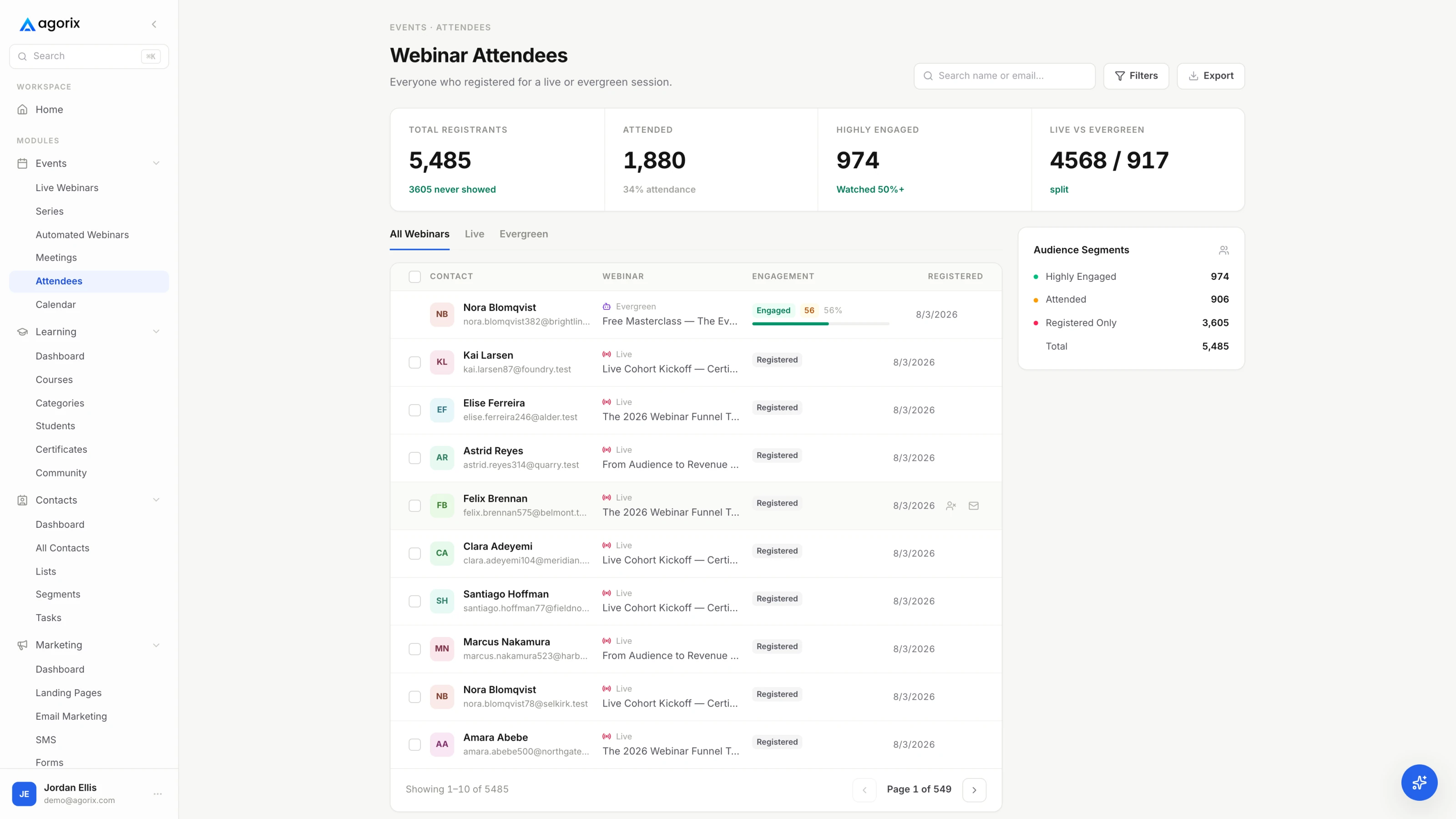
An attendee list showing registration source, attendance and engagement for each person, with audience segments alongside.
T−45dPicking a partner

Audience fit beats audience size, and it is not close.

The question is not how many people your partner can reach. It is whether the people they reach already have the problem your session solves. A large audience with the wrong problem produces a full registration list, a thin room and a follow-up nobody answers.

Same problem, different job

Their audience should already have the problem you are teaching about, and their offer should not be the thing yours replaces. Adjacent beats identical: you want the people who need both of you, not the people choosing between you.

The testCan you name the sentence their audience would use to describe the problem? If not, you are guessing at fit.

They have seen you teach

Asking somebody to send an email is asking them to lend credibility. Asking them to stand beside you for an hour is asking them to spend it. Partners who have watched you present say yes quickly; partners who have not give polite non-answers.

The testHave they seen you run a live session end to end, including the part where you sell something?

Their audience turns up

An audience with no habit of attending live sessions registers enthusiastically and attends occasionally. Ask what they last ran live, how many came, and what they would do differently — the answer tells you more than a subscriber count.

The testWhen did their audience last spend an hour with them in real time?

Two names is a session. Four is an event.

Each additional partner gets less stage time, has less reason to promote, and adds another calendar to the scheduling problem. Two presenters is the format this page is about. Three works with a host who presents nothing and does nothing but move between people. Beyond that you are running an event with a schedule, and it needs a different plan entirely.

Ask in terms of their audience

A request framed around what you need is the easiest kind to decline. Lead with the specific thing their people get, name the date range rather than a date, say what you will handle, and state plainly what you are offering in return — the reciprocal session, the commercial terms, or simply the work of running the whole thing. Then send the agreement below, because a partner who can see every decision already made is a partner who can say yes in one message.

DecideWho owns registration

One registration page. One room. One record.

This is the decision the rest of the session inherits, and the one most partnerships postpone because it feels like a question about fairness. It is not. It is a question about who can answer, afterwards, what happened.

Run two registration pages and you have created two of everything: two lists of registrants, two confirmation emails, two reminder sequences and two join links, one of which is wrong for anybody who signed up twice. The same person can appear on both sides and receive contradictory instructions from two systems on the morning of the session, which is the version of this failure the audience actually notices.

The version you notice comes later. Split registration means split follow-up: attendance sits with whoever owned the room, purchases sit with whoever owned the checkout, and nobody can answer the only question worth asking — who attended, stayed through the offer and did not buy — without exporting two files and matching them on email address. Addresses match less often than people assume, the merge takes a day, and the day it takes is the day the interest was worth the most.

Split registration

Two of everything

Two pages, two reminder sequences, two attendance records, two follow-ups. Every post-session segment is assembled by hand, and every number either party quotes is an estimate.

One owner

One record, one report

One page with a tracked link per partner. Registration source, attendance and purchase on the same person, so the report the other party receives is a fact rather than a reconstruction.

Choosing the owner, on capability

  1. Who can run all five parts on one record? Registration, confirmation, reminders, the live room and the follow-up. Whoever can do those in one place is the owner, regardless of whose audience is larger.
  2. Whose offer is being presented? The party whose offer runs at the end needs the attendance data to follow up honestly. Where those are different parties, the report they receive has to be specified in writing rather than promised.
  3. Who will still be paying attention next week? The follow-up window is where the value is, and it belongs to whoever has the capacity to work it. A partner who is travelling the week after should not own the record.

Whoever owns registration also owns the room, the recording and the replay deadline. They are a single job, and splitting them is how a session ends with a recording that one party cannot access and the other cannot publish.

What the other party gets, in writing

Not access to the list — a defined report, with the fields named, the timing agreed and the permitted use stated. Registrations from their tracked link, attendance, and where it can be traced, revenue. Naming the fields in advance turns the most common source of partnership friction into an administrative task, and it is the difference between “we will share the numbers” and a partner who can plan their next session around what actually happened.

T−30dBoth lists, honestly

Two lists, two senders, nothing exported.

The rule that keeps partner webinars clean is short enough to say in one line: nobody hands over a list. Your subscribers agreed to hear from you. They did not agree to hear from somebody you like.

What happens instead is straightforward. Each party emails its own list, from its own system, on its own sending domain, using its own tracked link. The two audiences merge on the registration page rather than in a spreadsheet, which is also the arrangement that lets you tell afterwards which side of the room came from where.

Then the part people skip: registrants who arrive through your partner’s link land on the registration owner’s record. Say so at the point of signup, in one readable line rather than a paragraph of legal furniture — who is running the session, who receives the details, and what each party will send. That sentence is the entire consent story for the joint audience, and writing it forces both parties to agree what they are actually doing.

Do

  • Each party sends from its own system, to its own list, with its own tracked link
  • Say on the registration form who receives the details and what each party will send
  • Agree the number of sends, the audience for each and the window, in writing, before promotion starts
  • Suppress registrants from further invitations on both sides the moment they sign up
  • Agree the date after which registrants stop hearing about this session and return to normal cadence

Do not

  • Export a list and hand it to a partner, in either direction, for any reason
  • Upload a partner’s audience into your system because they said it was fine
  • Describe the session as your own event in one party’s emails and a guest slot in the other’s
  • Add registrants to an unrelated sequence that was never mentioned at signup
  • Leave the question of who may email registrants afterwards until after the session

Commit to sends, not to enthusiasm

“We will promote it” is not an agreement. “Two emails to the active segment, one in the fortnight before and one the day before, plus one post” is. Write down the number of sends, the audience for each and the window they fall in, then suppress registrants on both sides so nobody is invited to something they already signed up for — the single fastest way to look careless to two audiences at once. The sends themselves are written out in the email sequence templates.

On the rules that apply to you

Consent and disclosure rules differ by where you and your audience are.

This page is operational rather than legal: it describes practices that keep a partnership honest, not the requirements of any particular jurisdiction. Whether you need explicit consent to pass details to a partner, what your unsubscribe obligations are, and how a commission must be disclosed all vary — check what applies to you and write the registration form to match it, rather than copying what a competitor does.

T−14dCo-presenting

Two presenters, one host, and somebody on chat who is neither.

The failure specific to joint sessions is that both people present and nobody runs the room. Chat goes unread for forty minutes, the questions that would have shaped the follow-up scroll away, and two capable presenters produce a session that feels unattended.

  1. Name the host. One person owns the clock, the room, the open and the close. They are still allowed to present — they are not allowed to lose track of the time while doing it.
  2. One presenter at a time, and the other is working. Whoever is not presenting is on chat and questions. That is a job with output — the questions collected there are the follow-up copy and the next session’s content.
  3. Agree the handoff cue and say it out loud. Something as plain as “…which is exactly where [Name] takes over.” Silence between two presenters reads as a technical fault, and people start checking whether their own audio has dropped.
  4. Partners introduce each other. It is the only introduction an audience believes, and it takes thirty seconds. Write one line about the other person and read it rather than improvising a job title.
  5. Decide who answers what before questions start. Otherwise you will both begin at once, both stop, and both defer — three times, in front of everybody. The person on chat assigns each question by name.

Rehearse the seams, not the session

Twenty minutes is enough. Run the first three minutes, each handoff, and the transition into the offer — the three places where two people have to behave like one session. Rehearsing the teaching is unnecessary; both of you already know your own material, and neither of you knows what the other sounds like ending a section.

Run the equipment list against both setups while you are there. The audience judges the session by the worse of the two microphones, and a partner who has only ever taken meetings has never had a reason to find out what their room sounds like for an hour — the equipment checklist is quicker to send than to explain.

Agree this one before the day

What happens if one of you cannot get into the room.

The other continues alone, from the shared deck, and says plainly what has happened and what the audience will get instead. Written on the run-of-show it costs fifteen seconds of explanation; improvised in silence at minute four it costs the room. Both parties need host access to the room, tested in advance on the device they will actually use, so that this is a decision rather than a scramble.

T−0The shared run-of-show

One document, both names, a cue on every row.

A run-of-show without a lead on each row is a schedule, and a schedule does not tell two people which of them is speaking. The cue column is the point of the document: it is what stops the pauses that make a joint session feel improvised.

Ten rows, tab-separated. Pastes into a spreadsheet both of you can edit — which matters more than the format, because a run-of-show only one party can change is a request rather than a plan.

TimeWhat is onWho leadsHandoff cue
−15Both presenters in the room. Audio checked by the other person, screen share tested, recording armed.BothNeither of you presents until the other has said the audio is fine.
00:00Open: what this hour is, what they leave with, and both names on it.Host“…and the person who is going to walk you through it is [Name].”
00:03Each partner introduces the other — why them, on this topic, for this audience.HostStraight into the first section, no pause to check anything.
00:05Section one. One person teaches; the other is on chat and questions.Partner A“That is the first half — [Name], the second half is yours.”
00:22Handoff. The second presenter takes over; the first moves to chat.Partner BNamed out loud in one sentence, never a silent switch.
00:38Section two, then the bridge to whatever is being offered.Partner B“Before we take questions, here is what happens next.”
00:45The offer, presented once, by whoever it belongs to, with any financial relationship stated plainly.Offer ownerSaid in one sentence, then straight into questions.
00:50Questions — read out by whoever is on chat, assigned by name to whoever they are for.BothChat holder assigns; nobody answers a question aimed at the other.
00:58Close: what is in the replay and until when, and one next step rather than two.HostOne next step. Two next steps is the same as none.
T+15Recording named and filed. Both parties confirm the follow-up sends are scheduled rather than drafted.Registration ownerIf the recording is missing, both parties know within the hour.

The times are an illustrative sixty-minute session rather than a prescription — replace them with your own sections and keep the structure. The four shaded rows are the ones that get improvised, and they are also the four that decide how the session is remembered: the pre-show check, the open, the offer and the close.

Put a real name in the lead column rather than a role. “Host” is a description; a name is an assignment, and on a session where neither party manages the other, an assignment is the only thing that holds.

TermsWhose offer, whose money

One offer, disclosed, on terms agreed before anyone promotes.

Start with the part that is not about money: a joint webinar should present one offer. Two offers in one hour is a session about the presenters rather than the audience, and an audience given two next steps reliably takes neither.

Which leaves the commercial question, and four models that answer it. None of them is correct in general; each is correct in particular circumstances, and the trade-offs below are what you are actually choosing between.

The straight swap

Nobody pays anybody. Each party promotes, each keeps whatever their own side produces, and you do it again in reverse.

The fastest arrangement to agree, and the right default between peers with comparable audiences who intend to keep trading.

  • Nothing to track, reconcile or dispute afterwards
  • No commission to disclose, so the framing stays simple
  • The reciprocal session is the incentive, and it compounds
  • Whoever’s offer runs captures the revenue; the other party has to be satisfied with reach
  • No incentive to promote hard once the date is booked
  • “Fair” is unverifiable, so it depends entirely on the return session happening

Commission on the offer

One party’s offer; the other earns an agreed share of sales traced to the session or their link.

Aligns effort with outcome, which is why it is the common arrangement when one party is bringing the audience and the other is bringing the product.

  • The promoting party has a reason to send more than once
  • Scales with the room rather than being fixed in advance
  • Produces a number both parties can point at afterwards
  • Needs tracked links, an attribution window and a written refund rule
  • Disputes are about attribution rather than honesty, and they are still disputes
  • Must be disclosed to the audience, which changes how the recommendation reads

A fee for the slot

One party pays a fixed amount to present to the other’s audience.

Predictable for both sides, and usually the honest structure when the audiences are very different in size.

  • No tracking infrastructure and no attribution argument
  • The payer keeps all the upside if the session works
  • Both parties know the outcome before it starts
  • The payer carries all the risk, including a thin room
  • The host has no incentive beyond the fee once it is agreed
  • It is closer to advertising than to a partnership, which changes what should be said to the audience

A shared paid ticket

The session itself is paid, one checkout, split on agreed terms.

Works when the session is the product rather than the introduction to one — a workshop people would have paid for separately.

  • Filters for intent, so the room is smaller and far more engaged
  • The split is arithmetic rather than attribution
  • Funds production, and pays even if nothing else is sold
  • A paid session is a much harder sell and a much smaller room
  • One party must be the merchant of record and carry refunds and support
  • Paying attendees expect a session, which constrains how the offer can be presented

Whatever the model, write these down

  • The number, and what it applies to. Gross or net, first purchase only or the whole order, one product or the catalogue. Most disagreements are about this line rather than about the percentage.
  • What counts as attributable. The tracked link, a coupon code, the registration record, or all three — and the window. A session sale that arrives three months later is a decision you should make now rather than then.
  • Refunds and chargebacks. Whether commission is reversed, and how a refund after payout is handled. Agree it before the first sale rather than after the first refund.
  • Who is the merchant of record. One party takes the payment, carries the refunds, and handles delivery and support for what was sold. It should be the party whose offer it is.
  • When payment is made. A date, after the refund window, with the report that supports it. “After the dust settles” is how partnerships end.
Why there is no percentage on this page

There is no standard split, and publishing one would only give you somebody else’s negotiation.

The right number depends on whose audience carries the room, whose offer is sold, whose margin funds it, and how much work each party is actually doing. Negotiate it against those four things, then write it down — and do that before either of you sends anything, because a number agreed after the results are known is not a negotiation, it is an argument.

Say the relationship out loud

If you earn from what your partner sells, disclose it — in the room, at the moment the offer appears, and in the emails that mention it. One sentence is enough, and the plainer the better: something on the order of “I earn a commission if you buy this, which is why I can spend an hour on it — it does not change what you pay.” Two reasons, in order of importance: rules on disclosure exist in most places you are likely to be operating and they differ, so check what applies to you; and an audience should never learn about a financial relationship from anybody other than you.

T+1dSplitting the follow-up

The room closes and the work divides along lines you already drew.

Most of the value of a webinar is created in the two days after it. On a joint session those two days are also the point where an unclear agreement becomes an awkward message, so the division is worth settling in week one.

  1. The replay goes out from the registration owner. One send, from the system that knows who attended and who did not, on the timing you agreed. Two replay emails from two systems is the most visible possible way to tell an audience that nobody was coordinating.
  2. The offer follow-up belongs to the offer owner. Not by preference — by capability. Only one party can see the checkout, and only one party can honour what the follow-up promises.
  3. The other party gets the report, flattering or not. Registrations from their link, attendance, and revenue where it can be traced. A partner who receives an honest thin result will run a second session; one who receives silence will not.
  4. Both parties honour the end date. After the agreed number of sends, or the agreed date, registrants return to normal cadence. This is the item that produces complaints when it is left unsaid, and it costs nothing to say.
  5. The debrief is booked before the session. Twenty minutes within a week, while both of you still remember what happened in the room. Decide there whether there is a second one, and what changes if there is.

The four segments, and what they need

Every useful follow-up on a webinar is defined by two facts about the same person: what they did in the room, and whether they bought. Attended and bought moves into delivery. Attended and did not buy gets the objection handled rather than the pitch repeated. Registered and never came gets the replay with a deadline. Watched the replay gets treated as an attendee, because they behaved like one.

Those four segments only exist cleanly when registration, attendance and the checkout sit on one record. Where they do not, decide in advance what the approximation is — usually “everyone who registered”, split by purchase only — and label it as an approximation when you report it, rather than presenting a merge on email address as though it were attendance data.

Where a tool decision changes the plan

Two audiences is a promotion problem. Two records is a follow-up problem.

Any stack can run a joint session. Answering “who came from which partner, stayed through the offer and did not buy” usually means reconciling exports. In Agorix the registration source, the attendance behaviour and the checkout sit on one customer record — see how live webinars work.

Start your 14-day trial 14 days · $0 due today · Payment method required · Cancel before first charge and pay nothing
In writingThe one-page agreement

Thirteen lines that prevent every argument on this page.

None of this needs a contract, and for most partnerships a contract would be theatre. What it needs is a shared document where each of these is written down and neither party has to remember what was said on a call six weeks ago.

Send it with the ask. A partner who can see that every decision has already been thought through is a partner who can say yes in one message — and the two or three items they push back on are exactly the conversations worth having before a date exists.

The one-page agreement0 / 13 agreed

Before either of you promotes

Before either of you presents

Common questions

Six questions about running one with somebody else.

Who should own registration for a partner webinar?

One party, chosen on capability rather than audience size: whoever can run the registration page, the confirmation, the reminders, the room and the follow-up on a single record. Splitting registration across two pages gives you two lists, two sets of reminders, two join links and no single answer to who attended — so the follow-up has to be assembled by matching exports on email address at exactly the moment the interest is warmest. The other party gets a tracked link into the same page and an agreed report.

Should we swap email lists?

No. Your subscribers consented to hear from you, not from your partner, and handing over addresses breaks that no matter how friendly the arrangement is. Each party emails its own list, from its own system, on its own sending domain, with its own tracked link. The two audiences merge on the registration page rather than in a spreadsheet, and the form tells people plainly who receives their details and what each party will send.

How do you split the revenue?

Four models are common — a straight swap, a commission on sales traced to the session, a flat fee for the slot, and a shared paid ticket — and each carries a real trade-off around incentive, risk and administration. There is no standard percentage, and this page deliberately does not invent one: the right number depends on whose audience carries the room, whose offer is sold and whose margin funds it. What is not negotiable is that the number exists in writing, with the attribution rule and the refund rule beside it, before either of you promotes.

Do we have to disclose a commission to the audience?

If you earn from what your partner sells, say so plainly, in the room and in the emails. Disclosure rules differ by jurisdiction and by channel, so check what applies to you rather than copying somebody else. The principle underneath the rules is simpler than the rules: the audience should never learn about a financial relationship from anybody other than you, because at that moment everything else you said in the session gets re-read in a worse light.

What if their audience is much bigger than mine?

A size difference changes the terms you can reasonably ask for. It does not change who should own the record. Bring something other than reach — the teaching, the production, the registration and follow-up system, the offer itself, or simply running the room properly. Fit still matters more than size, because a large audience with the wrong problem produces registrations that do not attend, which is the number attendance work is judged on.

How many partners should present in one session?

Two names is a session. Three is a panel, and needs a host who presents nothing and does nothing except move between people. Four or more is an event rather than a webinar — it needs a schedule, per-session attendance and a different plan, which is what running a virtual summit covers. The failure mode of adding partners is arithmetic: each one gets less stage time, promotes less as a result, and the session turns into a sequence of introductions.

Keep going

What sits either side of a joint session.

From a joint session to a repeatable one

Two audiences in the room. One record afterwards.

One registration page with a tracked link per partner, reminders that reach both audiences, the live room, per-person attendance and the checkout — on one customer record, so the report your partner receives is a fact and the follow-up goes out while the session is still warm.

14 days · $0 due today · Payment method required · Cancel before first charge and pay nothing