Skip to content
Agorix
Updated 29 July 2026

Sell an online course with a webinar: teach the belief, deliver the method.

A course is bought when somebody changes their mind, and a live session is the only asset that can change it in real time. This is how to pick the topic from the transformation, build the offer, hand off into the pitch without losing the room, and split the follow-up on the only question that matters. Written to work with any webinar and course tooling; where a tool decision genuinely changes the plan, it says so.

01belief per session
03parts to the offer
10offer-sheet items

What you will have at the end

  • A division of labour between the session and the course, so neither one does the other’s job
  • A webinar topic taken from the course’s transformation rather than from its table of contents
  • An offer in three parts: the course, what makes now different, and a deadline you will hold
  • The transition into the pitch, written so the room does not feel the gear change
  • Two follow-up sequences that split on one question — did they buy
  • A rule for when to stop running it live and let the recording run it for you
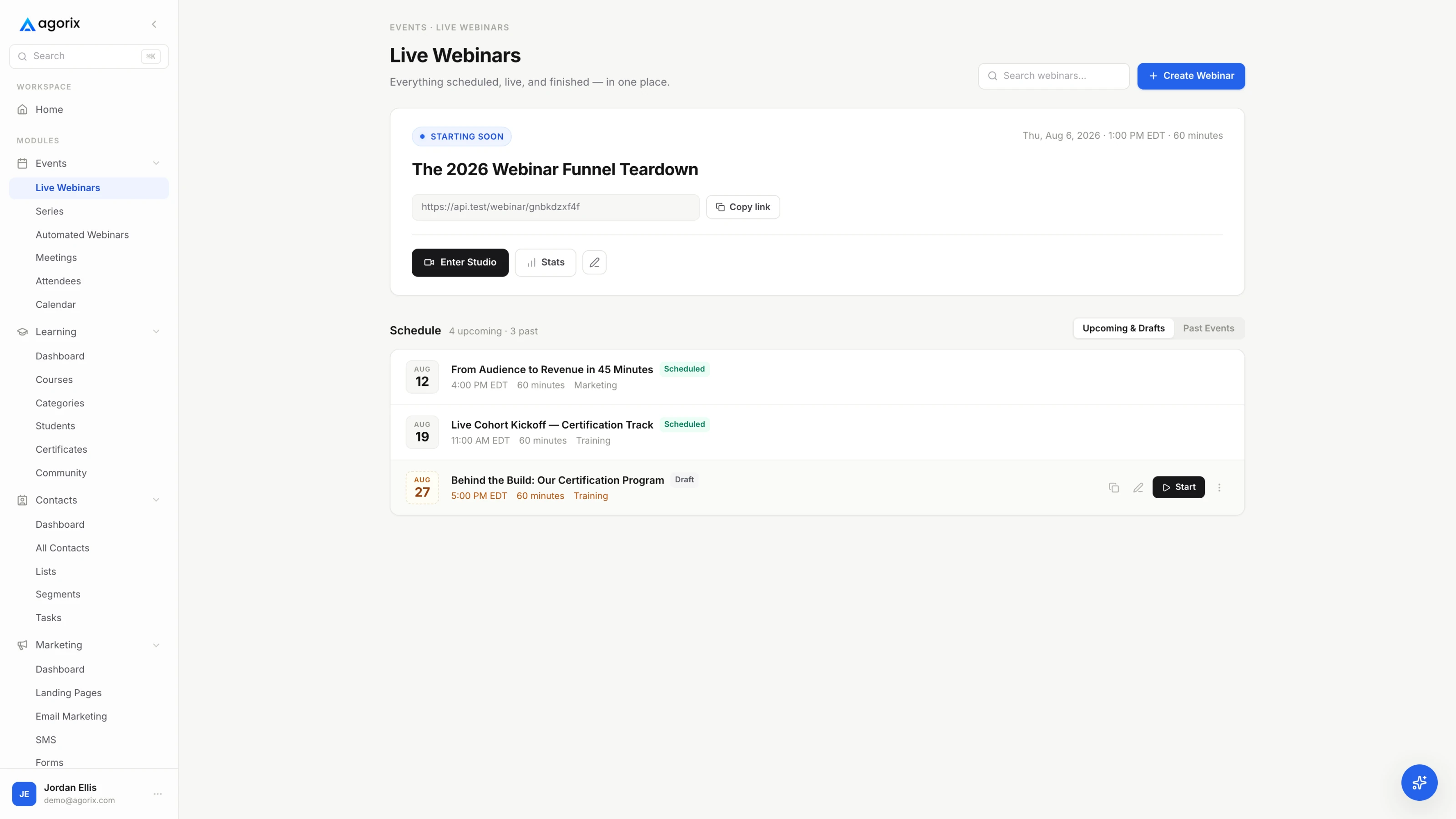
A live webinar session being managed alongside the offer that will be presented in it.
ModelWhy the webinar

The session teaches the belief. The course delivers the method.

Almost every course that fails to sell is failing at a belief, not at a feature list. The buyer does not doubt that your modules exist. They doubt that this approach will work for them, or that now is the moment, or that they are the kind of person it works for.

A sales page argues at somebody who is skimming. A live session argues at somebody who has blocked out an hour, and it can do three things a page structurally cannot: it holds attention long enough to make a complete argument, it lets people watch you do the thing rather than describe it, and it answers the specific objection in the words of the person who raised it, in front of everybody else who was quietly holding the same one.

That is why the webinar is the native selling motion for a course rather than one channel among many. Both are teaching instruments pointed at the same transformation. The difference is scope: the session changes one mind about one thing, and the course does the work that belief implies.

The division of labour

Most sessions that convert badly have taken on the course’s job — trying to deliver the method in an hour — and most that convert badly in the other direction have taken on nothing at all. Keep the two columns below apart and the session gets easier to write every time you run it.

The session’s job

  • Move exactly one belief — the thing somebody has to accept before the course is worth buying
  • Show the method working once, on a real example, from start to finish
  • Surface the objections in the audience’s own words, live, where you can answer them
  • Make the gap obvious between doing this alone and doing it inside a structure
  • Earn the offer by being useful before the offer arrives

The course’s job

  • Deliver the method in the order somebody actually performs it
  • Carry the buyer through the parts a one-hour session has to skip
  • Give the work a place to happen: lessons, assets, checkpoints, deadlines
  • Handle the individual case the single live example could not cover
  • Produce the outcome the session made them believe was available
What this is not

A webinar is not a sales page read aloud.

If the session could be replaced by somebody reading your page into a microphone, you have spent an hour of other people’s time to deliver something they could have skimmed in ninety seconds. The teaching has to be genuinely worth the hour on its own — that is the price of the attention, and it is also what makes the offer at the end feel earned rather than extracted.

Ch. 01The topicChapter 01 / 05

Take the topic from the transformation, not from the table of contents.

The most common way to lose the sale is to teach module one. A session assembled from the course outline gives away the beginning and proves nothing about the end, which is exactly backwards: the beginning is the part people are least worried about.

Start from what the course promises to change, then work back to what somebody has to believe before that change is worth paying for. That belief is the session. Not a summary of the course, not a highlight reel — one argument, made properly.

  1. Write the transformation as one sentence. [Who] goes from [a specific before] to [a specific after] in [roughly this long]. If you cannot finish that sentence without reaching for a list of modules, the course is not ready to be sold and no session will rescue it.
  2. Name the belief in the way. The thing they currently hold that makes the transformation seem impossible, irrelevant, or premature for them specifically. Usually it is one of three: this does not work in my situation, I have already tried something like it, or I am not the sort of person this works for.
  3. Choose the proof you can actually show in an hour. One real example, worked end to end, beats five described. Screen-share the thing, do the awkward part, narrate the decisions. Proof that survives being watched is worth more than proof that has to be claimed.
  4. Cut everything that is not that. Every extra thread costs you the belief change you came for. The material you cut is not wasted — it is the next session, and the questions the room asks will tell you which piece to run next.
  5. Title it as the outcome, not the curriculum. The title is doing promotion work before anybody reads a word of the page. Name the change, name who it is for, and leave the module names out of it entirely.

Topics that sell the course, and topics that do not

Sells the course

  • The one belief standing between them and the transformation, argued end to end
  • A complete walk-through of one narrow piece of the method, on a real example
  • The framework in overview, taught honestly, with the doing left to the course
  • The expensive mistake, shown, with the correction demonstrated live
  • An audit or teardown of something the audience immediately recognises as theirs

Does not

  • Module one delivered as a preview — you gave away the beginning and proved nothing about the end
  • Everything the course covers, compressed, which produces overwhelm rather than belief
  • The broad topic with no argument inside it, which entertains a room and sells nothing
  • A pitch with three teaching slides bolted to the front, which the room detects by minute four
  • A topic chosen because it fills a room, when the room it fills does not want the course

A useful test before you build a slide: if somebody attended, took your advice, and never bought anything, would the hour still have been worth their time? If the honest answer is no, the session is a pitch with teaching stapled to it, and rooms can tell. If the answer is yes, you have something people will recommend to somebody else while it is still running — which is the only promotion that arrives for free.

The reverse test matters too. If somebody could take the hour and get the whole transformation without you, the course has no job left. Teach the what and the why completely; let the course own the how, at the level of detail that only survives being worked through over weeks. If you are still deciding what the course itself contains, building the course and outlining the curriculum come first — the session is downstream of both.

Ch. 02The offerChapter 02 / 05

Three parts: the course, what makes now different, and a date.

An offer is not a price with bonuses attached to it. It is the thing they get, the reason this moment is different from next month, and a deadline that is true. Get those three right and the pitch is mostly description; get them wrong and no amount of delivery rescues it.

  1. The course, described as outcomes. What they will be able to do, in the order they will be able to do it, with the format and the time commitment stated. Module names are the least persuasive thing on the page — they answer a question nobody in the room is asking yet.
  2. What makes now different. One or two additions that reduce the risk of starting: a live onboarding session for this intake, an office-hours block for the first month, a fast-start module, a template pack for the exact thing you taught. The test is whether it helps them finish. If it only helps them buy, it is padding, and padding teaches people to discount everything else you sell.
  3. The deadline, and the reason it exists. A cohort that starts, a bonus call that happens on a date, a price that returns to standard. The reason has to be real, because you will run this session again and the people watching you extend a deadline are the people you want in the next room.

Price it before the session, not during it

The single most common in-room mistake is improvising the price against the energy of the chat. Decide it in advance, defend it in one sentence, and say it out loud once without apology. A price you talk around is a price the room stops believing in — and the number itself is a structural decision about tiers, payment plans and where the course sits in your ladder, worked through in how to price an online course.

If you sell more than one tier, do not make the room compare them live. Name the one you recommend, say who the other one is for in a single sentence, and let the page carry the comparison. A live audience asked to evaluate a pricing table stops listening and starts calculating.

Settle the offer sheet before you build a slide

Everything below has to be decided anyway. Deciding it now means the slides, the page, the checkout and the follow-up emails all say the same thing — which is the difference between an offer and a set of documents that contradict each other on the day.

The offer sheet0 / 10 settled

What they are buying

Why now, and what happens after

Minute 45The handoffChapter 03 / 05

The transition is one sentence, and it should surprise nobody.

The gear change is where sessions lose the room, and it is rarely a tone problem. It is a promise problem: an offer that arrives unannounced reads as a bait and switch even when the teaching was genuinely good.

The fix costs ten seconds and happens at the beginning. In the first two minutes, say what the hour contains: roughly this long teaching, then a few minutes on the program that goes further, then questions for as long as you have them. Nobody leaves over that. What people leave over is discovering at minute forty that the shape of the event was not what they were told.

The sentence that moves you across

Do not signal the transition with a slide that changes the show — a new colour scheme, a countdown, a different voice. Close the teaching properly, restate the belief, and then refer back to the promise you made at the start.

So that is [the method], end to end, on [the example].

If you take one thing away: [the belief, in a single sentence].

Now — I said at the start that I would spend a few minutes
on what happens if you want the whole thing rather than the
hour. That is [Course name]. Here is what is in it, who it
is for, and what it costs. Then I will take questions for
as long as you have them.

That is the whole manoeuvre. It works because it is consistent: the person who made the offer is the same person who just taught for forty minutes, and the offer is the thing they said would happen.

What the pitch actually has to answer

  • What is it, concretely. Show it if you can. Click into the course, show the module structure, open a lesson, show what week one looks like. Ninety seconds of screen share does more than a slide listing what is inside.
  • Why now rather than later. The cohort date, the bonus that happens on a day, the price that changes. Stated once, plainly, with the mechanics rather than the adjectives.
  • What happens if it does not work for them. Your refund or guarantee terms, said in the same words that appear at the checkout. Somebody has to be able to repeat this back accurately to a partner who asks.
  • What happens in the next five minutes if they buy. The receipt, the access, the first thing to do. People buy more readily when the immediate next hour is described rather than implied.

Take questions after the offer, not before

Questions asked before the offer are teaching questions. Questions asked after it are buying questions, and answering them while the offer is on screen is the single highest-value block in the session. Stay until they stop. The last three questions in a room are frequently asked by the people closest to deciding, and they are asked long after a scheduled hour would have ended.

One link, said out loud, pasted into the chat more than once, and on the final slide. Send it straight to the checkout when there is one thing to buy, and to a short page when there is a genuine choice to make — then make sure that page survives being opened on a phone in a queue, which is where a meaningful share of it will happen. The webinar script template writes out the full hour including this block, and checkout page optimization covers what the page has to do once they arrive.

T+0 → T+7dAfter the roomChapter 04 / 05

One question splits the follow-up: did they buy.

The hour ends and one list becomes three audiences whose next email should have almost nothing in common — buyers, attendees who did not buy, and registrants who never arrived. Sending them the same thing is the fastest way to undo an hour of goodwill.

The split has to happen immediately, not at the end of the day. The worst message in this entire motion is a last-chance email arriving in the inbox of somebody who already paid, and it is nearly always caused by a manual export that ran late.

WhenWhat goes outAudience
T+0 · within the hourBuyers get the receipt, the access and one instruction for today. Everyone else gets the replay with the deadline stated in the same words you used live. Two sends, two audiences, no overlap.Split
T+1dBuyers: onboarding email one — where to start and what week one looks like. Non-buyers: the objection email, answering the question the room actually asked rather than the one you expected.Split
T+2dNo-shows: the replay, once, with an honest line about what they missed and exactly how long it stays up. They are a different audience from the people who watched and declined.No-shows
T+3dNon-buyers: the case for the method rather than for the course. Teaching that stands on its own, with the offer at the end where it belongs.Attendees
T+5dBuyers: the first progress check. Whether lesson one is finished or not, the email is different — and the second version is the one that matters.Buyers
T+6dNon-buyers: what specifically changes when the deadline passes. Not urgency language — the actual mechanics, so the choice is informed.Attendees
T+7d · deadlineNon-buyers: two sends on the final day, morning and last hours. Then it closes, and it closes on time, because everything you sell after this depends on that being true.Attendees
T+8dNon-buyers return to the normal list. Buyers move onto the student track and stop receiving sales messages for the thing they already own.Split

That is a working default rather than a schedule to obey. Two rows do most of the work: the first one, because the split either happens inside the hour or it happens badly, and the last one, because a deadline held exactly is what makes every future deadline you set worth anything. The wording for the whole window is in the course launch email sequence, and the invitation and reminder sends that precede the session are in the webinar email templates.

The buyers

Not finished — started

The sale is the beginning of delivery, and the first week decides whether they finish. Somebody who completes the first lesson inside forty-eight hours is a different customer from somebody who has not opened it in a fortnight, and the two should not receive identical mail.

The non-buyers

A segment, not a failure

They spent an hour on this topic and declined, which is a lot of information. Usually it is one of three things: the price, the timing, or a specific doubt the session did not resolve. Ask, in one line, and some of them will tell you.

For the buyers, everything that matters now happens inside the course: onboarding emails that get week one done and completion systems that notice when somebody stalls. For the non-buyers, the honest move is a follow-up funnel that keeps teaching rather than a sequence that keeps asking — and an invitation to the next session, because the second room converts people the first room did not.

Where a tool decision changes the plan

The buyers and the non-buyers have to stop being one list within the hour.

Who registered, who actually attended, who bought and who has finished lesson one are four questions about the same person. When the answers live in four systems, the split runs on an export and arrives late. In Agorix the registration, the attendance, the checkout and the lesson progress sit on one customer record — see how courses connect.

Start your 14-day trial 14 days · $0 due today · Payment method required · Cancel before first charge and pay nothing
RepeatRun it againChapter 05 / 05

Live until it converts. Then let the recording run it.

The instinct after one good session is to automate it immediately. The instinct after one bad session is to abandon it. Both are early: a session is a draft, and the second and third runs are where it becomes an asset.

Run it live at least twice — three times if the first two disagreed with each other — because live is the only version that talks back. A recording cannot tell you which minute lost the room, which objection went unanswered, or which sentence made three people type “wait, say that again”.

  1. Change one thing per run. Two changes at once and you learn nothing from either. The order that usually pays: the topic and title first, because they decide who is in the room; then the drop-off point; then the offer; then the price. Everything else is decoration by comparison.
  2. Read the room, not the recording. The questions asked live are the objection list, written for you, in the buyer’s vocabulary. They belong in the sales page, in the follow-up emails and in the section of the session where the objection is now answered before it is asked.
  3. Fix where they leave before you fix what you sell. If half the room is gone before the offer, the offer is not the problem. Find the minute where attention drops, watch what you were doing, and cut or restructure it. An offer nobody hears cannot be improved by rewriting it.
  4. Only then record the one that worked. An evergreen session repeats whatever you built, faithfully, including the parts that were not working. Automation makes a converting session cheaper to run and a broken one more expensive to keep running.

What has to change when it goes evergreen

An automated session is not the live one with the date removed. Two mechanics have to be rebuilt, and both of them are about honesty rather than technology.

  • The deadline becomes personal. A shared cart-close date makes no sense to somebody who watched on a Tuesday in March. The deadline has to run from their session and expire for them, and it has to actually expire — a countdown that resets on refresh is the fastest way to teach an audience that none of your deadlines are real.
  • The follow-up keys off what they watched. Live, everybody experienced the same hour. Evergreen, one person left after eight minutes and another watched past the offer twice. Those two should not receive the same email, and the second one is the most valuable message you will send all week.
  • The live version does not stop entirely. Keep running sessions occasionally — for a launch, for a new topic, for a cohort intake. Live is where new questions arrive, and when nobody can ask them your evergreen session slowly ages into answering objections that people stopped having.

The mechanics of scheduling, deadlines, replay windows and the maintenance rhythm are covered in the automated webinar setup guide, and the move itself — taking a session that worked live and turning it into a standing funnel — is in live to evergreen. The shape of the whole path, from first click to enrolled student, is the webinar funnel.

Common questions

Six questions about selling a course live.

Do I need a webinar to sell an online course?

No. Courses sell from sales pages, email sequences, sales calls and communities, and plenty do. A webinar does one thing none of those can: it changes a belief in real time, and it answers the objection in the objector’s own words in front of everybody else who was holding it silently. That makes it the highest-leverage single asset for a course priced above an impulse purchase — and unlike a call, it does not cost you an hour per prospect. If you have not built the course yet, preselling it from the same session is a legitimate way to find out whether it should exist.

How long should a webinar be if I am selling a course?

Sixty to ninety minutes is a workable range, and the ratio inside it matters far more than the total: the majority teaching, a defined block for the offer, and open questions at the end. What matters most is that you announce the shape in the first two minutes, so the offer is expected rather than sprung. The webinar script template lays out the whole hour, block by block.

When in the webinar should I make the offer?

After you have finished teaching the thing you promised and before the room’s attention starts to go — for most sessions somewhere past the two-thirds mark. Announce in the first two minutes that it is coming, transition in one sentence rather than with a slide that changes the show, and take questions after the offer rather than before it. Objections answered while the offer is on screen do the work; objections answered before it are just teaching.

Should I say the course price on the webinar?

Yes. Say it out loud, once, plainly, and then show it on the page you send them to. A price withheld until the checkout reads as a trick, and a room forced to guess spends the Q&A guessing instead of asking the questions that would have sold it. What the number should be is a separate problem, worked through in how to price an online course.

How long should the deadline be after a webinar?

A few days to a week is a common and workable window: long enough for the people who genuinely need to check a calendar or a balance, short enough that the decision does not get deferred forever. The requirement is not the length. It is that the deadline is true — tied to a cohort start, a bonus call that happens on a date, or a price that returns to standard — and that you hold it exactly as stated. You will run this session again, and some of the people watching the deadline slide will be in the next room.

Can I sell a course with an automated webinar?

Yes, once the live version has converted. Run it live at least twice so the questions, the drop-off points and the objections are known, then record the session that worked. Two things have to be rebuilt for evergreen: the deadline has to become real for each individual viewer rather than a shared date, and the follow-up has to key off what that person actually watched. Both are covered in the automated webinar setup guide.

Keep going

The session, the course, and the price between them.

Further reading on what the follow-up window is actually worth: the webinar follow-up window and the evergreen webinar funnel.

From one session to a standing enrolment motion

You now have the motion. Agorix is the system that runs it.

Registration pages, the reminder sequence, the live room, the checkout, the course itself and the follow-up that knows who bought — on one customer record, so the person who attended, purchased and stalled at lesson two is one person rather than three rows in three exports.

14 days · $0 due today · Payment method required · Cancel before first charge and pay nothing