Skip to content
Agorix
Updated 29 July 2026

Webinar script template: sixty minutes, written out.

Eight copyable blocks that fill the whole arc — the open, three teach blocks, the transition sentence, the offer and the questions. Each one carries the reason it is the length it is, what to cut when you are running long, and what changes for a coaching, course or SaaS audience. Works with any webinar tool.

08script blocks
60minute arc
05transition lines

What you are taking away

  • A complete 60-minute script skeleton you can speak from tonight
  • Five transition sentences, so the moment nobody rehearses is the one you wrote
  • The timing reason for every block, so you know which minute is negotiable
  • What to cut in each block when you are running long, decided before you are
  • A slide map: how many slides each block needs and what is on them
  • Coach, course-creator and SaaS-demo variants of every block
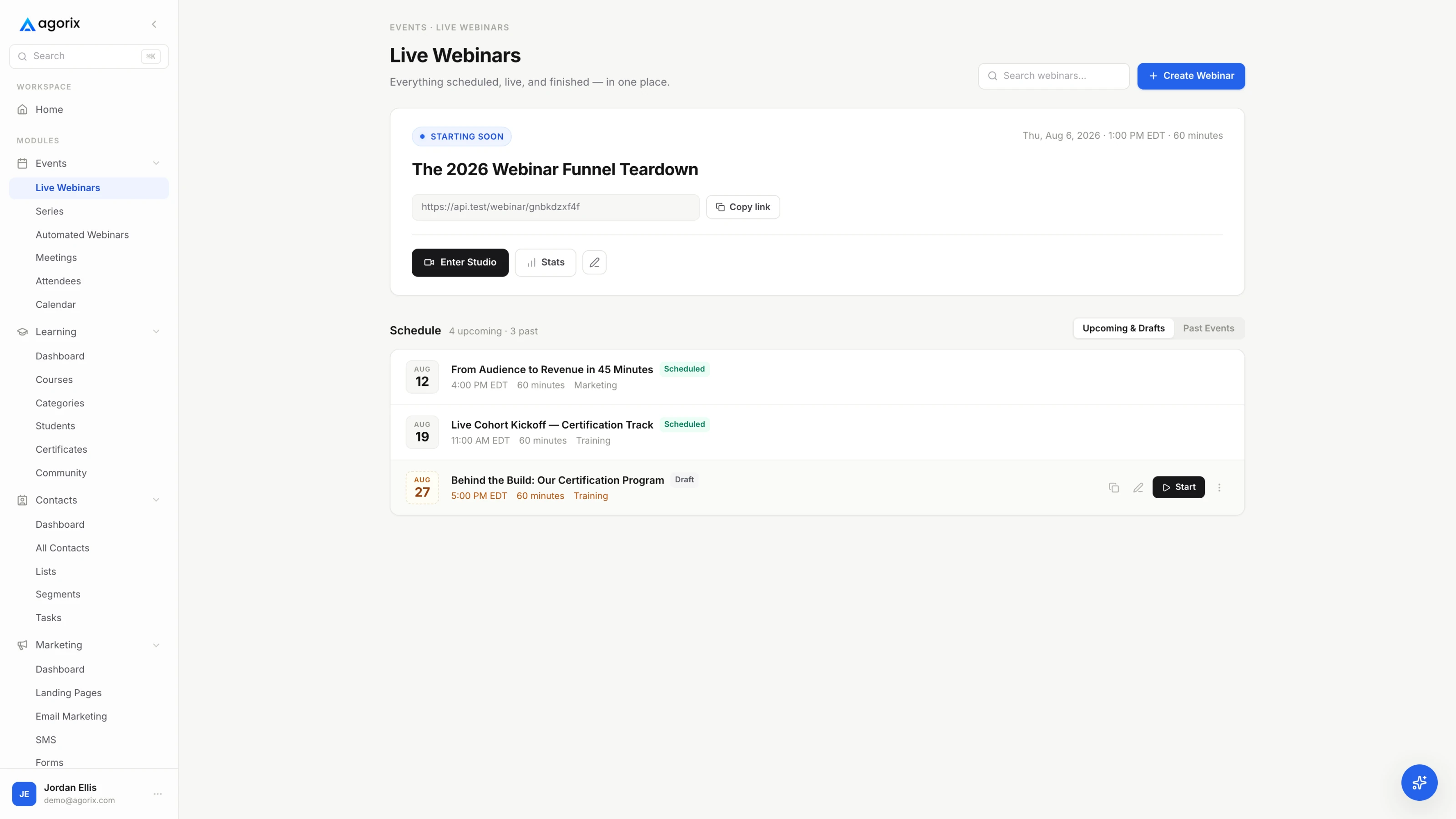
A live webinar room with the attendee list, chat and question queue alongside the presentation.
Before you write a word

Two decisions the script cannot make for you.

A script is the last thing you write, not the first. Two decisions determine every block below, and making them afterwards is how sessions end up with a beautiful forty-minute teach and a transition nobody believes.

Decision one

What the offer is, exactly

Not the name — the sentence. What it is, what happens after somebody buys, the price, and the situation in which it is the wrong purchase. The teaching has to leave a gap this fills, so you cannot write the teaching until you know what the gap is.

Decision two

Whether this recording gets reused

A session you will run once can reference today, the news, and what somebody just typed in chat. A session that becomes an evergreen replay cannot, and retrofitting that later means recording it again.

The brackets are the work

Everything in [brackets] is yours to replace, including the parts that read like instructions — they are there because a template that writes your teaching for you is a template that produces sixty minutes of nothing. What is not bracketed is the connective tissue: the sentences that move a room from one block to the next, which are the parts people improvise badly under pressure.

Copy a block, paste it into your notes app or speaker notes, and replace the brackets in order. Then read it out loud once. If a sentence is awkward to say to one person, it will be worse said to four hundred.

The arc, to scale

The shape comes from the pillar guide’s Run stage: open, teach, transition, offer, questions. This page is the words. The numbers below sit at the bottom of every range in that arc and total exactly sixty minutes — at the top of every range the same session runs to sixty-seven, so decide which one you are building before you make slides.

The pre-roll block sits outside that clock: five minutes of arrivals that cost you nothing and answer the questions you would otherwise field by reply. Questions run past the hour by design — the last ten minutes hold the people closest to buying, so the block is planned rather than left over.

Eight blocks, plain text, no tool-specific syntax. Copy them one at a time as you build the deck, or take the whole script as a single block and cut it down in your notes.

T−5:00 → 5:00Arrive and openPart 01 / 04

The first five minutes decide what the room thinks it is in.

Two blocks: the loop you run while people arrive, and the five minutes that set the promise, the shape and the fact that there is an offer at the end. Say the last part. Everything downstream is easier when the room already knows.

The poll in the open is not decoration. It establishes that participating is normal before the teaching starts, and its answer is the callback in the second teach block — what to ask and what each answer is worth is its own guide.

T−5:00

The room before the start

Off the clock01 / 8
JobFill the wait, answer the two questions you would otherwise answer by reply, and make typing normal before it matters.
[On screen: the title slide, the start time, and one line telling
people what to do while they wait.]

Say this, in some order, roughly every ninety seconds as people
arrive:

“We are starting at [Time] — a couple more minutes while people
join. If you can hear me, put [the city you are in / one word for
what you are working on] in the chat.”

“Housekeeping while we wait: this runs [length] minutes. [Replay
policy, said exactly as your emails said it.] Questions go in
[the chat / the questions box] whenever they occur to you — I
will get to them.”

“If you can, have [the one thing to have open] in front of you.”

At thirty seconds to the hour:

“Right — let us get going.”
Why it is this long

The room fills in the last two minutes, so the first thing most people hear is whatever you happened to be saying when they arrived. Give it a loop worth arriving to, then start at the advertised time. Waiting for stragglers punishes everyone who was punctual and teaches your list that your start times are approximate.

If you are long

Nothing here can run long, but it can start late. If you are still waiting at three minutes past, start anyway — the people who are coming are already there, and the housekeeping repeats at the first checkpoint.

Change it for
  • CoachAsk what they are working on this quarter rather than where they are joining from. You are reading those answers back in the session and using them in the follow-up.
  • Course creatorName the workbook or worksheet here and give people the ninety seconds to download it. Having it open is a commitment device.
  • SaaS demoAsk which tool they are using for [the workflow] today. It tells you which comparison you are quietly making for the next hour.
0:00 → 5:00

The open

5 min02 / 8
JobRestate the promise in the registration page’s words, shape the hour, and say the offer is coming.
“Welcome — this is [Session title]. I am [Name], and I [one line
that says why you are the person running this. A fact, not a
résumé: what you do, or how long you have been doing it].

Here is what the next [length] minutes look like. Three things:
[one], [two], and [three]. By the end you will be able to [the
outcome, in the same words the registration page used].

Two pieces of housekeeping. First: [replay policy, plainly].
Second: at about [minute] I am going to spend [eight] minutes on
[what you sell], because [the honest reason it is relevant to
what we are covering]. The teaching is finished by then, so if
that part is not for you, you can leave without missing anything.

One question before we start — [poll question one].”
Why it is this long

Five minutes, three of them spent on the promise. People arrive holding the sentence that made them register, and hearing it in the same words tells them they are in the right room. The thirty seconds announcing the offer is the highest-leverage passage in the script: it removes the suspicion that otherwise sits behind every teaching minute, and it converts the transition at minute forty from a swerve into a promise kept.

If you are long

Cut your introduction to one sentence before you cut anything else — nobody registered for a biography. Do not cut the offer announcement to buy back thirty seconds; you pay for it with the whole transition later.

Change it for
  • CoachYour credibility line is the pattern, not the CV: “I have watched about forty businesses do this badly and a few do it well.” Then name what the poll will change.
  • Course creatorThe three things are the transformation in three steps, not three module titles. Curriculum belongs on the sales page.
  • SaaS demoSay plainly that this is a demo and that you will show the product. An audience told it is a demo is not disappointed to see one.
5:00 → 40:00TeachPart 02 / 04

Three ideas, each complete enough to be used tonight.

Thirty-five minutes divided three ways, and the division is the point. Three ideas at twelve minutes each can be taught properly; five ideas at seven minutes each is a list of headlines that leaves the room with nothing they can do tonight.

The blocks are ordered by the job they do, not by difficulty. The first proves the session is worth the hour. The second shows what breaks in the obvious version, which is where the credibility is earned. The third puts the pieces together and arrives at the limit of what an hour can do — which is what the transition needs in order to be honest.

Each block ends with a checkpoint rather than running straight into the next. Fifteen seconds, every twelve minutes, is what keeps a room typing — and what tells you which idea landed while there is still time to spend more of the session on it.

5:00 → 17:00

Teach block one

12 min03 / 8
JobOne complete idea they could use tonight, ending on a checkpoint.
“The first thing is [idea one, named the way your audience would
name it].

Most [audience] handle this by [the common approach]. That works
until [the specific point where it stops working] — and it stops
working quietly, which is the expensive part.

[The teaching itself. Four to six minutes: the mechanism, the
sequence, or the distinction that makes the rest make sense.
Write this as bullets you speak from, not paragraphs you read.]

So the move is: [the complete, usable version of idea one — the
thing they can do tonight, without you, and have it work].

[Optional: the demonstration or the example. Two to three
minutes. Show it rather than describing it.]

Before I move on — put a [1] in the chat if this is the part you
came for, or type a question if any of it is unclear.”
Why it is this long

Twelve minutes is about one idea taught properly with room for a demonstration. Three ideas fit an hour; four turns the session into a summary of a session. The checkpoint at the end costs fifteen seconds and does two jobs — it keeps the room typing, and it tells you which of your three ideas people actually came for, which is worth knowing before you write the follow-up.

If you are long

Cut the demonstration and keep the usable step. A teach block without the step is a trailer, and nobody buys the film on the strength of a trailer.

Change it for
  • CoachTeach the diagnostic rather than the fix: the four questions that tell someone which situation they are in. It is more useful and it is genuinely hard to act on alone.
  • Course creatorThis is the shortest complete lesson you have. Give the whole thing — proving one lesson is complete is what implies twenty more.
  • SaaS demoTeach the workflow before you show the screen. A feature tour with no method behind it is a tour of somebody else’s software.
17:00 → 29:00

Teach block two

12 min04 / 8
JobShow what breaks in the obvious version, and hand back the answer to the poll you asked at the open.
“Second thing: [idea two].

[Lead with the mistake. Name the version of this that almost
everyone does first, and say why it is a reasonable thing to
have tried — people recognise their own version of a mistake
before they will accept a fix.]

Here is what it looks like done properly: [the sequence, the
comparison, or the worked example. If you are showing arithmetic,
put your assumptions on the slide and say out loud that they are
assumptions and that yours will differ.]

Why this matters for you specifically: [the callback — “most of
you answered [poll answer], which means [the consequence for
them]”].

Quick one before the last idea — [poll question two, written so
that the answer changes what you emphasise for the rest of the
session].”
Why it is this long

The middle of the hour is where attention leaks, which is why this block opens with a mistake rather than a method. The callback to the first poll is the payoff for having asked it and the only reason anyone answers the second one — a room that has watched its own answer change the session participates for the rest of it.

If you are long

Shrink the worked example to its result. Keep the callback: it is thirty seconds, and it is the one piece of evidence in the session that answering you changes anything.

Change it for
  • CoachThe mistake is usually sequencing — the right actions in the wrong order. That is a satisfying thing to be shown and an awkward thing to fix alone.
  • Course creatorShow the before and after of one real piece of work, with permission and the identifying details removed. Do not describe results you did not produce.
  • SaaS demoThis is where the screen earns its place: the workflow from block one, done live, at the speed it actually takes.
29:00 → 40:00

Teach block three

11 min05 / 8
JobMake the first two work together, then name the honest limit of what an hour can do.
“Last of the three: [idea three].

[Idea three is the one that makes the first two work together —
the sequencing, the system, or the part that keeps it running
when you are not paying attention to it.]

Here is how far you can get with what we have covered today:
[state it accurately and generously. This is not a teaser. It is
the actual result of doing the three things, and if it is not
worth an hour of their evening, the session has a bigger
problem than the transition.]

And here is what I cannot do in the time we have: [the genuine
constraint — the volume of work, the setup, the review, the six
weeks of trial and error, the thing that needs someone to look
at yours specifically].

One last thing before we move on: [the obstacle prompt — “type
the one thing that is actually in the way of you doing this”].
[Read three of them out loud, by name, and answer one.]”
Why it is this long

This block decides whether the transition lands. The offer needs a gap to fill, and the gap has to be real, named as a fact about the work, and stated before the product exists in the conversation. The obstacle prompt at the end hands you the objection language you are about to answer, and it warms the room in the ninety seconds before the block where you ask for something.

If you are long

If you are at forty minutes and still teaching, stop mid-idea and say so: “I am going to leave the third one for the follow-up email so we have time for questions.” Then actually send it. Two ideas and a clean ending beats three ideas and a transition at fifty-two minutes.

Change it for
  • CoachThe honest limit is usually that nobody can see their own situation clearly. Say that, and the conversation you are about to offer is obviously the thing that fixes it.
  • Course creatorThe limit is rarely information. It is structure, sequence and finishing — which is what a course is, so say it in those words.
  • SaaS demoThe limit is the part where doing it by hand stops scaling. Show the point at which the manual version breaks rather than asserting that it does.
40:00 → 42:00The transitionPart 03 / 04

Two minutes that everyone improvises and nobody rehearses.

This is the block people get wrong, and they get it wrong in a predictable way: they try to hide it. The room can hear the join regardless — forty minutes of teaching has a different sound from eight minutes of asking, and pretending otherwise is what makes an audience feel handled.

Signalled honestly it costs you nothing. Announced at the open, arrived at on the minute you said, delivered in the same voice — and the people it is not for get to leave with the teaching they came for, which is a fair trade and a reason they come back.

40:00 → 42:00

The transition

2 min06 / 8
JobOne honest sentence naming the gap and what fills it, in the voice you have used for forty minutes.
“That is the teaching. [Pause. Do not fill it.]

[The transition sentence. One sentence, written out word for
word, rehearsed out loud. Five variants that work are below —
pick the one that is true for your offer, not the one that
sounds strongest.]

I am going to take [eight] minutes on what that is, and then we
are into questions — and I will stay for as long as there are
questions.”
Why it is this long

Two minutes, and the only block worth learning word for word. Everything before it earned attention and everything after it asks for something, so the join is audible whatever you do — the job is to make it honest rather than invisible. Announced at the open, arrived at on the minute you said, in the same voice: that is the whole technique.

If you are long

Nothing. If you are running long, take the time out of the teaching or the offer. A rushed transition reads as a swerve, and a swerve costs you the room you spent two weeks filling.

Change it for
  • CoachYour transition points at a conversation rather than a checkout. Say that explicitly — high-ticket audiences relax when they hear the next step is a call and not a card.
  • Course creatorIf a cart opens now, say it opened now and say when it closes. A deadline mentioned for the first time in the offer block sounds invented, because it usually is.
  • SaaS demoThe transition is into the trial, the pricing, or the next call. Name which, and say what happens in the first week of it.

Five transition lines that are honest. Pick the one that is true for your offer, not the one that sounds strongest. Each copies as a single line.

The plain one

“There is a version of this where you go and build it yourself, and it works — it took me [time] and [what it cost to learn]. There is also a version where we do it with you, and that is [offer name]. Let me take [eight] minutes on what it actually is.”

Use it when the teaching was genuinely complete and what you sell is speed, support, or the version that is already built.

The one that keeps a promise

“At the start I said I would spend about [eight] minutes on [offer name] at this point, and this is that part. If it is not for you, the teaching is finished — thank you for the hour, and the replay is in your inbox tonight either way.”

Use it when the room is cold, the list is new, or you are more nervous about looking like a pitch than about the pitch itself. It only works if you did say it at the open.

The one that names the limit

“Everything I showed you works, and you can do all of it without me. What it does not do is [the honest limit — do it at your volume, do it before [date], cover the case where [situation]]. That gap is exactly what [offer name] is for.”

Use it when you taught something complete and the real constraint is time, volume or scope rather than knowledge.

The one that points at a conversation

“The next step here is not a purchase, it is a conversation. If [the situation from the third block] sounds like yours, book [length] minutes at [link] and we will map [the specific thing] for your business. If it does not, the replay covers everything and there is no next step.”

Use it when the offer is high-ticket, custom, or genuinely needs qualification — engagements, done-with-you work, anything with an application step.

The one with nothing to sell

“There is nothing to buy at the end of this one. The thing I want you to do is [the single action], this week, and I will send [the resource that makes it easier] tonight. If you want the version where I look at yours, reply to that email and say so.”

Use it when there is no offer yet. Say it at the open as well as here — a session that hints at something for sale and never names it spends trust it did not have to spend.

Transitions that hold the room

  • Announced at the open, and arrived at on the minute you said it would be
  • The same voice, pace and volume you have used for the last forty minutes
  • A gap the teaching genuinely left, named before the product is named
  • The price said out loud, in the room, by you
  • An exit line you mean — the teaching is over, and leaving now costs them nothing

Transitions that lose it

  • “Before we get to questions, one quick thing” — the room hears the swerve
  • Scarcity invented in the moment: seats that were never limited, a deadline you will extend
  • Apologising for selling, which tells the room the offer is not worth its eight minutes
  • The pitch voice — faster, louder, and suddenly nothing like the previous forty minutes
  • Answering a planted question as though it arrived on its own
If the offer is a call

The transition points at a conversation, and the eight minutes change shape.

A booking is a smaller ask than a purchase and a larger commitment of someone’s time, so the block spends its minutes on what happens on the call rather than on what is included. Say how long it is, what you will cover, who should not book one, and whether there is an offer at the end of it — the last question is the one everybody is asking silently. The webinar-to-call funnel covers what happens after they book.

42:00 → 60:00Offer and questionsPart 04 / 04

Eight minutes of clarity, then as long as the questions last.

The offer block is not persuasion. By the time you reach it the argument is already made — the teaching made it. What is left is information, delivered in an order somebody can follow while deciding, and then the ten minutes where the people closest to buying tell you what is stopping them.

Put the link in chat while you are talking, and say it out loud as well as posting it. Some of the room is on a phone with the chat panel collapsed, and the click you lose there is the one you spent two weeks of promotion earning.

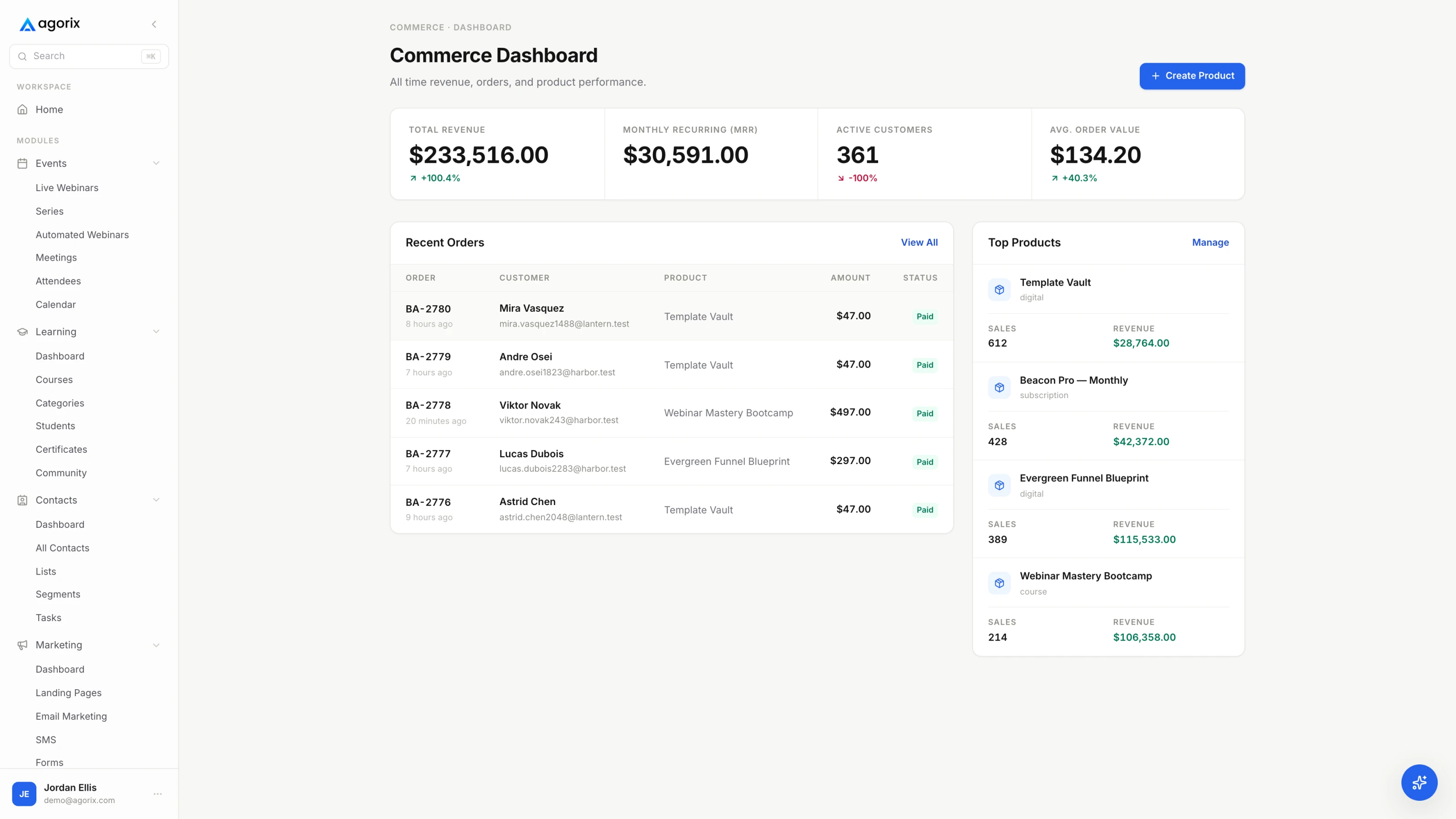
A commerce dashboard showing revenue, monthly recurring revenue, recent paid orders and the products earning them.
Fig. 01The offer behind the link you read out loud. Eight minutes of talking has to agree with what the buyer is charged — same price, same deadline, same words for the offer.
42:00 → 50:00

The offer

8 min07 / 8
JobWhat it is, what happens after, the price out loud, the deadline, the link, and who should not buy.
“[Offer name] is [what it is, in one sentence a stranger could
repeat accurately to somebody else].

Here is what happens after you [buy / apply / book]:

— [What arrives immediately]
— [What happens in the first week]
— [Where you are by [week n], stated as the outcome rather than
  the content]

It is [price, said out loud, including the payment option if
there is one]. [Deadline: the date, the time, the timezone, and
what changes when it passes.]

The link is [URL] — I am putting it in the chat now, and it is
in the email that goes out when we finish.

Who this is for: [the specific situation].
Who it is not for: [the situation where this genuinely is not
the right move. Name one, and mean it.]

[If there is a guarantee, a refund policy or a payment plan:
state it exactly as it is written, not as it sounds best.]

Questions on any of that in a moment — but first, any questions
on the teaching?”
Why it is this long

Eight minutes in a fixed order, because the order is what makes it followable: what it is, what happens after, price, deadline, link, and who should not buy. The price goes before the link — a link clicked without a price is a click you have to re-earn on the page. The sentence naming who it is not for is what makes every other sentence in the block credible, and it disqualifies people who were never going to buy anyway.

If you are long

Cut the feature list. Never cut the price, the deadline or the who-it-is-not-for line — those three are the block, and the rest is packaging.

Change it for
  • CoachReplace the purchase with the application or the call, and say what happens on it: how long, what you will cover, and whether there is a pitch at the end of that too.
  • Course creatorSay the deadline exactly as your emails will say it, then hold it. Extending a deadline teaches your list that your deadlines are decorative, and you only get to teach that once.
  • SaaS demoGive the trial terms in the room: what is required to start, what is not charged, and when the first charge happens. Every unanswered billing question becomes a support ticket or a lost signup.
50:00 → 60:00

The questions

10 min, and it overruns08 / 8
JobAnswer from the queue, in public, until the questions genuinely stop.
“Right — questions. I will stay until they stop.

[Start from the queue, not from the newest chat message. Read
the question out loud with the name: “[Name] asks [question].”]

[Answer in under ninety seconds. If it needs longer, it is a
call or a follow-up email — say which, and say it to the room.]

[When an objection arrives, answer it as an objection, in
public: “The honest answer is [x]. If [situation], this is not
the right thing for you to buy today.” The room is deciding
alongside the person who asked.]

[Every four or five answers, once: “The link is [URL], and the
deadline is [date, time, timezone].” Not after every answer.]

[When they slow down:] “Last call for questions — anything at
all, including the ones you think are too basic.”

[To close:] “That is everything. [What happens next: the email,
the replay, the deadline.] Thank you for the hour.”
Why it is this long

The last ten minutes hold the people closest to buying, which is why this block is planned rather than left over. Starting from the queue matters: you chose that question because most of the room is thinking it. Reading questions aloud with the asker’s name matters more — the people not typing are deciding whether their question is stupid, and hearing somebody else’s answered is what settles it.
If you are long

This is the block that runs long, and it should. If you have a hard stop, say so in the open rather than discovering it at fifty-eight minutes. The only thing to cut here is your own answer length.

Change it for
  • CoachEvery question that needs your eyes on their situation is the offer, demonstrated. Say “that is exactly what the call is for” once, not five times.
  • Course creatorThe most common question is whether they will finish it. Answer with the structure and the support, not with more curriculum.
  • SaaS demoMigration, integrations and team buy-in. Have the honest answer ready, including the cases where the answer is no.
Where a tool decision changes the plan

The script ends at sixty minutes. The click it produces has to go somewhere.

Reading a link out loud is easy anywhere. Knowing which attendee clicked it, whether they bought, and what they asked in the questions block usually means reconciling a webinar export, a checkout report and a chat log. In Agorix the in-event offer, the checkout and the attendee’s behaviour sit on one customer record — see how live webinars work.

Start your 14-day trial 14 days · $0 due today · Payment method required · Cancel before first charge and pay nothing
The slide map

Script first, slides second, and never the other way round.

A deck built before the script becomes the script, which is how sessions end up reading their own bullets aloud. Write the blocks, then build the smallest deck that supports them.

BlockSlidesWhat is on screen
The room before the start01Title, start time, and one line telling people what to do while they wait. It is on screen longer than any other slide in the deck.
The open03–04The promise in the registration page’s words, the three things, housekeeping and replay policy, the first poll.
Teach block one04–06One idea per slide: the common approach, where it breaks, the mechanism, the usable step. The step slide stays up while you talk through it.
Teach block two04–06The mistake named, the worked example with your assumptions visible on the slide, the corrected sequence, the poll callback.
Teach block three03–05How the first two fit together, how far this gets you, and the limit. The last teaching slide is the gap, with no product on it.
The transition01One line, or nothing at all. No logo, no price, no bullets. This is the block where the room should be looking at you.
The offer04–06What it is, what happens after you buy (three rows, not fifteen), price and payment options, deadline with the timezone, and the link in text large enough to read on a phone.
The questions01One slide that stays up for the whole block: the link, the deadline, and where to put questions.

That is twenty-one to thirty slides for the hour, which is an output rather than a target. The number that matters is how long each slide is on screen: anything under thirty seconds is a slide you are clicking past, and anything over four minutes is a slide the room stopped reading three minutes ago.

Two rules survive every deck review. One idea per slide, and no slide you have to read aloud for it to make sense — if the sentence is the content, say the sentence and put the diagram up instead.

Mechanics

Seven things that decide whether the script survives the room.

The blocks are the visible part. These are the habits around them, and a good script delivered without them performs worse than a rough one delivered with them.

  1. Write it to be spoken. Read every block out loud once before the session. Sentences that need punctuation to parse do not survive being said, and you will find all of them in about fifteen minutes — which is far less time than recovering from one of them live.
  2. Word for word in three places only. The open, the transition and the price. Everything else is bullets you speak from. A script you read makes you sound like someone reading, and a room can hear that inside the first minute.
  3. Timings in your notes, never on the screen. Put the clock time beside each block in the speaker notes and check it at the boundaries. A countdown on screen announces that you are behind before you have decided what to do about it.
  4. Three ideas, and only three. When you have four, the fourth becomes the follow-up email or the next session. A fourth idea does not add value to the hour; it takes eleven minutes away from the three that were working.
  5. Pre-load the question queue. The confirmation email invites replies and the registration form can ask what people want covered. Both hand you real questions to open the Q&A block with, so it starts with a question the room recognises rather than a silence.
  6. Somebody watches the clock. You, with a timer beside the notes, or a moderator briefed to message you at ten minutes and two minutes before the transition. Sessions do not run long at the offer — they run long at teach two, and pay for it at the offer.
  7. Record it, and mark the block timestamps as you go. Note the minute each block starts. The no-show email tells people where to start watching, and that single line is most of the difference between a replay watched and a replay archived.
When the hour is forty-five minutes

Cut an idea, not the ending.

The instinct is to compress everything by a quarter, which produces a rushed version of the same session. Dropping the third idea produces a complete shorter one — and the third idea becomes the follow-up email, which people read.

  1. Open (4 min). Same block, one-sentence introduction. Keep the offer announcement and add the hard stop: “I finish at [time].”
  2. Two teach blocks (22 min). The two ideas that make the offer make sense. Keep the checkpoint at the end of each.
  3. Transition (2 min). Unchanged. It is two minutes at any length of session.
  4. Offer (8 min). Unchanged. This is not the block that absorbs a shorter session.
  5. Questions (9 min). Shorter, and announced as shorter. Park the long ones as replies rather than rushing three answers.
Common questions

Six questions about writing the script.

How long should a webinar script be?

Long enough to fill your arc at your own speaking pace, which is the only pace that matters — read it out loud against a timer rather than counting words. Most of a working script is bullets you speak from, and only three passages are written out in full. The arc itself is the fixed part: five minutes to open, thirty-five to forty teaching, two for the transition, eight to ten for the offer, ten for questions.

Should I write a webinar script word for word or work from bullets?

Both, in fixed places. Word for word: the open, the transition sentence, and the price and deadline. Bullets for everything else. Those three passages are where people change voice, hedge, or improvise a promise they did not mean to make — and all three together are short enough to rehearse out loud in ten minutes.

What do I say to move from teaching into the offer?

One honest sentence that names the gap your teaching left and what fills it, said in the same voice as the previous forty minutes and arrived at on the minute you announced at the open. Five variants are written out above — pick the one that is true for your offer rather than the one that sounds strongest. The pillar guide covers where the transition sits in the wider session.

How many slides do I need for a 60-minute webinar?

Roughly twenty-one to thirty for this arc, but treat the count as an output rather than a target. One idea per slide, no slide you have to read aloud to make sense of, one slide for the transition or none at all, and one slide during questions carrying the link and the deadline so the room can act while you are still talking.

What if I run out of time before I get to the offer?

Cut teaching, never the offer or the transition, and say out loud that you are doing it — leave the third idea for the follow-up email, then actually send it. Sessions run long at the second teach block rather than at the end, so the clock check that matters is the one at forty minutes. The email sequence templates cover the follow-up that idea three ends up in.

Can I reuse a live webinar script for an automated webinar?

Yes, with two edits made before you record. Remove everything that dates the session — today, this Tuesday, the reference to what somebody just typed in chat — and give every live interaction a replacement mechanism or take it out entirely. Write and run the live version first: turning a live webinar into an evergreen one works because the live room already told you which parts were working.

Keep going

What surrounds the sixty minutes.

From a script to a session that runs itself

You have the hour. Agorix is the room it runs in.

Registration and reminders, a browser-based room with chat, polls and questions, the offer presented at minute forty-two, and the follow-up that already knows who clicked it — on one customer record, so Tuesday’s email does not start with an export.

14 days · $0 due today · Payment method required · Cancel before first charge and pay nothing