Skip to content
Agorix
Updated 29 July 2026

Welcome email sequence: the first five, written out.

Deliver, orient, teach, explain yourself, ask once — the five emails a new subscriber should get in their first week, complete with subject lines and ready to copy. Each one says why it is sent when it is sent, and what to change for a coach, a course creator or a digital-product seller. Works in any email tool.

5templates
03audience variants
09min read

What you are taking away

  • Five complete emails with subject lines, ready to paste into any tool
  • The reason each one is sent when it is sent, so you can compress the cadence safely
  • What to change for a coach, a course creator or a digital-product seller
  • The line between a welcome sequence and a launch sequence, drawn plainly
  • A first ask that is small enough to be real, in three shapes
  • The handoff into your regular cadence, so nobody sits in “welcome” forever
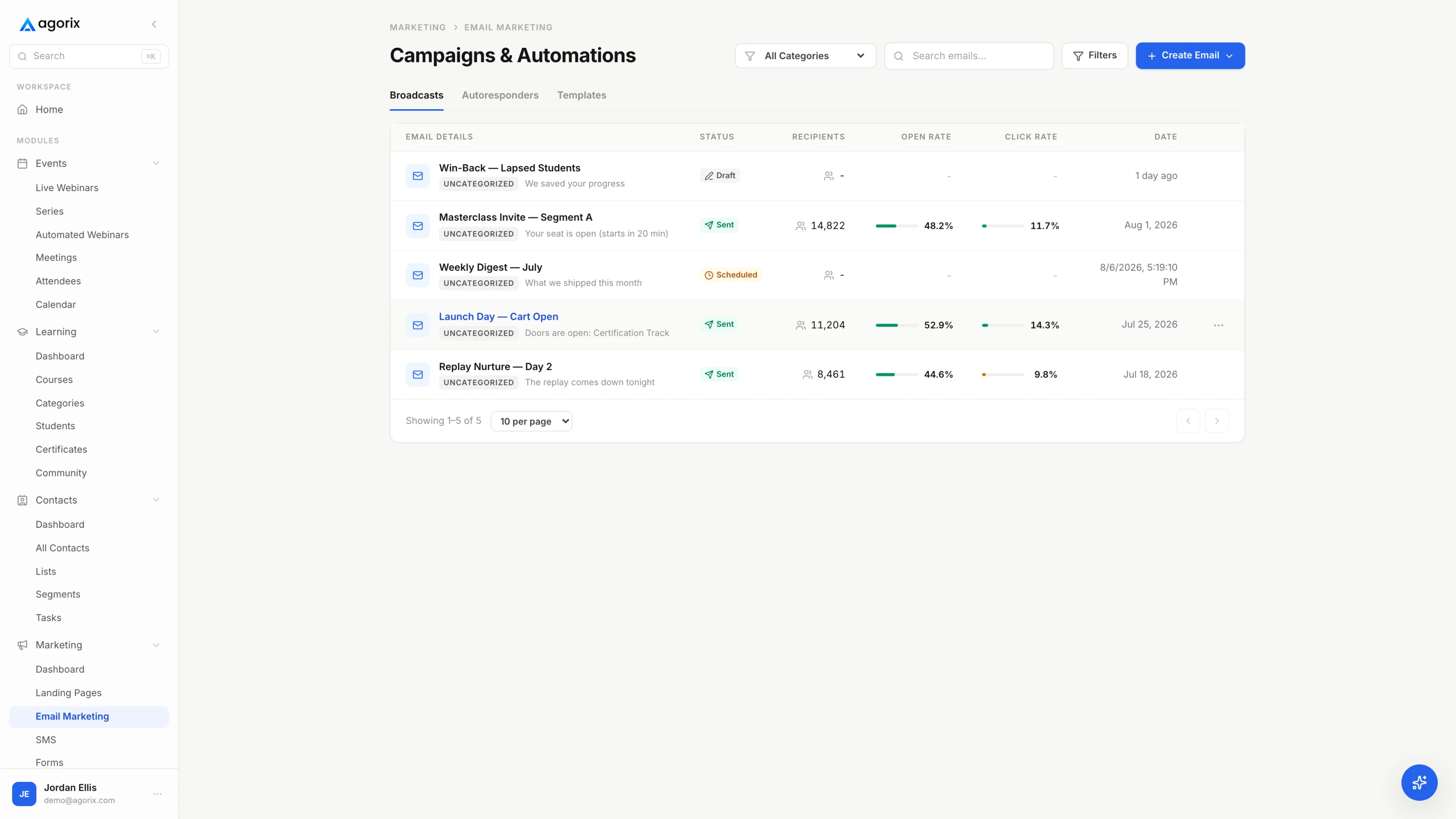
An email sequence listed alongside the audience it sends to.
Before you paste anything

Two jobs, done in seven days.

A welcome sequence has to do two things, and almost every one that fails is doing only the first. It has to hand over what was promised, and it has to establish what happens now — who you are, how often you show up, and what you will eventually ask for.

Job one

Settle the debt

Somebody gave you an address in exchange for a specific thing. Until that thing is delivered you are in arrears, and nothing else you send reads properly. This is the first email and it is the only one with a hard deadline: immediately.

Job two

Set the terms

The other four emails establish the relationship: who is sending, how often, what it is worth, why it exists, and what you will ask for. Get these right and later emails arrive as expected rather than as intrusions.

The brackets are the work

Everything in [brackets] is yours to replace — including the parts that read like instructions, which are written that way on purpose. The story email in particular is a scaffold rather than a draft: a borrowed origin story is the one thing in this sequence a reader can smell, and it costs more than sending nothing.

Swap the brackets for your tool’s merge fields where a merge field exists. Field names differ by platform, so these are written in plain brackets rather than any one product’s syntax. The copy button gives you the subject, the alternate subject and the body as plain text.

The whole sequence

Day counters, not calendar dates — the clock starts when somebody subscribes. Spacing is a starting cadence to adjust against your own list, not a benchmark to hit. If you send more often than this normally, compress it; the frequency guide covers how to choose a rhythm you can hold.

WhenEmail
ImmediatelyDeliver the thingThe link they came for, and nothing else asked of them.
Day 1Who you are and what happens nowThe cadence promise. The email that prevents the later unsubscribe.
Day 3One small complete winProof that reading you pays. Finishable today.
Day 5Why this existsYour reasons, so the next ask is predictable rather than sudden.
Day 7The first askOne request, the smallest real one. Then the sequence ends.
Day 10 →Regular cadence beginsThey join the normal list at the next scheduled send.

Five templates, plain text, no merge syntax. Copy them one at a time, or take the whole sequence as a single block and cut it down in your editor.

A boundary worth drawing

A welcome sequence is not a launch sequence.

The most common failure here is not a bad email. It is the right emails doing the wrong job — five days of countdowns and closing dates aimed at somebody who met you on Tuesday.

A launch sequence is a legitimate thing. Deadlines, bonuses and a cart that closes all work — on a list that already knows who you are and has some reason to want what you are selling. A new subscriber has neither yet, so the deadline that feels urgent to you reads as arbitrary to them, and the only thing it accelerates is the unsubscribe.

A welcome sequence

  • Delivers what was promised, in the first minute
  • Says who you are and how often you will show up
  • Proves the emails are worth opening, with one finishable thing
  • Explains your reasons before it asks for anything
  • Makes one small ask, then stops
  • Ends on a date and hands the person to your regular cadence

Belongs somewhere else

  • A launch: countdowns and closing dates for something they met four days ago
  • A product tour split into five parts
  • Five emails of credentials before a single useful thing
  • An indefinite “nurture” track with no end and no handoff
  • The place to run scarcity — a deadline nobody was waiting for is just noise
  • The buyer onboarding sequence, which is a different sequence for a different person
The exception, stated precisely

A dated invitation is not a countdown.

The day-7 ask can point at something with a real date on it — a live session next week, a workshop, an application window that genuinely closes. That is fine, because the date exists whether or not they subscribed. What does not belong is a deadline manufactured for their arrival: a discount that expires because they joined the list, a bonus that vanishes at midnight on their fifth day. The first kind is information. The second is a trick, and it is the sort people remember.

Immediately → Day 1ArrivalBlock 01 / 03

The two emails that decide whether the other three get opened.

The first delivers what was promised, in the first minute, and asks for nothing. The second tells the subscriber who you are and how often you intend to appear. Together they convert a form submission into a relationship with terms.

The cadence promise in the second email is the highest-leverage sentence in the whole sequence and the one most often left out. Somebody who knows an email is coming on Thursday does not experience Thursday as an intrusion. Promise the frequency you will keep in a bad month, not the one you would like to keep in a good one.

Immediately

Deliver the thing

01 / 5
SubjectYour [lead magnet name] — here it is
Alt[Lead magnet name], as promised
[First name] —

Here is [the lead magnet name]: [link]

[One or two sentences on how to use it. Not what it contains — what to
do with it first. “Open the second tab and fill in the three yellow
cells” beats “this spreadsheet has four tabs.”]

If the link does not work, reply to this email and I will send it
straight to you.

[Your name]

P.S. I will send you a short note tomorrow about what else to expect
from me. Nothing to do before then.
Why it is sent then

Send it the second the form is submitted, or the second a double opt-in is confirmed — the address was given in exchange for a specific thing, and every hour between the promise and the delivery is spent turning an interested person back into a stranger. This email asks for nothing. It carries one link, and that link is the thing they came for.

Change it for
  • CoachIf the magnet is a diagnostic or an assessment, say what to do with the result — the score is not the value, the next move is.
  • Course creatorIf the magnet is a free lesson, name the time it takes. “Eleven minutes” removes the reason to save it for later and never return.
  • Digital-product sellerIf the magnet is a template, file or preset, include the one setup step people always miss. That is your support queue, answered before it forms.
Day 1

Who you are and what happens now

02 / 5
SubjectWhat to expect from me
AltQuick note on what happens next
[First name] —

Yesterday you grabbed [the lead magnet name]. Here is the rest of the
picture, so nothing that arrives from me is a surprise.

Who this is:
[Two or three sentences. What you do, who you do it for, and the one
thing you are known for. Say only what is true — this email is read by
people deciding whether to keep reading you, and a claim you cannot
back is worse than no claim.]

What you will get:
— [Topic one]
— [Topic two]
— [Topic three]

How often: [the number, stated plainly — “about once a week, usually
Thursday.” Say what you will actually do, not what you hope to do.]

What I will not do: [the promises you can keep — no selling every
email, no passing your address on, no daily sending.]

If that is not what you signed up for, [unsubscribe link] is at the
bottom of every email and I would rather you use it than mute me.

Next from me: [what the day-3 email is about], on [day].

[Your name]
Why it is sent then

The cadence promise is the whole point of this email, and it is the one people skip. A subscriber who knows an email is coming on Thursday does not read Thursday as an intrusion. Make the promise small enough that you will keep it in a bad month — the frequency you can sustain beats the frequency you would like to sustain.

Change it for
  • CoachSay whether you send anything about working together, and roughly how often. Being direct about it now buys you the right to make the ask later.
  • Course creatorDistinguish free emails from student emails. If they enrol later, the mail they receive changes, and saying so prevents the “why am I getting both” reply.
  • Digital-product sellerIf you run sales, say so here — “a few times a year I run a sale, and you will hear about it.” The people who leave over that line were going to complain about it later.
Day 3 → Day 5Earning the next openBlock 02 / 03

One thing that works, then the reason any of it exists.

These two emails answer the questions a new subscriber is quietly asking: is reading this worth the time, and is the person behind it worth trusting. The order matters — proof first, then reasons. A story from somebody who has already been useful lands differently.

The teaching email has one requirement: complete. Something finishable this afternoon, with an observable result, beats a tour of everything you know. A finished thing is evidence; a survey is another promise, and they already have one of those outstanding.

A signup form connected to the sequence it starts.
Fig. 01The trigger is the form, not a weekly export. Whatever you build it in, the delivery email has to fire on submission — it is the one email in the set that cannot afford to be late.
Day 3

One small complete win

03 / 5
Subject[The specific fix], in about ten minutes
AltTry this before [the next thing you do]
[First name] —

Something small you can finish today.

The problem: [name it in the words your audience uses, in one
sentence].

Do this:

1. [Step one — concrete enough to follow without you]
2. [Step two]
3. [Step three]

You will know it worked when [the observable result. If you cannot name
one, the win is not complete and this email is not ready].

That is one piece of [the larger thing]. [One sentence on where it
sits: what comes before it, what it makes possible.]

If you try it and something does not fit your situation, reply and tell
me what happened. I read these.

[Your name]
Why it is sent then

This is the email that earns the fourth open. The subscriber has taken something from you and heard your plan; now they need evidence that reading you pays. Complete matters more than impressive — one thing they can finish this afternoon beats a survey of everything you know, because a finished thing is proof and a survey is a promise.

Change it for
  • CoachA four-question diagnostic and what each answer means beats a how-to. It makes the problem specific to them, which is what a coaching relationship is.
  • Course creatorSend the shortest complete lesson you have — the actual thing, not a preview of it. Giving away one complete idea is what proves there are thirty more.
  • Digital-product sellerShow the smallest useful thing your product does, done by hand. Doing it by hand once is the argument for buying the thing that does it for you.
Day 5

Why this exists

04 / 5
SubjectWhy I built [the thing]
AltThe reason any of this exists
[First name] —

A short one, and then back to useful things.

[The situation. Two to four sentences on when this problem was yours —
what you were doing, what was not working, what it cost you. Real
details only. If the honest version is “I did this job for six years
and kept watching the same thing go wrong,” write that. A borrowed
origin story is the one thing in this sequence a reader can smell.]

[What changed. Two or three sentences on what you tried, what actually
worked, and what you were wrong about. The part you were wrong about is
the part people believe.]

[Why it is a business now. One or two sentences: who you built it for
and what you want it to do for them. No mission statement — a plain
sentence.]

That is the whole reason [the lead magnet, the emails, the product]
exists. Everything I send you comes from that.

[Your name]

P.S. If you are in [the situation described above] right now, reply and
tell me where you are stuck. It is the most useful email you can send
me and I answer them.
Why it is sent then

People buy from someone whose reasons they can predict, and this is the email that supplies them. It is placed fifth rather than first because a story from a stranger is a demand for attention, while a story from someone who has already delivered something and taught you something is context. Every line is a placeholder for a reason: a manufactured founder story is the fastest way to lose a list that was going well.

Change it for
  • CoachEnd on who you work with now and who you do not. Disqualifying people plainly is the strongest trust signal available to you in email.
  • Course creatorName the mistake you made that the curriculum now prevents. That is the sentence people quote back to you when they enrol.
  • Digital-product sellerSay what you built it for yourself first, if that is true. If it is not true, do not say it — write the honest version, which is usually that a customer asked for it.
Day 7The first askBlock 03 / 03

One ask, and it should be the small one.

Seven days in you have delivered something, set expectations, taught one thing and explained yourself. That is enough to have earned a single request. One is the number: asking in every email trains people to skim, and never asking trains them to expect nothing, which takes longer to undo.

The mistake is asking for the biggest thing you would accept rather than the smallest real step. Three shapes cover almost every business, and the right one is decided by what you sell and how much explaining it needs.

Three shapes the first ask can take

Pick one. Not two.

Whichever you choose, the email carries one link and one action. An ask with three options is a decision the reader has to make before they can act, and most of them will make it by closing the email.

  1. A live session. Free, dated and low-commitment, and the only one of the three that creates a second appointment with you. Best when what you sell needs explaining before it can be wanted.
  2. A reply. The cheapest ask and the most underrated: one question, answered in the inbox. It produces segmentation you could not buy, and it is the only ask that works when you have nothing to sell yet.
  3. A small paid thing. A low-price product or a paid workshop. The first transaction changes the relationship more than the amount does, so the point is the decision, not the revenue.
Day 7

The first ask

05 / 5
Subject[The next step], if you want it
AltOne thing, then back to normal
[First name] —

Over the last week you got [the magnet], a way to [the small win], and
the reason I do this. Here is the one thing I would like you to do
next, and it is the only ask in this sequence.

[The ask, in one or two sentences. One only. Name it plainly and say
what it costs in time or money — “45 minutes, free,” “a reply,” “[the
price] and about an hour.”]

[Link]

Why this one: [one or two sentences on who it fits and what they get.
If it is not for everyone, say who it is not for. The people that
disqualifies were not going to act, and the people it does not will
trust the next ask more.]

If now is not the time, nothing happens — you stay on the list and the
regular emails start [when they start].

[Your name]
Why it is sent then

Seven days in you have delivered, oriented, taught and explained yourself. That is enough to have earned one request, and one is the number: a sequence that asks in every email trains people to skim, and a sequence that never asks trains them to expect nothing, which is worse. Whatever you choose, it has to be the smallest real step, not the biggest one you would accept.

Change it for
  • CoachThe ask is a conversation, not a purchase — a call, an application, or a reply. High-ticket does not close from a seventh-day email and asking it to is how good leads get burned.
  • Course creatorA live session is the natural ask: it is free, it is dated, and it is where the course is actually sold. The enrolment ask belongs in that room, not in this email.
  • Digital-product sellerA small paid product is the strongest ask you have — the first transaction changes the relationship more than the amount suggests. Keep the price low enough that it is a decision, not a project.
Where a tool decision changes the plan

The sequence has to start on the form and stop on the action.

Both ends are the same problem: the emails need to know what the person did. On a stitched stack the form lives in one place, the sequence in another, and the registration or purchase that should end it in a third. In Agorix the form, the audience, the sequence and the purchase sit on one customer record, so the day-7 ask can reference what they downloaded and the sequence can stop the moment they act — see how marketing works.

Start your 14-day trial 14 days · $0 due today · Payment method required · Cancel before first charge and pay nothing
Day 10 →The handoff

The sequence has to end somewhere specific.

A welcome sequence with no defined ending turns into an indefinite nurture track, and the person who subscribed in March is still being treated as new in September. Decide the join point before you build it.

  1. Name the join date. They receive their first regular send at the next scheduled one after day 7 — day 10 in the table above, or whenever your normal rhythm next comes round. A specific point, not “eventually.”
  2. Do not double up. Hold broadcasts while the sequence runs, or accept that the frequency you promised on day one was approximate. Getting the day-5 story email and the Thursday newsletter in the same afternoon is how a promise breaks in week one.
  3. Take them out of the welcome audience. The audience should empty as people finish. If it only ever grows, every report you run counts eight months of subscribers as new and you cannot tell whether the sequence works.
  4. Anyone who acted exits early. Registration, reply or purchase moves them into the path that action belongs to. The remaining welcome emails stop — including the ask they already took.
  5. Tag the ones who opened nothing. Five emails with no open, no click and no reply is your first real signal, and the only one you get this cheaply. That tag is what a win-back campaign runs on later.
  6. Review the sequence, not just the list. Read all five again once a quarter with fresh eyes. Links rot, the lead magnet gets replaced, the ask points at a session you stopped running — and nobody notices, because the people receiving it are new every week.

The handoff is also the moment to be honest about what happens to people who never engage. They are not a failure of the sequence and they do not need to be chased yet — but they should be identifiable, so that in six months a re-engagement campaign has a real segment to run against rather than a guess.

Mechanics

Eight settings that decide whether any of this lands.

The copy is the visible part. These are the settings around it, and a welcome sequence with good copy and wrong mechanics performs worse than the reverse — because the mechanics are what make it arrive at all.

  1. It starts on the form, not on the import. The trigger is the subscribe action itself. A sequence you start by hand or by weekly export gets the delivery email wrong on day one, which is the only email in the set that cannot afford to be late.
  2. From a person, replied to by a person. Two of these five invite a reply and both will get them. A no-reply address on the orientation and the teaching email throws away the first conversations a new subscriber was willing to have.
  3. Day counters, not calendar dates. The clock starts when they subscribe, so somebody joining on a Saturday gets the same spacing as somebody joining on a Tuesday. Do not batch a welcome sequence into a weekly send slot.
  4. Suppress them from broadcasts while it runs. A new subscriber receiving the welcome sequence and the Thursday newsletter in the same week gets twice what you promised in the orientation email. Hold broadcasts until the sequence ends, or accept that the promise was approximate and say so.
  5. Buyers do not get this sequence. Somebody who bought before they subscribed does not need to be told who you are, and an ask for a small first step reads as an insult to a customer. Send them the onboarding sequence and skip this one.
  6. One link per email. Every email above has a single action. Adding the podcast, the archive and the socials to the delivery email does not add clicks, it divides them and pushes the one link that mattered below the fold.
  7. Keep the unsubscribe link visible. A welcome sequence is the moment somebody decides whether to keep you. Making leaving hard converts an unsubscribe into a complaint, and complaints follow your sending domain around for a long time.
  8. Subscribe to yourself and read all five. A personal address, a phone screen, every link clicked. Fifteen minutes, and it is the only reliable way to find the merge field that renders as a blank and the day-3 email that never scheduled.
When you are starting from nothing

If you can only build two, build these.

Five is the shape, not a quota. Two emails running correctly beat five drafted and never scheduled, and these two carry the load.

  1. The delivery email, firing on submit. It settles what you owe. Late delivery is the single most expensive mistake available here and it happens on day one.
  2. The orientation email, the next day. The cadence promise prevents most of the unsubscribes that arrive weeks later from people who no longer remember signing up.
Common questions

Six questions about the welcome sequence.

How many emails should a welcome sequence have?

Five covers the jobs that have to be done: deliver what was promised, orient the subscriber, teach one complete thing, explain why you do this, and make one small ask. Five is the shape, not a quota — if you only have time for two, send the delivery email immediately and the orientation email the next day. Those two prevent most of the damage a missing welcome sequence causes.

How soon should the first welcome email be sent?

Immediately on subscribe, or immediately on the double opt-in confirmation click. The address was given in exchange for a specific thing, and every hour between the promise and the delivery converts an interested person back into a stranger. Nothing else in the sequence is time-critical in the same way, which is why the trigger has to be the form submission rather than anything you do by hand.

Should a welcome sequence sell?

It should ask once, at the end, for the smallest real next step. A sequence that asks in every email trains people to skim; a sequence that never asks trains them to expect nothing from you, which is harder to undo later. If you are not sure what the ask should be, a reply is a legitimate answer — and it produces the segments the segmentation guide would otherwise have you build from scratch.

Is a welcome sequence the same as a launch sequence?

No, and treating them as the same thing is the most common way this goes wrong. A welcome sequence orients a new subscriber and ends by handing them to your regular cadence. A launch sequence runs a dated offer to a list that already knows you. Countdowns and closing dates aimed at somebody who met you four days ago produce unsubscribes rather than sales, because the deadline is real to you and arbitrary to them.

Should buyers get the welcome sequence?

No. Somebody who bought before they subscribed does not need to be told who you are, and a first ask for a small step reads badly to a customer who has already taken a larger one. Exclude buyers by rule rather than by memory, and send them the onboarding sequence instead — different person, different job.

What happens after the welcome sequence ends?

They join your regular cadence at the next scheduled send — a specific date, not a vague someday. Set the join point deliberately so nobody gets the last welcome email and a broadcast in the same afternoon, and take them out of the welcome audience so they are not treated as new for the rest of the year. What they join is worth designing on its own: the newsletter system and how often to email cover it.

Keep going

What comes before these five, and what comes after.

From five drafts to a sequence that runs itself

You have the emails. Agorix is the system that sends them.

The form that starts it, the audience that empties as people finish, the sequence timed in days rather than dates, and the registration or purchase that ends it — on one customer record, so the ask on day seven already knows what happened on day zero.

14 days · $0 due today · Payment method required · Cancel before first charge and pay nothing