The questions repeat
Several students hit the same wall, the answers are usually short, the cohort is bigger than your calendar, and attendance can be optional without anything breaking. One person’s absence costs nobody an hour.

A structure for the recurring open session: which scheduling model survives your timezone spread, how to collect questions so the hour opens with substance, the queue order and the timebox, what to do the week nobody asks anything, and the loop that turns every repeated question into the lesson you were missing. Written to work with any course platform; where a tool decision genuinely changes the plan, it says so.
Office hours earn their place when students have questions you cannot predict, and when the answers are useful to more than the person who asked. If either half is untrue, something cheaper will do the job better.
The format does two things at once. It converts a queue of individual support requests into a single hour with an audience, which is the obvious saving. And it lets people learn from questions they would never have thought to ask, which is the larger and quieter one — most students do not know what they do not know until somebody with the same problem says it out loud. That second effect disappears entirely the moment you run the session as a lecture.
Several students hit the same wall, the answers are usually short, the cohort is bigger than your calendar, and attendance can be optional without anything breaking. One person’s absence costs nobody an hour.
Money, contracts, personal circumstances, or a review of the student’s own work in front of people they compete with. Also when somebody is stuck badly enough to need sustained attention rather than a good answer in four minutes.
Office hours are demand-led: the room brings the agenda and you serve it. A group coaching call is agenda-led — you decide what is taught, you run a hot seat, and questions arrive around the structure rather than as the structure. If you are teaching a planned thing every week and taking questions at the end, you are running a coaching call and should structure it as one; the group coaching call structure covers that format properly. Running the two formats under one name is the most common reason a session feels flat: the people who came for answers sit through a lesson, and the people who came for a lesson get a queue.
Size changes the format whether you intend it to or not. Somewhere above thirty or forty live participants a queue stops being a conversation and becomes a moderated Q&A, and the room becomes an audience. That is a perfectly good thing to run — it is simply a live session with questions, and how to host a webinar covers the mechanics of holding a room that large.
For a membership rather than a course, the calculation is different again: the standing hour is often the product’s heartbeat, the thing that makes a renewal feel like a decision rather than an oversight. In that case it runs whether or not any given week justifies it, and the sections below on silence and cadence matter more than the ones on scale.
The scheduling decision quietly determines who is able to attend at all. Most courses default to whatever suits the instructor and then treat the resulting absence of one continent as a motivation problem.
Do the count before you pick a model. Pull the actual distribution of your students from the enrolment data — not where you assume they are — and look at the shape. Two clusters and a scattering is a very different problem from an even spread across twelve hours, and only one of them justifies running two sessions.
| Model | How it runs | What it costs you |
|---|---|---|
| Fixed weekly slot | The same day and the same time every week, indefinitely. The strongest habit and the least admin: nobody has to look it up, and it can be printed on the sales page. | Anyone more than a few hours away is excluded permanently rather than occasionally. |
| Rotating times | Two or three times on a fixed cycle — early one week, late the next — so every region reaches a workable slot at a predictable interval. | Every individual session starts smaller, and no one builds a habit around a single slot. Publish the whole cycle in advance or it reads as chaos. |
| Paired sessions | Two sessions in the same week, roughly twelve hours apart, with the same queue and the same prepared teach. One cohort, two doors. | Twice the delivery time for the same students, which only pays back at real scale or real price. |
| One slot plus a written channel | A single live hour for the people it suits, and a permanent written thread where anyone can ask and everyone can read the answer. | The thread is real work and needs answering on a schedule of its own, or it becomes a graveyard of unanswered questions in public. |
| Split by cohort stage | Separate sessions for people in their first weeks and for people finishing, because the questions barely overlap. | Only works once each room can be filled on its own. Below that it produces two thin sessions instead of one solid one. |
Whichever model you pick, the most valuable property of a recurring session is that nobody has to look it up. Keep the day of the week constant even when a rotation moves the hour. Keep the same join link forever. Keep the length the same, so people can decide in advance whether they can make the whole thing. Publish the next several dates rather than the next one — a rotation that is visible for two months reads as a system, and the same rotation announced weekly reads as improvisation.
Weekly while a cohort is actively working, because questions have a deadline attached and a fortnight is long enough for somebody to give up. Fortnightly for self-paced or evergreen students, where questions arrive at random and there is no shared clock. Monthly for a low-touch membership. Forty-five to sixty minutes in every case, and the ability to end early is part of the design rather than a failure of it.
Timezone hygiene is not optional and takes almost no effort: publish every time in the student’s own timezone rather than yours, write the timezone out in every reminder, and let the calendar entry do the arithmetic instead of a paragraph explaining offsets. Half the people who miss a rotating session did the conversion themselves and got it wrong.
The difference between a session that feels essential and one that feels like an obligation is almost entirely whether it opens with a real question at minute two or a silence at minute six. That is decided before anyone joins.
Open a permanent intake — a form, a thread, a channel, whatever your students already use. Permanent matters more than the format: questions occur while people are working at eleven on a Tuesday night, not while they are remembering that a session is coming. An intake that only opens forty-eight hours before the call collects the questions people can still remember, which are not the same as the questions that stopped them.
The question itself, the lesson or step it relates to, and what they have already tried. The third field does most of the work: it converts a vague question into an answerable one, it tells you whether the problem is comprehension or execution, and a surprising number of people answer their own question while typing it. The second field is what makes the curriculum loop later on possible at all — without it you have a pile of questions and no way to tell which lesson is failing.
Close the queue for the session at a stated time, a day or two ahead, so you can prepare — but never close the intake. Anything arriving after the cut-off goes to the next session or gets a written answer, and both are fine as long as the person is told which one is happening.
Reading questions for the first time while thirty people watch you scroll is the single most avoidable way to waste the first ten minutes. Group the duplicates, order them (the next section covers how), and pick one question that deserves five minutes of structure. That one becomes the prepared teach that opens the hour — and it is also your insurance for a week when nobody speaks.
Name the people who asked, where they are comfortable with it. Seeing a question attributed and answered properly is the most effective recruitment there is for next week’s intake, and it costs nothing.
An hour with no shape is one long answer to the loudest person. The structure below is not ceremony — it exists so that the quiet student who submitted a question on Sunday gets served before the confident one who thought of something at minute four.
| When | What happens | Mode |
|---|---|---|
| 0–2 min | Open on time and say the finish time out loud. Name what is already in the queue so the room knows the hour has substance in it before anyone has to be brave. | Open |
| 2–8 min | The prepared teach: the one submitted question that deserves five minutes of structure. It covers the arrival minutes and gives latecomers something to walk into. | Teach |
| 8–40 min | The queue, in order. Duplicates answered once, out loud, naming everyone who asked so people can see that asking works. | Queue |
| 40–52 min | Open floor. Whatever the room brings — including the questions the first forty minutes made people willing to ask. | Floor |
| 52–58 min | The parking lot: what was not answered, who asked it, and exactly where the answer will appear. Then close, even if it is early. | Close |
| Same day | Recording filed against the lessons it touches, questions logged, absent askers sent the timestamp rather than the whole hour. | After |
Say the finish time in the first minute, and say roughly how long each question gets. Then use the same phrase every week when you need to move on — “let me park that and come back to it if we have time” — because a phrase people have heard before is a norm, while the same sentence used once, on one person, is a rebuke. The parking lot is what makes the timebox humane: nothing is being refused, it is being scheduled.
When a question turns out to be much bigger than the format, name that out loud and convert it rather than fighting it. Some questions are a lesson, some are a one-to-one, and one or two are the reason your next module exists. Saying so is a better answer than twenty rushed minutes.
Never cancel for a thin queue — cancelling teaches the room that the session is optional for you as well, and a habit is far harder to restart than to keep. Arrive with three things in reserve: the prepared teach from the intake, the question you are asked most often by email, and a walkthrough of a student’s work you have permission to show. Then change the prompt, because “any questions?” manufactures the silence it is asking about. “What did you get stuck on this week, even if you solved it?” almost always produces something — and what it produces is usually the most useful material in the hour.
Capturing the session is the easy part and the part with the least value in it. What makes a recording worth the disk space is the ten minutes of filing that happen afterwards, and almost nobody does them.
Decide the recording policy once and state it at the start of every session, before anybody asks something they would rather not have published. Keep an obvious route for private questions — a message, a note in the intake form, or the offer of five minutes after the recording stops. A student who is unsure whether their question will be public usually resolves the doubt by not asking it.
Nobody watches an hour of office hours to find one answer. Publish the recording, then list the questions underneath it with timestamps — that list is what turns an unsearchable hour into something a person will actually open. It takes about as long as it takes to write, because you already have the queue.
Then go one step further, because this is the highest-return habit in the whole format: attach the answer to the lesson it belongs to. A question about the third module is most useful sitting inside the third module, where the next student hits the same wall at the same moment and finds the answer without knowing that an office hour ever happened. Over a few months this quietly rebuilds the course into the version that answers its own questions.
Keep the recent sessions in reverse order and promote the evergreen answers into the lessons. Without that, a year of recordings becomes a library of things that were true two versions ago, and new students trust the course a little less every time they find one. If an answer still matters in six months, it should be a lesson by then rather than a timestamp.
Anyone who submitted a question and could not attend gets the timestamp, not the whole recording. Sending an hour-long video to somebody who asked one question is a technically complete answer and a practical non-answer.
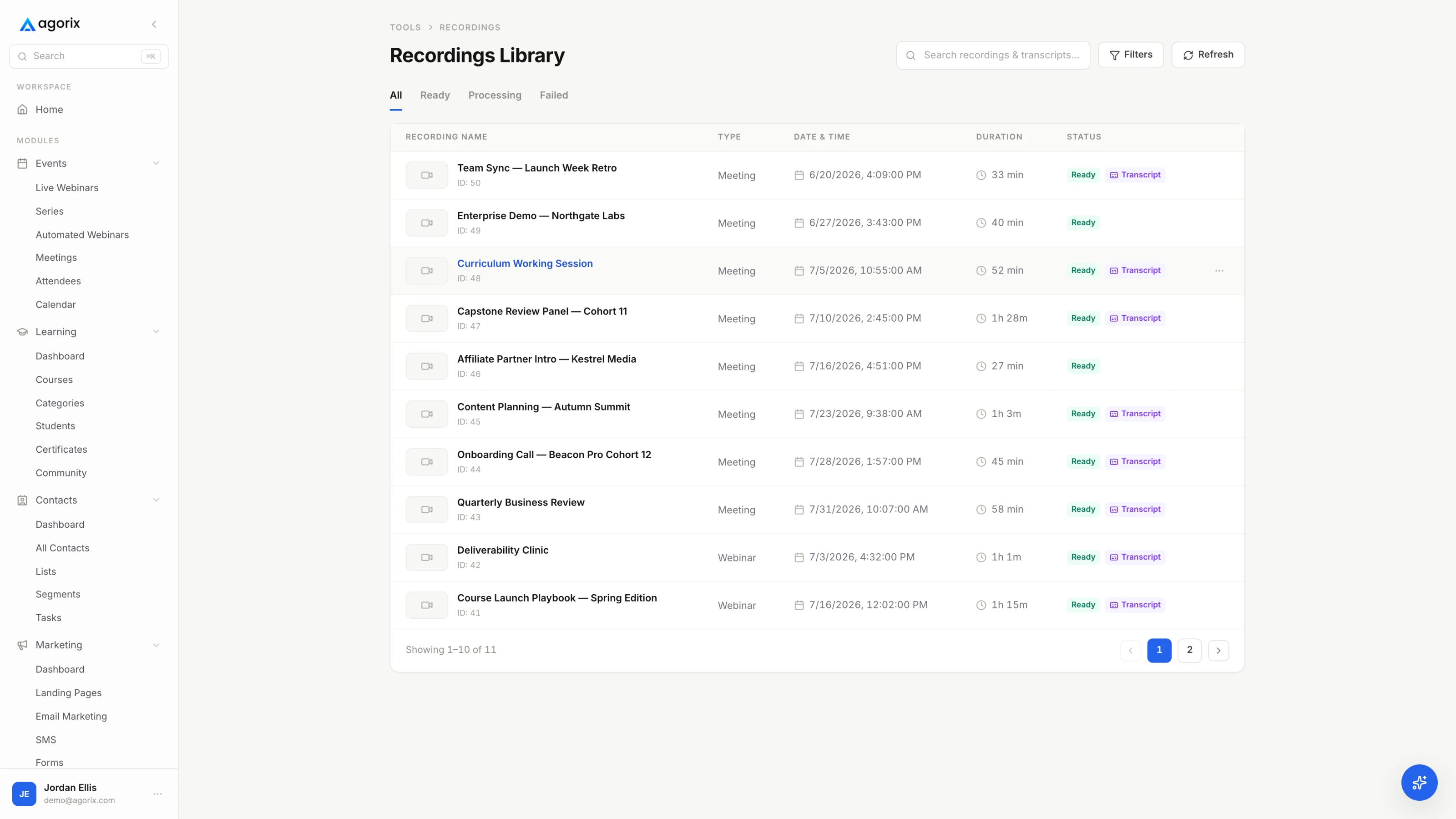
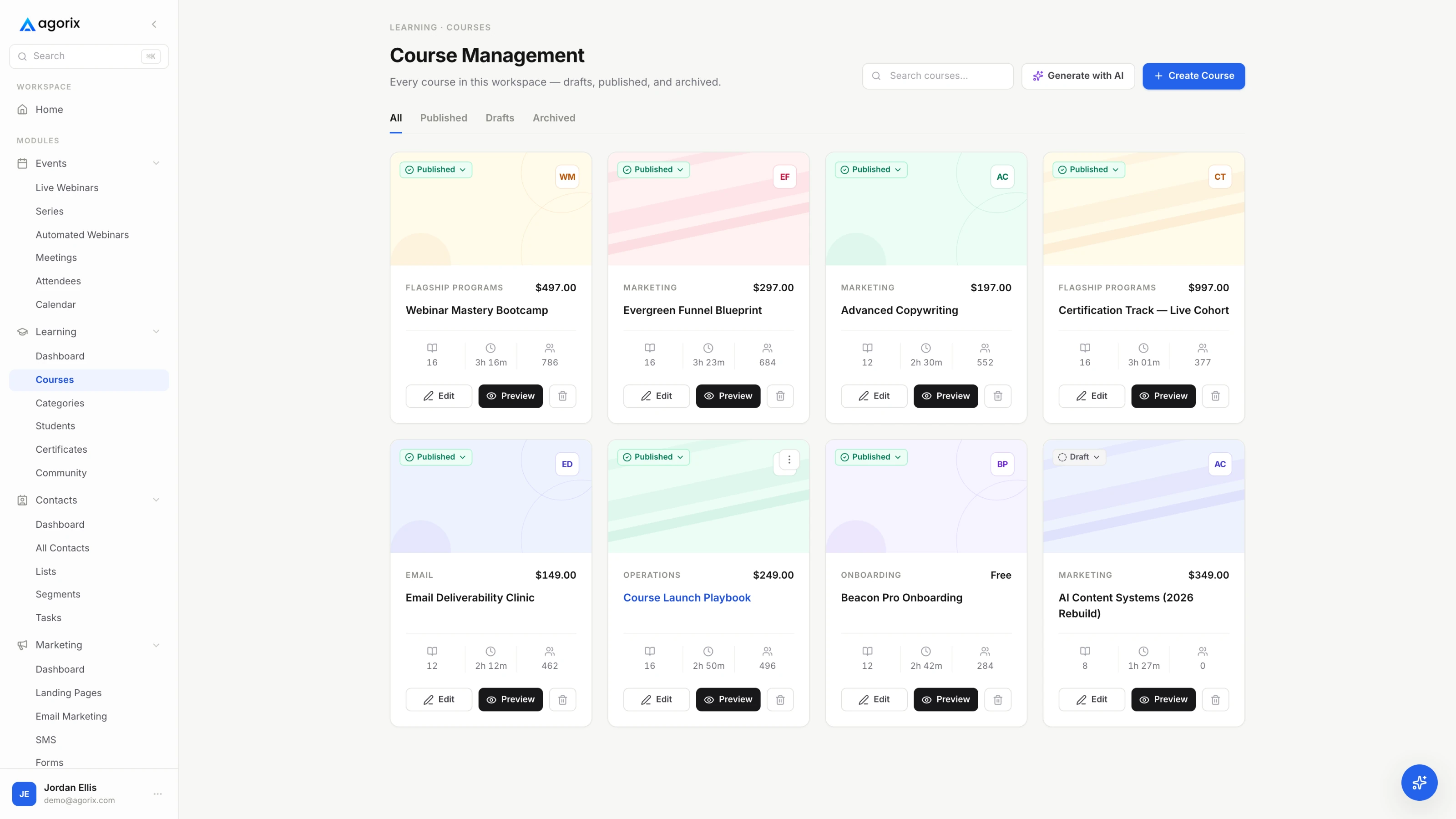
Filing an answer against a lesson works in any stack. Knowing that the person who asked it has been stalled on that same lesson for nine days normally means holding a course platform, a calendar and a CRM in your head at once. In Agorix the course progress, the session attendance and the customer history sit on one record — see how courses work.
The office-hours log is the most honest curriculum feedback you will ever get, because it is produced by people trying to do the work rather than by people reviewing the course. It is also the feedback most creators throw away weekly without noticing.
Keep one running list with three columns: the question, the lesson it relates to, and the date. Nothing more elaborate survives contact with a busy month. Read it in one sitting once a month — in one sitting matters, because the whole value is in seeing the same question three times in a row rather than three times across nine weeks.
When you fix a lesson because of a question, say so in the next session and in the course. “The thing three of you asked about last month is now lesson 4b” is the single strongest argument for bringing your question next week — stronger than any amount of encouragement, because it is evidence rather than a promise. It also tells the cohort that the course is maintained, which is worth more than most things you could add to it.
Over a few months, the recurring-question list stops being feedback and becomes an outline. The questions that arrive after completion are the next programme; the questions that arrive in week one are the prerequisite you keep apologising for; and the questions nobody can answer without a conversation are the thing you should probably be selling as a coaching programme rather than giving away one hour at a time.
Recurring formats fail slowly and quietly. Knowing which decline is normal and which is terminal is what stops you cancelling something that works, or maintaining something that stopped working in March.
Three declines are normal and need no action. Attendance falls after the opening weeks of a cohort, because people get unstuck and stay unstuck. A core of the same six faces every week is not a failure of reach — it is what a standing session looks like. And live attendance sitting far below the number of people who watch the recording is the format working as designed, provided the recording is filed where they can find it.
Which is why attendance is the wrong health metric. Count questions asked and answers watched instead. A session with four people and six good questions is doing its job better than a session with twenty silent attendees, and only one of those two numbers tells you anything about the course.
A fortnightly session people attend beats a weekly one they have learned to ignore, and moving from weekly to fortnightly is a schedule change rather than a broken promise — announce it as one. If the questions have genuinely stopped because the course now answers them, that is the format succeeding: promote the answers into the lessons, keep a written channel open, and run the live hour monthly. Retiring a session for that reason is a very different conversation from letting one fade out, and students can tell the difference immediately.
One last comparison worth keeping in view: this is the only teaching format where an empty chair costs nothing. Nobody has to be chased, nothing has to be rescheduled, and the hour happens either way — which is exactly why it is the right offer for a student who has already missed two booked calls. What to do with those is in the meeting no-show playbook.
Weekly while a cohort is actively working through the material, fortnightly for a self-paced or evergreen course, and monthly for a low-touch membership. Consistency matters far more than frequency. A fortnightly session that has never once moved is worth more than a weekly one that gets cancelled whenever the week fills up, because students only save questions for a slot they believe will be there.
Count where your students actually are, from the enrolment data, before you choose anything. If they cluster in one or two regions, a fixed weekly slot that works for the cluster beats a rotation that dilutes every session. If they are genuinely spread, rotate two or three times on a published cycle or run paired sessions twelve hours apart in the same week. Hold the day constant even when the hour moves, and publish every time in the student’s own timezone — the five models are compared above with what each one costs you.
Never cancel — cancelling teaches the room that the session is optional for you too, and it is much harder to restart a habit than to keep one. Arrive with three things in reserve: the prepared teach from the intake, the question you are asked most often by email, and a walkthrough of a student’s work you have permission to show. Change the prompt as well, because “any questions?” manufactures silence and “what did you get stuck on this week?” does not. Two consecutive silent sessions is a signal about the course or the invitation rather than about shyness.
Usually yes, with the recording notice stated at the start of every session and a private route for anything personal. The recording on its own is worth very little. What makes it useful is the list of questions timestamped underneath it and, better still, the answer attached to the lesson it belongs to, where the next student will hit the same wall. A folder of unlabelled hour-long files is an archive rather than a resource — the filing section covers the ten minutes that make the difference.
Forty-five to sixty minutes, with the finish time announced in the first minute and then honoured. End early when the queue is empty rather than filling the time; ending early is the clearest signal you can send that the hour exists for the questions rather than for the attendance. Put the one genuinely long answer at the end of the session so that overrunning for a single person never holds the rest of the room.
For most support questions, yes — and they do it better, because everybody in the room learns from an answer they would not have known to ask for. Keep one-to-ones for anything confidential, anything that needs a student’s private work on screen, and for a learner who is genuinely stuck and needs sustained attention. Office hours are also the right fallback for somebody who keeps missing scheduled calls: no hour is lost when one person does not arrive, which is the no-show playbook’s recommendation after a second miss.
Course lessons and progress, browser-based sessions with the student’s history beside them, and the follow-up afterwards — on one customer record, so a question asked in office hours can end up filed against the lesson that produced it.
14 days · $0 due today · Payment method required · Cancel before first charge and pay nothing