Bias toward automated marking
Submissions arrive at unpredictable times and at unpredictable volume, so anything requiring your attention has to have a published review window attached or it will be late.

What to assess when recall is not the point, six formats ranked by what they cost against what they tell you, a pass threshold you will actually enforce, and a certificate that says what was earned rather than who paid. Written to work with any course tool; where a tool decision changes the plan, it says so.
Your course made a claim about what somebody would be able to do afterwards. That sentence is the assessment specification. Everything else is a quiz about the videos.
The test is simple: read the outcome you sold, then look at your assessment and ask whether passing it would convince you. If the promise was “you will be able to write a launch plan for your own product” and the assessment is ten multiple-choice questions about launch terminology, the certificate you issue will assert something the assessment never checked. Nobody sues you over that. It simply makes the document worthless, and quietly, over time, it makes the course feel worthless too.
Recall questions are not useless — they are just a different tool. They are good for checking that a definition landed before the next module depends on it, and good for giving the student a low-stakes signal that they were not paying attention. What they cannot do is carry a credential, because the thing they measure is not the thing you promised.
The cheapest moment to design an assessment is while the curriculum outline is still a document. Each module states what the student will be able to do; the assessment is the evidence they can do it. Written in that order, the assessment tells you which lessons are missing before you record any of them. Written afterwards, it becomes a quiz retrofitted to whatever you happened to teach.
One more consideration belongs here rather than at the end: an assessment that only works for people who can type quickly, see a diagram, or sit still for ninety uninterrupted minutes is excluding people for reasons unrelated to competence. Course accessibility basics covers the practical version of that problem.
Read down the table until the cost stops being payable at your price and your numbers. The format immediately above that line is the one to build.
| Format | What the result tells you | What it costs to run |
|---|---|---|
| Recall quiz, auto-marked | Whether the words were recently in front of them. It cannot distinguish understanding from a scroll back through the transcript, and a student who guesses well is indistinguishable from one who knows. | Almost nothing to author and nothing to run. The cheapest thing on this list, and the one most likely to produce a certificate that asserts something untrue. |
| Scenario quiz, auto-marked | Whether they can choose the right move in a described situation. Much closer to competence, because the distractors are the plausible wrong answers real people actually pick. | Still nothing per student, but the authoring is the real work — a good scenario question takes longer to write than a lesson, and the wrong answers matter more than the right one. |
| Self-check exercise with a model answer | Nothing to you, by design. It tells the student where they stand and hands them a worked comparison, which is often the most valuable thing in the module. | Cheap to build, free to run, and honest only if you do not pretend it is an assessment. Nobody submitted anything, so nobody passed anything. |
| Submitted artifact against a published rubric | Whether they can do the thing the course promised. The strongest signal that survives at any scale, because you are looking at their work rather than their answers about the work. | Real minutes per student, and they are your minutes. This is the format that decides whether you can afford the certificate you want to issue. |
| Peer review against the same rubric | A usable second opinion plus a second learning event — assessing somebody else’s attempt against a rubric teaches more than most lessons do. | Coordination, and enough students at the same stage to pair. Quality varies, so it works best as the first pass with your review reserved for the borderline cases. |
| Live walkthrough or defence | The most of anything here, because you can ask the follow-up question. Somebody who cannot explain their own decision reveals it in about ninety seconds. | Does not scale, at all. Reserve it for high-priced programmes, or for the final credential in a programme whose price already includes your attention. |
For most courses the defensible combination is the second row plus the fourth: scenario questions checking judgement along the way, and one submitted artifact at the end marked against a published rubric. The quizzes cost you nothing per student and keep people honest between modules; the single artifact is what the certificate is actually about, and one is enough.
Review in batches on fixed days rather than as submissions arrive, and say so in advance — “work submitted by Friday is returned the following Wednesday” is a promise you can keep, whereas continuous review turns your week into an inbox. Put peer review in front of your own pass so that most work has already been improved once before it reaches you. And write the rubric before the first submission, because a rubric invented while marking is a rubric that will not survive the tenth student.
Submissions arrive at unpredictable times and at unpredictable volume, so anything requiring your attention has to have a published review window attached or it will be late.
Everyone is at the same stage in the same week, which is what makes peer review and live walkthroughs practical. The delivery-model decision changes which formats are even available to you.
Eighty per cent is the number everybody picks and almost nobody defends. The question is not what figure looks right on a page — it is where you would stop being willing to vouch for somebody.
Plenty of good courses should not have a graded assessment at all. A short practical programme, a workshop, an introductory series — for these, marking work you cannot afford to mark properly makes the course worse, not better. Say “certificate of completion”, define completion as something more than pressing play, and stop. It is a stronger position than a graded assessment nobody can fail.
Somebody who fails an assessment in a course they paid for is at the most fragile point of the whole programme. What arrives in the next message decides which way it goes.
The resubmission is not an administrative inconvenience — it is the most valuable teaching event in the course. The student has produced work, received specific feedback on it, and is about to apply that feedback to their own material. No lesson you record will ever be that well targeted. Which is a good reason to be generous with resubmissions on rubric-marked work even when you are strict about the threshold itself.
Decide two policies before the first person needs them. First: what happens if somebody fails and asks for their money back — the answer belongs in your refund policy rather than being improvised under pressure. Second: whether a failed attempt ever expires, so a student who disappears for eight months knows where they stand when they return.
The value of a credential comes entirely from what it excludes. If the only requirement is having paid, then the document records a transaction, and the people you most want to impress can tell at a glance.
The contents follow from the audience. A certificate destined for an employer’s reimbursement process needs the programme name, the hours, the date and an invoice it can be matched to. One destined for a professional development log needs whatever that body records. One destined for a public profile needs to survive being looked at by a stranger who will judge it in two seconds. And one destined for the student’s own wall needs only to be true and to look like somebody cared.
Audience also decides whether to have one at all. Some markets want the artifact badly; others find it faintly embarrassing, and a certificate offered to a senior practitioner can read as a misjudgement of who they are. If you are unsure, ask five past students what they would do with one. The answers will be more decisive than any argument on this page.
A reader in a professional context will often infer accreditation, licensure or recognition by a body. Naming the issuer fixes most of it — “Certified by [your business]” is accurate and makes the scope obvious. Avoid designs that imitate institutional credentials, and in regulated fields check what you are permitted to imply before printing anything at all.
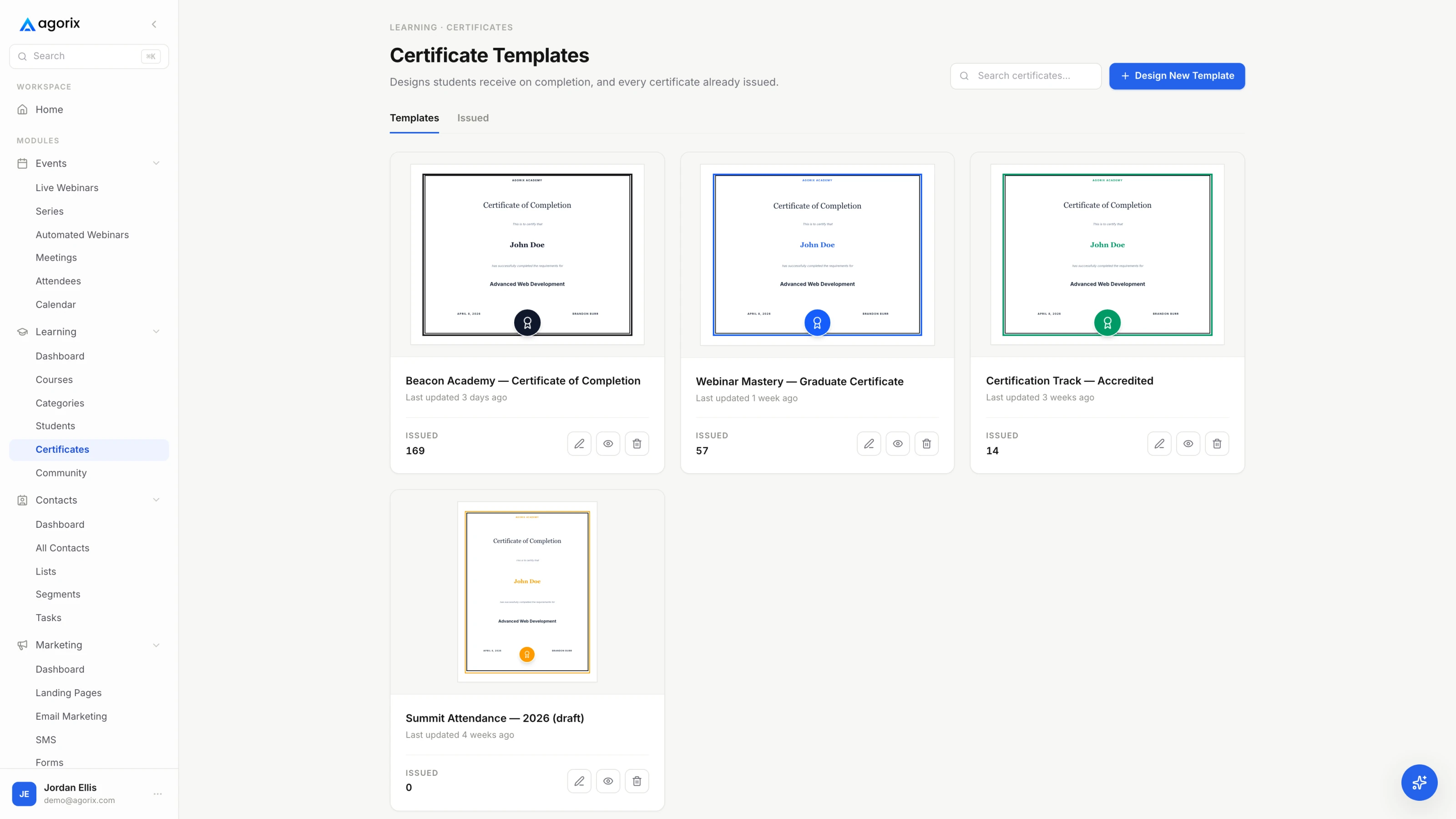
Most course certificates carry a name, a course title and a date. The line that actually does the work is the one almost nobody includes: a specific description of what the person did.
“Has completed Advanced Web Development” is a fact about attendance. “Built and deployed a working application against the published specification, reviewed to the v2026.1 rubric” is a fact about work. The second version tells a reader what to expect from the person holding it, which is the only reason anybody ever reads a certificate.
Keep the design plain and the claims narrow. A wide border and an ornate seal make a document look more institutional and less true; a clean layout with a specific achievement line and a verifiable identifier does the opposite. Everything you cannot fit on the face belongs in the record behind it — which matters more than the face, because it is what you will need the day somebody asks you to confirm an award from two years ago.
Verification does not require infrastructure for most businesses. A unique identifier on the certificate plus a record you can search is enough to answer an emailed “did this person really do this”. If you go further and publish a check page, decide the privacy question first: publishing a learner’s name against a course is personal data, and consent for that belongs in the record, not in an assumption.
Any tool can produce a PDF. Answering “which assessment did this person pass, against which version, and what happened next” usually means three exports and a spreadsheet. In Agorix, lesson progress, assessment results and the issued credential can sit on the same customer record as the purchase — see how courses work.
Every course that stays alive gets rewritten. The question is what that does to the hundred documents already sitting in other people’s files, and the answer is a policy you write once.
v2026.1 in July. Number your course versions the day you issue the first certificate, not the day you first need one.A course version does not need a formal scheme, only a consistent one. v2026.1 is enough: the year plus the revision. Put it on the certificate, in the rubric, and at the top of the syllabus, and keep a dated changelog inside the course so a returning student can see what moved. That changelog is worth more to past buyers than any re-engagement email you could write, because it is evidence that the thing they bought is still maintained.
Two things not to do. Do not retroactively invalidate an award because the course got better — the person completed the version they completed, and the certificate says so. And do not quietly reissue everybody’s certificate with a new version number stamped on it, which asserts on their behalf that they did work they never did.
Only if you can say what it certifies. Ask what the reader of the certificate is supposed to do with it — an employer reimbursement, a professional development log, a public profile, a personal marker of having finished — because each of those answers demands different contents. If the only thing the document can honestly assert is that videos were watched, then it is a completion marker, and calling it one is the more durable choice. That is a perfectly good thing to issue; see completion systems for what else can mark the end of a course.
Five conditions, and they compound. It has to be possible to fail — a document nobody can fail to receive asserts nothing. The requirements have to be published in specific language before anyone starts. It has to name what was done rather than that something was finished. The issuer’s name has to mean something to whoever ends up reading it. And a third party has to be able to check that it is real. A certificate failing all five is decoration, and the people you most want to impress recognise that instantly.
On the face: the learner’s name spelled as they spell it, the exact programme name with its version or year, one specific line describing what was done to earn it, the completion date, the named issuer with a way to make contact, and a unique identifier that resolves to your record. Behind it, in your own system: which assessment was passed, the threshold in force that day, the course version, who reviewed the work, the attempt history, and whether the learner consented to public listing. The twelve-field specification above is the same list as a checklist.
Set it where you would be comfortable saying out loud that this person can do the thing, publish it before anyone starts, and do not move it for individuals. On an auto-marked quiz with unlimited attempts, the threshold measures persistence rather than competence — so either cap the attempts, draw from a question bank, or accept that what you have is a completion marker and describe it that way. For submitted work the rubric is the threshold: write what “meets” looks like for every criterion, and publish an example of work that meets it.
Yes, with limits matched to the format: cap attempts on auto-marked quizzes, and be generous with resubmissions on rubric-marked work, because redoing the work against specific feedback is where the learning happens. Every miss should come back with the criterion that was not met, one concrete change, and the date they can try again. Decide in advance what happens if somebody fails and asks for their money back — that belongs in your refund policy, written before the first person needs it.
Nothing, usually. A certificate names a programme version and a date, so it stays true after you publish a new version — the person genuinely did complete that one. Where the change is material, publish the difference as a short top-up module and issue an updated award to whoever takes it. Reserve expiry for subjects that really do stop being current, and prefer a “current as of” date to retroactive invalidation. Student feedback loops covers the review cadence that produces those versions in the first place.
Be careful with it. A reader who sees “certified” in a professional context will often infer accreditation, licensure or recognition by a body — and if none of that exists, the word is doing work you cannot back. Naming the issuer explicitly solves most of it: “Certified by [your business]” is accurate and makes the scope of the claim obvious. In regulated fields, check what you are permitted to imply before you print anything, and never design a certificate to resemble a credential issued by somebody else.
Course delivery, assessment results, issued credentials, the purchase behind them and the follow-up that comes next — on one customer record, so completing a programme can begin the right next journey instead of ending the workflow.
14 days · $0 due today · Payment method required · Cancel before first charge and pay nothing