Skip to content
Agorix
Updated 28 July 2026

How to price a virtual summit: free room, paid pass.

The economics of the model almost every virtual summit runs on — free registration to fill the room, an all-access pass to make it a business, and a price ladder with four rungs. Written to work with any stack, and worked with your numbers rather than anybody’s benchmarks.

06stages
04price rungs
13min read

What you will have at the end

  • Why free registration plus a paid pass beats a paid ticket for most first summits
  • What belongs in an all-access pass, and what quietly devalues it
  • A four-rung price ladder from the registration moment to the post-event deadline
  • Two speaker revenue-share models, and what each one actually costs you
  • The path from summit to your core offer, which is where the economics resolve
  • Three numbers to judge it by, defined precisely and compared to nobody
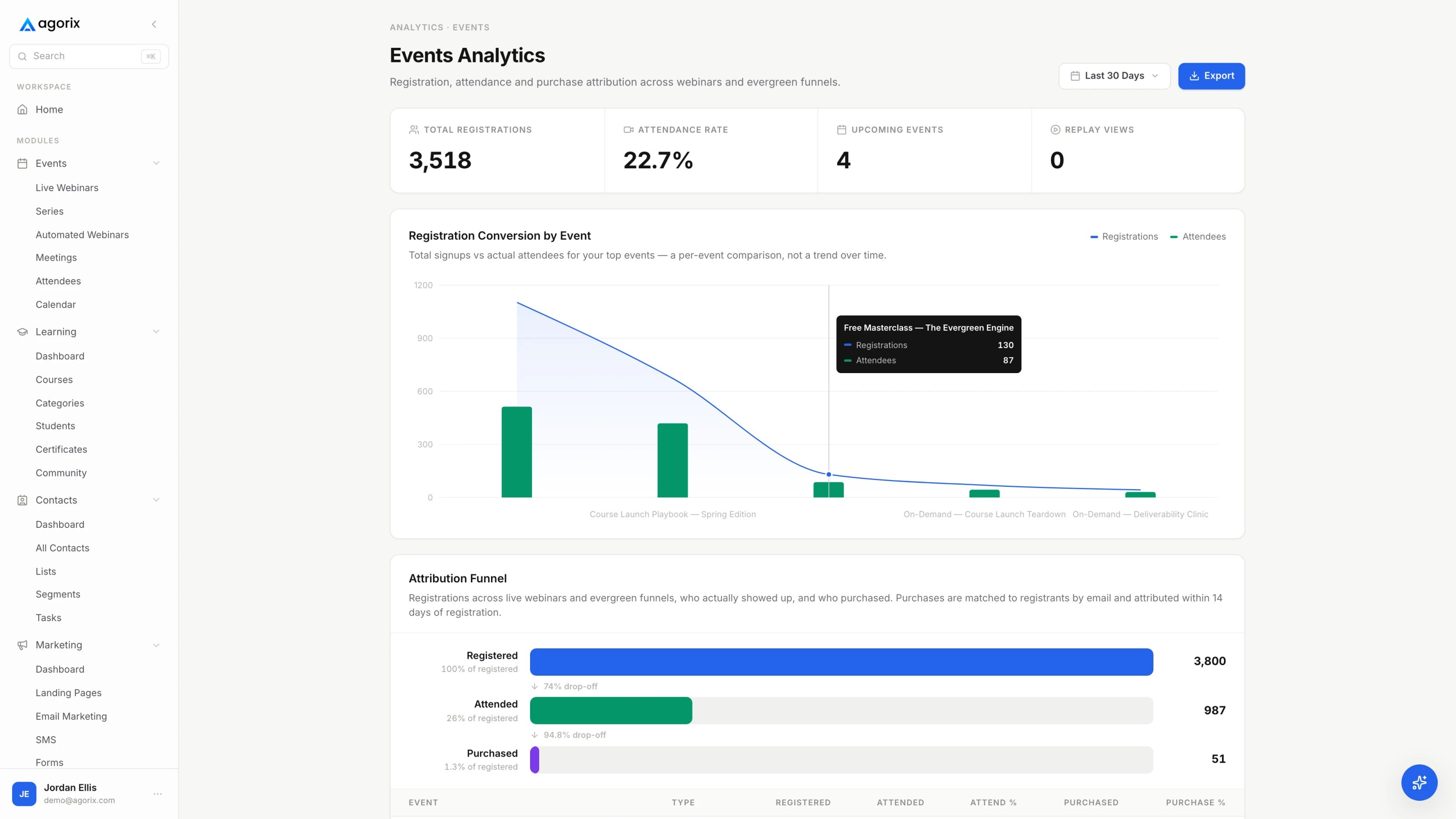
A commerce dashboard showing revenue, monthly recurring revenue, recent paid orders and the products earning them.
StructureThe model01 / 06

The pass sells a problem the free event created.

That sentence is the whole model, and it is the reason free-plus-pass outperforms a paid ticket for most first summits. A ticket sells attendance. A pass sells the answer to something the event itself manufactured — honestly, and in front of the buyer.

Here is the manufacture. You run twenty sessions across three days, live, to an audience spread over several timezones with jobs. Somebody registers wanting six of them and makes two. By the afternoon of day two they know precisely what they have missed, they have seen the quality of what they did catch, and the free replay window is counting down. The pass is the obvious answer to a need they can feel — which is a completely different sale from asking a stranger to pay for a schedule.

Why free registration is structurally right

  1. Speakers promote it. This is the largest single reason. You are asking a speaker to ask their audience for an email address rather than for money, and the difference in willingness between those two requests is enormous. A paid ticket quietly turns every speaker into an affiliate whether or not you pay them like one.
  2. It maximises the asset you keep. The registrant list outlives the event by years. Pricing the front door optimises for the revenue you collect this month at the direct expense of the thing that pays for next year.
  3. It moves the sale after the proof. The buying decision happens once you have demonstrated value across several sessions, rather than before you have demonstrated anything. That is the easiest sale in the whole model, and the reason the pass can carry a real price.

What free costs you

A registrant list worth less per name, a room where a substantial share never show up, and — this is the important one — no revenue at all if the pass is weak. Free registration does not remove the revenue problem. It converts it into a pass-design problem, which is why the next stage is longer than this one.

When a paid ticket is the better call

The model is not universal, and pretending otherwise is how people build the wrong event.

Charge at the door when the event is small, tightly scoped and high-intent and the price is doing qualification work; when you are running it again to an audience that already turned up once; or when you are selling to a B2B audience for whom free reads as low value and a line item is easier to approve than a favour. In those cases the pass becomes an upgrade tier rather than the whole business model — but the ladder in stage three still applies.

ContentsThe pass02 / 06

Build it out of time saved, not out of volume.

The buyer of an all-access pass is not buying more content. They are buying a way to get the value out of content they have already decided they want, on their own schedule. Everything that belongs in the pass follows from that; everything that devalues it comes from forgetting it.

Belongs in the pass

  • Replays beyond the free window — the load-bearing item. State both windows exactly: how long a session stays free after it airs, and how long the pass keeps it.
  • Transcripts and session notes. Cheap to produce, genuinely used, and the thing that makes twenty hours of video searchable.
  • Audio versions of every session, for the people who will only ever consume this on a commute.
  • An index organised by problem rather than by speaker. Twenty hours of video is a burden; twenty hours arranged by “what am I trying to fix” is a resource.
  • Workbooks, templates or checklists tied to specific sessions, where the speaker agreed to them at acceptance.
  • Real speaker offers — a genuine discount or a genuine extra, negotiated at the moment of yes, with an expiry date you will hold.
  • One live, time-boxed thing: a post-summit Q&A or an office-hours call. Often the item that justifies a higher price, and it costs you an hour.
  • A certificate or CE credit where it genuinely applies, which for some B2B audiences is the entire reason to buy.

Quietly devalues it

  • Anything you were going to give away anyway. Padding an offer teaches people to discount everything else you sell.
  • Speaker “bonuses” that are funnel entrances — a free call, a trial, a lead magnet. If it is a sales asset for them, it is not a bonus for the buyer.
  • Access to a community you have no intention of moderating. An empty forum is a visible broken promise.
  • A discount on your core offer as the headline benefit. It moves the sale you actually want and prices it down before you have made the argument.
  • Lifetime access you are not certain you can host in three years. Promise a window you will keep instead.
  • Volume for its own sake. A stack of bonuses with an invented total value tells the buyer the rest of the page is invented too.

Price it against their alternative, not against your effort

Production cost is invisible to the buyer and irrelevant to the decision. What is visible is the alternative: the twelve hours they would spend trying to catch sessions live, the sessions they will simply lose, and whatever they would otherwise pay to learn the same material. Price the pass somewhere inside that gap and it reads as obvious. Price it against how hard you worked and it reads as arbitrary, because it is.

Then check it against your own offer ladder. A pass priced strangely relative to the thing it is meant to lead into damages both sales — a $497 pass in front of a $997 program makes the program look thin, and a $19 pass in front of it makes the pass look like a tripwire, which your audience will read correctly.

PriceThe ladder03 / 06

One pass, four moments, four prices.

A single price on a single page for the whole event leaves most of the money on the table, because intent is not constant — it spikes twice and decays in between. The ladder exists to meet both spikes without discounting the middle.

The registration moment

The early-bird, shown the second somebody registers

The pass offered immediately after a free registration — on the thank-you page and again in the confirmation email — at the lowest price it will carry all event.

Keep the window genuinely short and genuinely enforced. If it expires when the first session airs, it expires when the first session airs.

Why it worksThe highest-intent thirty seconds in the entire funnel is the moment somebody has just committed to attending. The discount is honest because the reason is real: these people are buying before the event has proved anything, and that is worth something.

At checkout

The order bump

One checkbox on the pass checkout, priced well below the pass, adding one specific thing — the transcript and notes bundle, the workbook pack, the audio library.

One bump, not three. A checkout with a stack of add-ons converts worse on the thing you actually wanted to sell.

Why it worksIt works because the decision has already been made and the friction is a single click rather than a second checkout. It is also the cheapest rung to build: order bumps are available on every Agorix plan, including Launch.

During the event

The standard price

The price on the page while the summit is running. This is your reference price, and everything else on the ladder is defined against it.

It has to be a price you would defend, unprompted, to somebody who paid it — because by the end of the event several people will have paid every price on this ladder and they talk to each other.

Why it worksMost passes sold during the event are sold immediately after a session that landed. That is an argument the sessions make for you, which is why the standard price is the one rung that does not need a discount attached to it.

After the last session

The deadline close

A final window — commonly a few days — that ends when the free replays come down. Priced at standard, not discounted.

This rung is powered by the deadline, not by the price. The value has just been demonstrated and the loss is imminent: people who meant to watch four sessions watched one.

Why it worksIt is frequently the strongest single revenue day of a summit, and it is the rung most often left off entirely because everyone is exhausted. Schedule it before the event starts, while you still have the energy to write it.

The fifth thing, which is not a rung

The moment immediately after somebody buys the pass is the second-highest intent moment in the funnel, and a one-click upsell is how you meet it without a second checkout — an implementation workshop, a bundle with your core offer, a done-with-you tier. It is not a rung because it is not the same product at a different price; it is the next product, offered at the only moment it is easy. In Agorix, one-click upsells are available from Growth upward, while order bumps are on every plan.

The principle underneath all four

A deadline that moves is not a deadline. It is a discount with a story attached.

Every rung on this ladder is a deadline, which means the ladder only works as well as your willingness to hold it. In practice that means three things: the price goes up on the date you named, the free replay window closes when you said it would, and if you genuinely have to extend something you announce it as an extension and make the earlier buyers whole. The cost of a quiet extension is never the revenue — it is what your list learns about every future deadline you set. Countdown timers are legitimate when the deadline is real and shared by everybody, and corrosive when they reset per visitor for something that is not actually per visitor. The evergreen playbook works through the same rule in the case where the deadline genuinely is per-viewer.

Illustrative pass mathYour assumptions, your arithmetic
Read this first

This is arithmetic, not a forecast, and the starting values are not benchmarks. They are round numbers chosen to be obviously made up, so that you replace them. We have deliberately not published a “typical” pass take rate, because we do not have one that would be honest for your list, your topic and your price — and neither does anyone who quotes you one. Change every field below to your own assumptions and read the output as a shape, not as a result.

What that arithmetic gives you
Pass buyers100
Pass revenue$9,700
Order bumps (25 of 100)$675
Less speaker share (pass revenue only)−$2,910
Kept after the share$7,465
Revenue per registrant$10.38

Gross of everything a real summit also pays: payment processing, refunds, production and editing, any ad spend, speaker honoraria, and your own time across the weeks it takes. It also ignores the one-click upsell and any core-offer revenue in the follow-up window — which, as the next-but-one stage argues, is usually where the economics of a summit actually resolve.

Where a tool decision changes the plan

Three of these four rungs are checkout mechanics.

An order bump at checkout, a one-click upsell after the purchase, and a price that flips on a date — on a stitched stack each one is a separate integration, and tying any of them back to a free registration is a spreadsheet join. In Agorix, order bumps are on every plan, one-click upsells come in from Growth, and registration, attendance and purchase sit on one attendee record — see how commerce works.

Start your 14-day trial 14 days · $0 due today · Payment method required · Cancel before first charge and pay nothing
SpeakersRevenue share04 / 06

Two models, and the choice is about incentives rather than generosity.

Whatever you choose has to be decided before the first invitation goes out, written into the acceptance email, and never renegotiated after a yes. Speakers compare terms with each other — that is not cynicism, it is just what people do.

The flat thank-you

A fixed honorarium per speaker, or nothing at all plus a genuinely valuable stage.

Simple, predictable and sometimes the only option — many employed B2B speakers cannot accept affiliate income, and offering it can create a problem for them rather than a benefit.

  • Predictable cost you can budget before you know anything
  • No tracking infrastructure, no attribution rule, no disputes
  • Works for speakers who cannot take a commission
  • Creates no promotion incentive whatsoever — the ask has to carry it alone
  • Costs the same whether the summit sells nothing or sells out, which is real risk on a first event
  • Tempts you to invite fewer, cheaper speakers for reasons that have nothing to do with the audience

The affiliate share

A percentage of pass sales attributed to each speaker’s tracked link.

The model that aligns the incentive with the thing you actually need, which is promotion. It also converts your speaker roster into a reconciliation obligation with a date on it.

  • Pays for promotion in proportion to promotion that worked
  • Costs nothing if nothing sells, which protects a first summit
  • Gives speakers a reason to send twice rather than once
  • Requires per-speaker tracked links and attribution you can actually defend
  • Creates a payment date you must hit, and silence around it ends relationships
  • Invites politics: who gets credit when a registrant arrived via one speaker and bought after another

The attribution rule is the whole argument

Decide it before the summit and publish it in the acceptance email. First touch — the link that registered them — is the simplest to explain and the easiest to defend, and it rewards the promotion you were paying for. Last touch rewards the session that closed the sale, which is a defensible position too, and much harder to explain to the speaker whose email brought the person in. Pick one, write it down, and do not change it after you have seen the numbers. Changing an attribution rule post hoc is the single fastest way to lose a roster.

Three more terms belong in the same paragraph: what the share applies to (pass only, or pass plus bump plus upsell — say which), the cookie or attribution window, and the payment date, set after your refund window closes. Speakers care about the payment date more than the rate, and hitting it without being chased is worth more goodwill than a higher percentage.

The honest version

A revenue share is not a way to avoid paying speakers.

It is a way to align an outcome. If your summit sells very little, a revenue-share speaker received the recording and the exposure and nothing else. Decide in advance whether you would be comfortable with that outcome and comfortable explaining it, and say plainly in the invitation which model you are running. A hybrid — a small flat fee plus a share, or a share only for speakers who take a promotion commitment — is a reasonable middle, provided the tiers are consistent enough that you would be content to have them read aloud.

PathSummit to offer05 / 06

The summit is the top of a funnel, not the business.

Pass revenue on its own rarely justifies weeks of coordinating fifteen people who do not work for you. If you judge a summit purely on what the pass took, most summits look like a bad trade — and the ones that do not were funnels all along.

What actually pays for it is three things the event produces and the pass does not. The registrant list, which outlives the event by years. The credibility of having convened the room, which is why speakers answer your next invitation. And the segmentation — you now know, for each person, which sessions they attended, which replay they went back for, and therefore which problem they came in with. That is the most precise picture of intent you will get all year, and it has a short shelf life.

The path, in order

  1. Free registration. The list, and the first signal — which sessions they chose when they registered.
  2. The all-access pass. The first purchase, and the segment that matters most. A pass buyer has told you they intend to do something about this.
  3. The one-click upsell. Offered at the only moment it is easy — immediately after the pass purchase, with no second checkout.
  4. The core-offer window. Seven to fourteen days after the final session, while the segmentation is still true and the room still remembers. A live session, a workshop, a cohort open or a call — not a broadcast blast to everybody.
  5. The evergreen path for the rest. Registrants who did not buy anything are not failures; they are warm subscribers who have just told you what they care about. Route them by the sessions they watched, not by the fact that they did not buy.

The failure mode is treating the summit as a standalone event, collapsing afterwards, and coming back to the list six weeks later with something unrelated. By then the segmentation is stale, the goodwill has cooled, and the most valuable asset the event produced has quietly expired. Whatever the summit sells next has to be decided before you invite the first speaker — the same rule the pillar guide puts at the top of the clock, for the same reason.

NumbersMeasurement06 / 06

Three numbers that matter, defined precisely.

Published summit benchmarks are close to useless: no other organiser’s take rate includes your list, your topic, your speakers, your price or your promise. Definitions travel between businesses. Numbers do not. Your second summit compares to your first.

MetricDefinition and what it judges
All-access-pass take ratePass purchases ÷ free registrations. Judges the pass and the ladder together, which is exactly why it has to be split by rung — registration-moment, during-event and deadline-close behave so differently that the blended number hides the thing you needed to see. Segment it, or it will average away your only signal.
Revenue per registrantTotal attributed summit revenue ÷ free registrations. The number to optimise against, because it is the only one that survives a change in promotion volume. Decide once whether it includes the order bump, the one-click upsell and any core-offer sales inside the follow-up window — then label which, and never quietly change it between events.
Replay consumptionSessions watched per pass buyer inside the pass window, plus the share of buyers who watched at least one. The number that predicts refunds, next year’s pass sales and whether the pass was worth building. High sales with near-zero consumption is a refund queue and a reputation cost you have not paid yet.
Session-level attendanceLive attendance and replay views per session. Not a scorecard for speakers — a map of which topics actually held a room, which is how you build next year’s roster out of evidence rather than out of who was easiest to book.
Speaker-attributed registrationsRegistrations per tracked speaker link. Only meaningful if you issued per-speaker links, and only worth collecting if you will act on it — either to reconcile a revenue share or to decide who to invite again.
Refund rate on the pass, by rungRefunds ÷ purchases, split the same way as the take rate. A rung with an outsized refund rate is almost always a promise problem rather than a price problem: something the page said at that moment did not survive contact with the product.

Read them together rather than separately. A low take rate with high replay consumption among the people who did buy says the pass is good and the ladder is not — the offer is not reaching people at the moments intent spikes. A healthy take rate with near-zero consumption says the opposite: you sold it well and delivered something nobody opened, which shows up as refunds this year and as a much harder second summit next year. And revenue per registrant that moves while the take rate holds steady is the ladder doing its job.

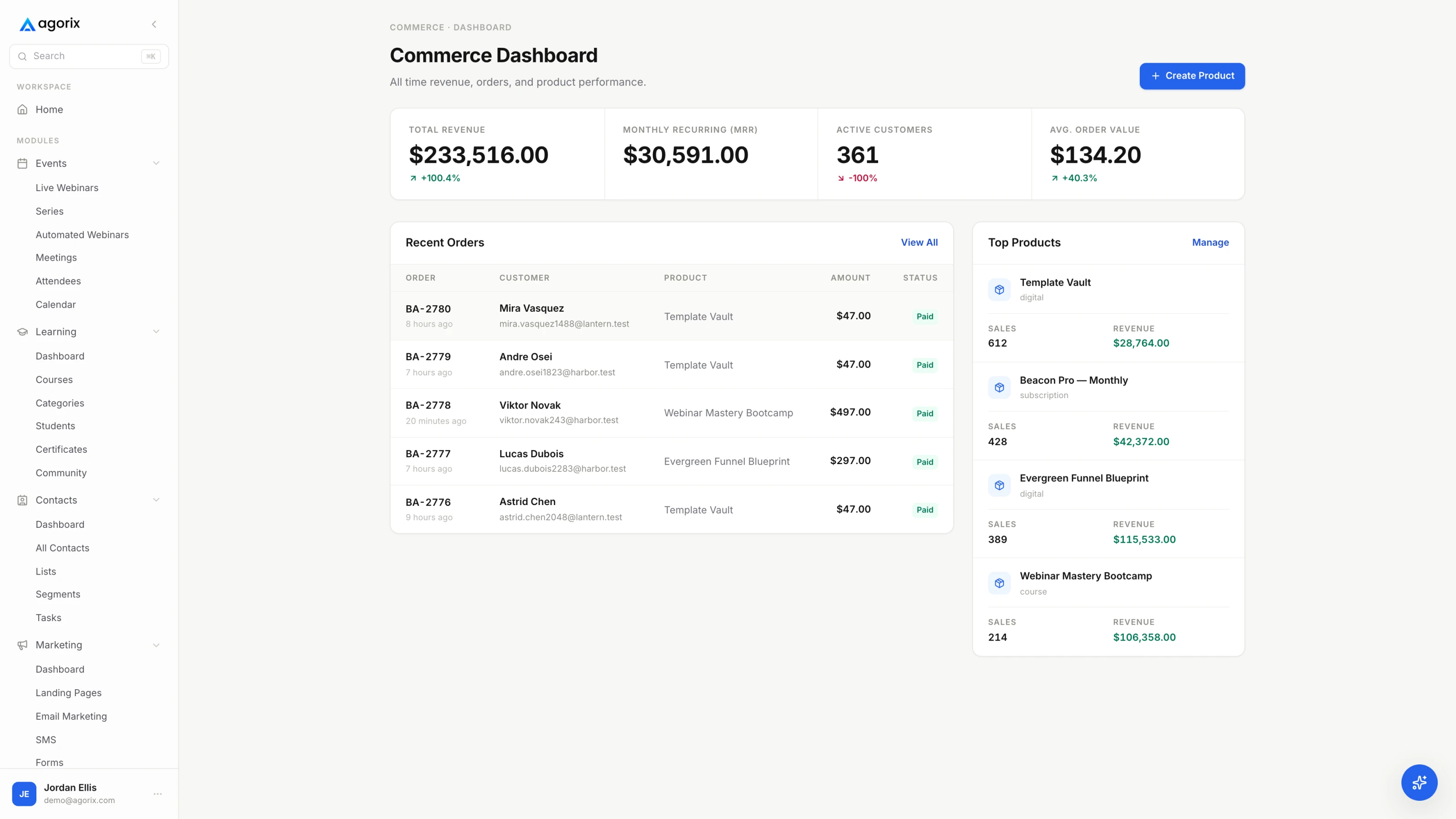
Events analytics showing registrations against attendance per event, and the funnel from registered to attended to purchased.
Fig. 02Take rate by rung and consumption per buyer both require registration, attendance and purchase on one record. If they are not, the numbers are estimates — label them as estimates rather than reporting them as facts.

Record all six after the first summit, change one thing, and run it again. Almost every useful improvement to a summit’s economics comes from a rung that was missing rather than a price that was wrong.

Common questions

Six questions about summit pricing.

Should virtual summit registration be free or paid?

Free registration with a paid all-access pass suits most first summits. Speakers promote a free event far more willingly, because they are asking their audience for an email rather than for money, and the purchase decision happens after value has been demonstrated instead of before it. A paid ticket makes more sense for a small, high-intent, tightly scoped event where the price is the qualifier, for a repeat summit with a proven audience, or for a B2B audience that expects to pay and reads free as low value. Whichever you choose, decide it before you write the first speaker invitation — it changes what you are asking them to promote.

What should an all-access pass cost?

There is no correct number, and anyone quoting you one has not seen your pass. What determines it: what is actually in it, the alternative cost of your audience’s time, what else you sell and at what price, and whether a speaker revenue share comes out of it. Anchor the price to your own offer ladder rather than to other summits — a pass priced oddly against the thing it is meant to lead into confuses both sales. And get the rung structure right before you spend any effort testing the number; the ladder moves revenue per registrant more reliably than the price does.

Do I have to pay virtual summit speakers?

No, but you have to decide before you invite anybody, because the model goes in the acceptance email and cannot be renegotiated after a yes. The two common structures are a flat thank-you — predictable, simple, no promotion incentive — and a revenue share on the pass, which aligns the incentive but requires per-speaker tracked links, an attribution rule set in advance and a payment date you hit. Both are covered below, and the wording that commits them is in the speaker outreach templates.

When do most all-access passes sell?

It varies enough by audience, topic and price that any published figure is worth ignoring. Structurally, the model concentrates intent at two moments: immediately after a free registration, when somebody has just committed to attending and nothing has been proved yet, and in the final window after the last session, when the value has been demonstrated and the free replays are about to expire. Measure your own split by rung rather than assuming either one, and expect the answer to move between your first summit and your second.

Should summit replays be free or behind the pass?

Both, deliberately. A short genuinely free replay window is what makes free registration honest and what creates the need the pass answers — somebody who wanted six sessions made two, and now they can see exactly what they missed. Zero free replay makes the free ticket thin and costs you registrations at the top. Unlimited free replay removes the reason to buy anything at all. State both windows exactly, in the same words on the registration page, in the confirmation email and on the pass page, and then hold them.

Is the summit itself supposed to be profitable?

Sometimes, but it is far more reliable as the top of a funnel than as a standalone revenue event. A summit is weeks of work coordinating people who do not work for you; the durable returns are the registrant list, the credibility of having convened the room, and the segmentation the event produces — you know, per person, which problem they came for. Decide which of the two you are running before you invite anyone, because it changes the pass design, the revenue share and the follow-up. The pillar guide sets that decision at the top of the clock, for the same reason.

Keep going

The rest of the summit, in order.

From a price list to a working ladder

You have the model. Agorix is the system that runs it.

Free registration, multi-session live journeys, a paid pass with order bumps at checkout, one-click upsells from Growth, replays and follow-up that branches on what each person actually watched — on one attendee record, so the take rate is a fact rather than an estimate.

14 days · $0 due today · Payment method required · Cancel before first charge and pay nothing