Do nothing
No edits, no price change, no new promotion angle, no fixing a typo on one version. Every mid-test change adds a variable you did not agree to and cannot subtract afterwards.

Testing for people without a data team or a hundred thousand visitors a month. What to change first, how to know whether your traffic can answer the question at all, how to read a result honestly — including the result nobody plans for — and when the right move is to decide rather than test.
An A/B test is the same traffic, split between two versions of a page that differ in exactly one thing, judged on one number chosen before the test began. Every part of that sentence is doing work, and dropping any of them turns a test into an anecdote.
What a test buys you is a decision you would otherwise make by argument. Two people who both have opinions about a headline can spend an hour disagreeing; a test ends the disagreement with a number. That is a real and valuable thing, and it is the whole product. A test does not tell you why the winner won, whether it will still win next quarter, or whether the same change works on a different page.
Three things get called tests and are not. Changing the page and comparing this month to last month is a before-and-after: the world moved as well as the page, and you cannot separate the two afterwards. Running version A this week and version B next week is the same problem wearing a lab coat. Changing six things at once and keeping the result is a redesign — which is fine, as long as you do not tell yourself you learned something transferable.
The page, the single variable, the primary metric and the stopping rule. All four before the first visitor arrives. The reason is not ceremony: every one of them can be chosen after the fact in a way that flatters the result, and the temptation to do so is strongest exactly when the numbers are closest.
This is the section that testing articles skip, because it disqualifies most of the people reading them. It is also the only section that can save you six weeks of running something that was never going to produce an answer.
The problem is not that small numbers are imprecise. It is that small numbers swing on their own, with nothing changed at all. Flip a fair coin twenty times and you will rarely get exactly ten heads; run the same unchanged page for two consecutive weeks and the conversion counts will differ. That ordinary swing does not disappear because you have labelled the two versions A and B. It sits on top of whatever difference your change actually made, and a test can only see a difference that is bigger than the swing.
Splitting the traffic makes it worse before it makes it better: each version now sees half of what the page used to get, so the counts you are comparing are half the size and the swing is proportionally larger. That is the price of a clean comparison, and it is worth paying — but it has to be budgeted for.
Suppose a page receives four hundred visitors a month and forty of them convert. Split evenly, each version sees two hundred visitors and around twenty conversions in a month. A change that moves one version from twenty conversions to twenty-two is a difference of two events — comfortably inside the range you would see between two identical months with nothing changed. These figures are worked arithmetic to show the shape of the problem, not a benchmark: substitute your own traffic and your own conversion count and the shape stays the same.
You will find articles naming a magic number of visitors or conversions per variant. Do not use them: the required number depends entirely on your current conversion rate and on how small an improvement you want to be able to detect, neither of which the author knows. Do this instead, in about five minutes.
When the duration comes back longer than the offer will exist, you have three honest options and no dishonest ones. Make the change on judgment and move on. Go and get more traffic first, which is usually the higher-value work anyway. Or test something larger — a genuinely different page rather than a genuinely different sentence — because only a big difference is visible at small volume.
On modest traffic only large differences are visible, so the testing queue should contain only changes capable of producing one. That single constraint sorts the list for you, and it puts button colour where it belongs.
| Order | What you change, and why it moves | Likely effect |
|---|---|---|
| 01 | The headline and the promise. It decides whether a stranger believes the page is for them. Nothing else on the page can rescue a promise aimed at the wrong person. | Large |
| 02 | How the offer is framed. The same thing described as a checklist, a workshop or a teardown is a different trade to the reader, even when the file is identical. | Large |
| 03 | The size of the ask. Form fields, the length of the commitment, whether a phone number is required. Removing an ask usually moves the number more than rewording one. | Medium |
| 04 | The specifics and the proof. Concrete detail against general claim: what they will be able to do, named, versus a paragraph of adjectives. | Medium |
| 05 | Order and what sits above the fold. Moving the answer to where the question arises. Real, but usually smaller than a change to what the page says. | Small |
| 06 | Button copy. Worth writing well. Rarely worth a slot in a testing queue when a slot costs you weeks. | Small |
| 07 | Colour, type and imagery. Fix these when they are wrong — unreadable, off-brand, slow. Testing them at low volume spends the queue on the least likely thing to move. | Rarely visible |
Button-colour tests are famous for two reasons: they are trivial to run, and they make a good story. Neither reason is about your page. A colour rarely changes whether a stranger believes the page is for them, which is the decision the page exists to influence. If your button is genuinely hard to see, that is not a test — it is a repair, and you should just do it.
The same reasoning promotes the headline to the top. It is the only element every visitor reads, and it is the one that decides whether the rest of the page gets read at all. Where the elements sit and what each is doing is covered in the landing page anatomy guide; how to write two variants that are genuinely different rather than reworded is covered in landing page copywriting.
The one-variable rule exists so that a result means something: if three things changed and the variant won, you have to keep all three forever, because you do not know which one carried it. That is the argument for discipline.
The counter-argument is arithmetic. On a small page, a single sentence rarely moves the number far enough to be detected, while a genuinely different page sometimes does. Both positions are defensible; what is not defensible is running a six-change test and then reporting it as though you learned which change mattered. Name the trade in the log: this test buys a decision, not a lesson.
Setting a test up is easy and takes an hour. Running it honestly takes several weeks of not touching it, which is the part that actually fails.
Can your tool split traffic between two versions of the page, and can it report the outcome by variant? They are separate features and a stack can easily have the first without the second, which leaves you with a running test and no way to read it. Confirm both in your own account rather than from a features page, and confirm them before you write a variant.
If you cannot split traffic at all, you can still learn something — but call it what it is. Run the change, hold everything else steady, compare like periods, and write the caveat into the log: anything that changed in the world during those weeks is inside the result and cannot be extracted later. Decisions made this way are ordinary business decisions. They are just not evidence.
No edits, no price change, no new promotion angle, no fixing a typo on one version. Every mid-test change adds a variable you did not agree to and cannot subtract afterwards.
A test cut short for a business reason is not a result. Log it as abandoned with the reason. An abandoned test costs you nothing; a half-finished one you quietly count costs you the next decision.
Everyone sets up a test imagining a clear winner. The most common outcome by some distance is that the test cannot tell the two versions apart, and knowing how to handle that outcome well is most of the skill.
A variant that lifts form submissions and lowers the quality of who submits has not won anything. Remove two form fields and more people will fill in the form; whether more of them turn up, buy or stay is a different question, and it is the one you are actually asking. Judge on the furthest number you can honestly attribute — for a registration page that is attendance, for a sales page it is purchases, for a lead magnet it is whatever the magnet is supposed to lead to.
This is where most small-team testing quietly gives up, because the further down the funnel the number sits, the more systems it lives across. If registrations are in the page tool, attendance is in the webinar tool and purchases are in the payment processor, then judging a variant on customers means reconciling three exports — and nobody does that twice.
One more honest caveat before you generalise: a result belongs to the page, the audience and the moment it was measured in. A headline that beat its control against cold ad traffic may lose against your own list, who already know the format and do not need it named. Carry the reasoning to the next page. Do not carry the sentence.
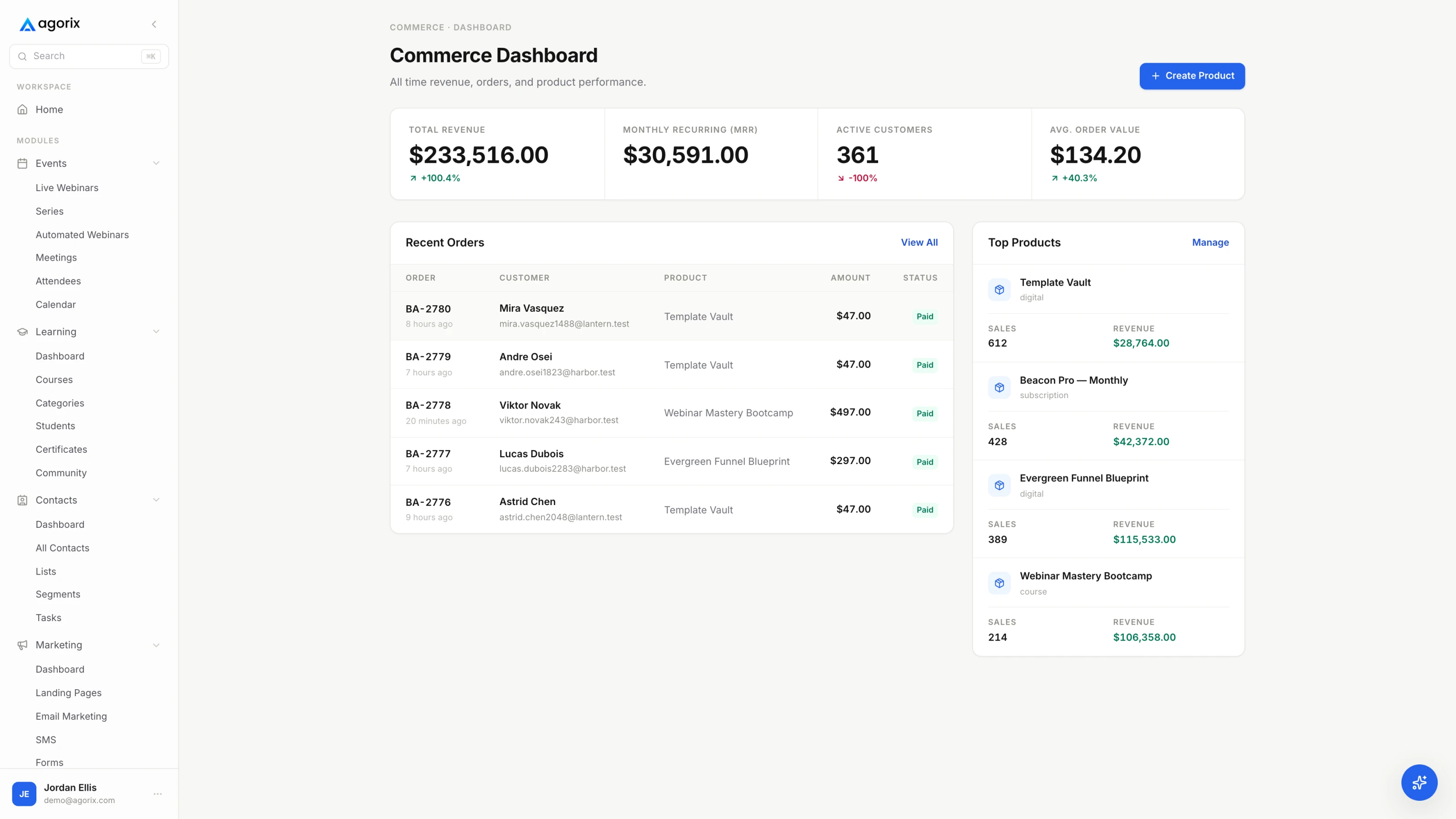
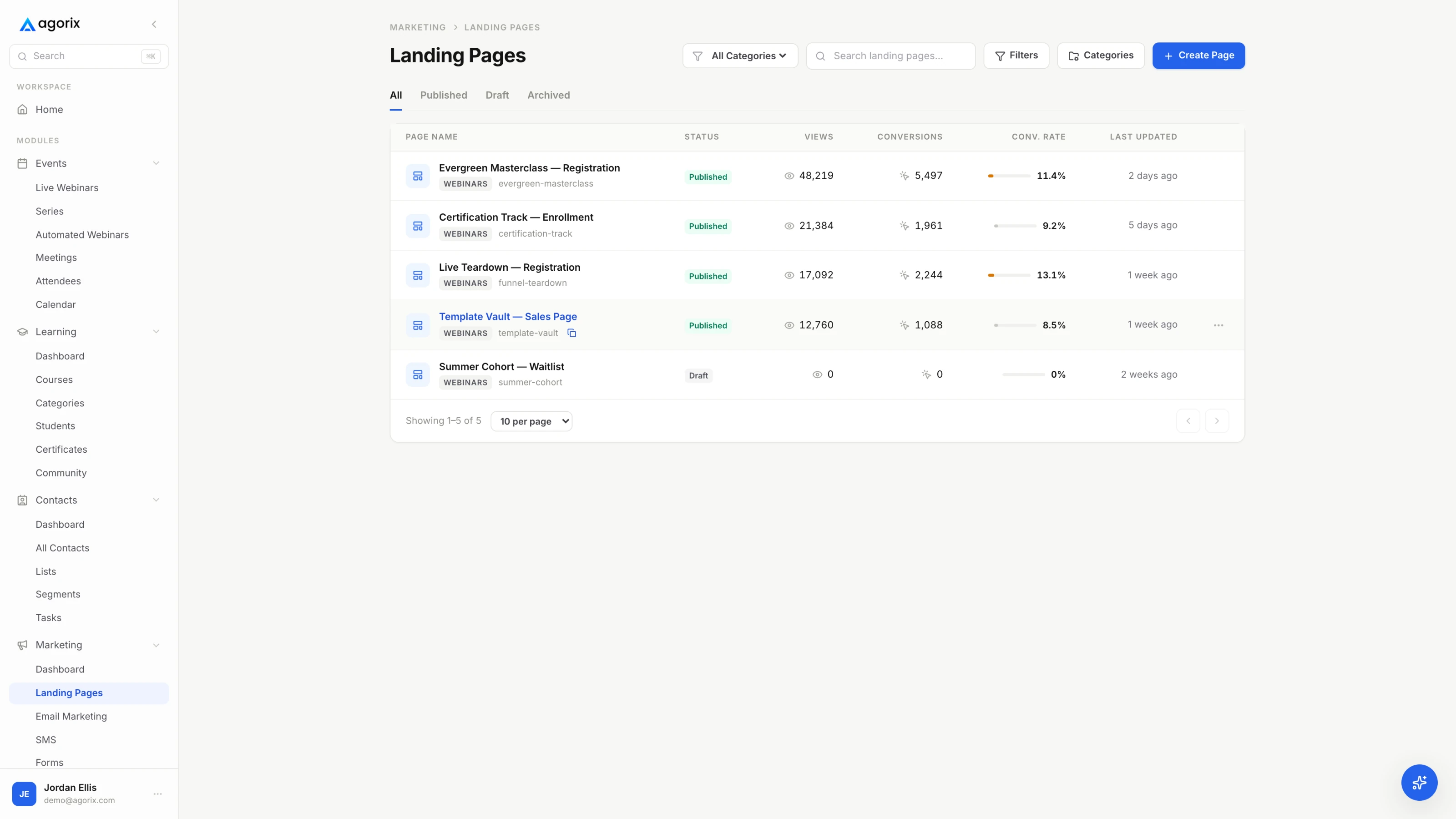
Splitting traffic is the simple half. Following the same person from the version they saw through to whether they showed up, bought or stayed is the half that decides whether the test was worth running — and on most stacks it means reconciling the page tool, the email tool and the payment processor by hand. In Agorix the page, the form response, the follow-up and the checkout sit on one customer record. Full closed-loop attribution is limited on the entry plan and included from Growth upward — see how marketing works.
A new page with no audience does not have a measurement problem. It has an unknown-audience problem, and no amount of splitting traffic you do not have will solve it.
Ship the version you can defend out loud — the one where you can say who it is for, what they get and why the trade is fair — and then go and find out whether you were right by talking to people. Five conversations in a week will teach you more than five weeks of a test that cannot reach a conclusion, and they produce something a test never does: the objection in the reader’s own words.
Do this with five people who resemble the audience and you will have more usable material than a quarter of testing would produce, plus a set of hypotheses worth testing later, when you have the traffic to test them with.
Almost every page that works was written by someone who understood the reader, not assembled from winning variants. Testing is a refinement tool: it makes a working page better and it settles arguments. Used as a substitute for knowing who you are writing to, it produces a slow, expensive version of guessing.
The log is not admin. It is the only thing that turns a series of isolated tests into knowledge about your audience — and the only defence against re-running a test you already lost eight months ago.
Fill in the top half before the test starts and the bottom half when the stopping rule is met. The field that earns its place is the second-to-last one: what you learned about the reader, stated in one sentence with no reference to the specific page. That sentence is the part that transfers.
TEST [number] — [short name]
Page:            [url]
Started:         [date]          Stopped: [date]
Question:        [the one sentence this test answers]
Variable:        [the single thing that differs]
  A (control):   [what A says or does]
  B (variant):   [what B says or does]
Primary metric:  [the number chosen before the test began]
Stopping rule:   [date or visitor count, whichever falls later]
Traffic source:  [same mix to both — name it]

RESULT
  A: [visitors] → [conversions] = [rate]
  B: [visitors] → [conversions] = [rate]
Tool verdict:    [what the significance calculator reported]
Call:            [ship B / keep A / no detectable difference]
Learned:         [one sentence about the reader, not about the page]
Next:            [the next test, or "none — go and get traffic"]
The question and the stopping rule are there because both are easy to invent afterwards in a way that flatters the result. The traffic source is there because a result belongs to an audience. The learned line is there because it is the only field you will ever read twice.
A conversion problem is often not a copy problem, and a test is the slowest available way to discover that. Run the cheap checks in order first; each one takes an afternoon and can retire the test entirely.
Working the list in order is the same discipline as funnel diagnostics: find the stage that is failing before you optimise a stage that is not. Once you know it is the page, this guide tells you what to change and whether you can measure it.
There is no universal number, and any article quoting one is guessing at your conversion rate. The honest method: take your current conversion rate and the smallest improvement you would actually act on, put both into the sample-size or significance calculator your testing tool provides, and convert the answer into weeks of your real traffic. If that comes back longer than the offer will exist, you do not have a test — you have a decision to make on judgment, which is a normal way to run a business.
Until the stopping rule you wrote down before it started, and in whole weeks so both versions see the same mix of weekdays and weekends. Stopping on the first good-looking day is the most reliable way to get a confident wrong answer, because early numbers swing hardest. If a test has to be cut short for a business reason, record it as abandoned rather than as a result — an abandoned test you are honest about costs you nothing, and one you quietly count costs you the next decision.
The headline and the promise, then how the offer is framed, then the size of the ask. Those three change whether a stranger believes the page is for them, which is the only kind of change likely to produce a difference large enough to see on modest traffic. Colour, type and button copy sit at the bottom of the list: fix them when they are wrong, but do not spend weeks of testing queue on them. What each of those elements is doing is laid out in the landing page anatomy guide.
You can, and on a small page it is often the only test with a visible effect: a whole new page against the current one. The trade is that a multi-change test tells you which page won without telling you why, so every change has to stay bundled together and you learn nothing you can carry to the next page. One variable teaches you something reusable. A big swing gives you a decision. Both are legitimate — just know which one you bought.
It means this test could not tell the two versions apart at this volume, not that they perform identically. The two honest responses are to keep whichever version you prefer for reasons unrelated to the test — shorter, truer, easier to maintain — and move on, or to accept that the change was too small to be visible and test something bigger. Declaring a narrow gap a winner is how noise becomes a permanent decision, and it is the most common failure in small-scale testing.
You need one that can split traffic between two versions and report the outcome by variant, and those are two separate capabilities worth confirming before you plan anything. Without traffic splitting, the honest substitute is a documented before-and-after with the caveat written into the log: everything that changed in the world during those weeks is inside your result, and you cannot separate it out afterwards.
Landing pages, forms, email, the live room and checkout on one customer record — so the version somebody saw and the purchase they made sit on the same timeline, and a test can be settled on customers instead of clicks.
14 days · $0 due today · Payment method required · Cancel before first charge and pay nothing