Route to a human
Above it, somebody gets a personal message, an offer of a call, or a task with a name and a due date on it. Set by capacity, reviewed monthly, and always attached to an action rather than a label.

Small teams do not have a sales floor to route leads across, so most of what is written about scoring does not apply. What does apply is narrow and useful: five to seven behaviours, weighted by how close they sit to money, cooled so they describe now, and two thresholds that change what somebody does on Monday morning.
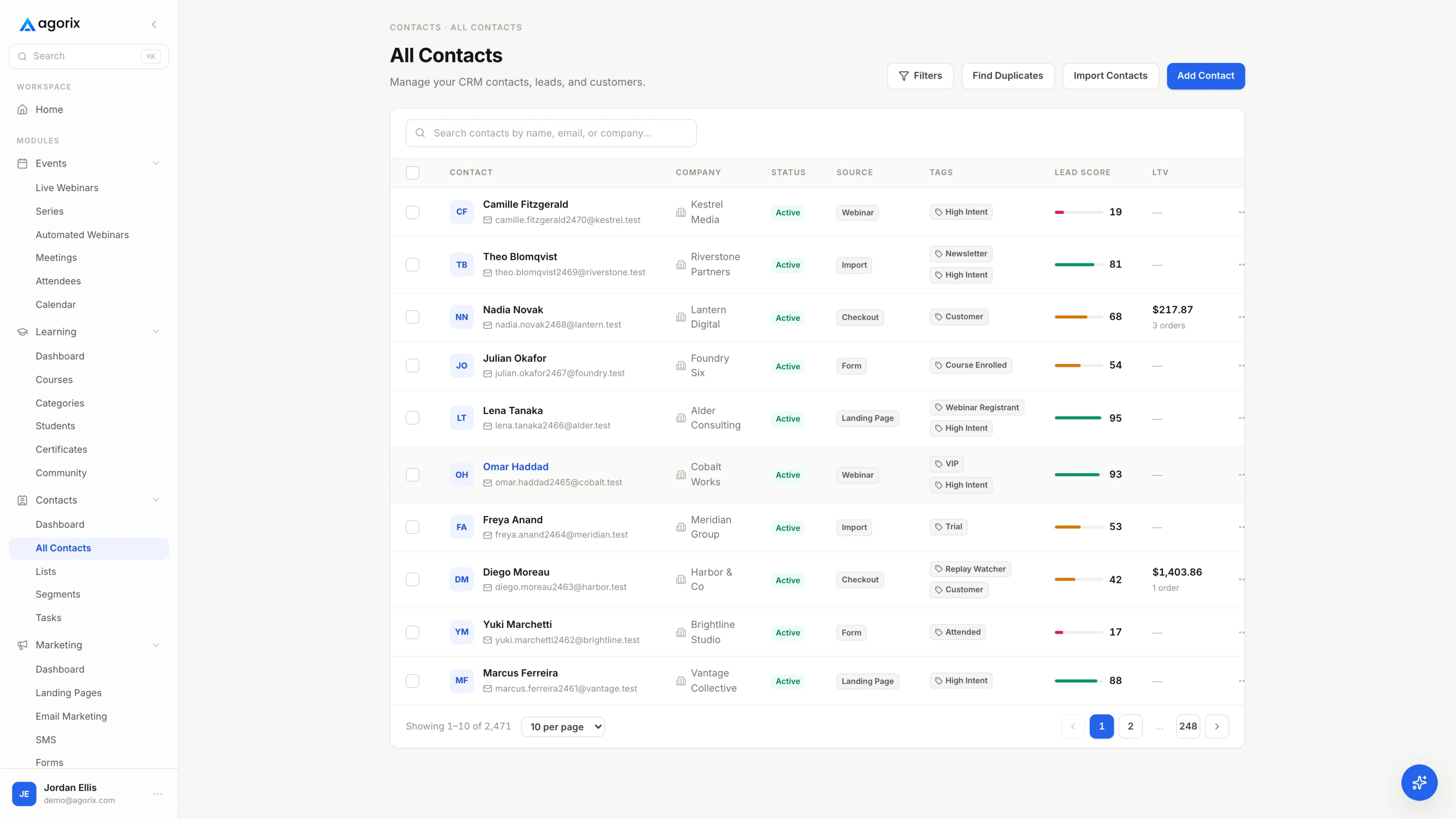
Most lead scoring advice was written for businesses with a queue and a team to work it. Copy the apparatus without the queue and you get scoring theatre — a number on a dashboard nobody opens, feeding a routing decision nobody makes.
A small business needs routing far more than it needs scoring. Routing is the act of getting the right person in front of a human while they still care. Scoring is one mechanism for deciding the order, and it only becomes worth building on the day the number of people showing intent exceeds the number of conversations you can hold. Before that day, the score is a project that feels like progress.
If any answer is no, build visibility instead. A saved view of everyone who did something meaningful in the last seven days, checked each morning with a coffee, is most of the value of a scoring model for a fraction of the work — and it is also the thing you will keep doing while you are busy, which the model is not.
Enterprise models split into demographic and behavioural halves. For a small business selling to individuals, the demographic half is mostly self-reported, rarely updated, and restates a decision you already made when you chose who to sell to. Drop it and score behaviour.
Five to seven is the working range, and the reason is maintenance rather than accuracy. Every signal is a definition somebody has to remember, a piece of tracking that can silently break, and a line in the explanation you give when a colleague asks why a contact is at forty. A model with fifteen inputs is not more accurate at this size; it is merely harder to argue with, which is not the same thing.
Each of those signals also has to come from somewhere you can query. That is the constraint that decides your list in practice — the same one that governs behavioural triggers, and for the same reason: a score can only count what one record can see.
Not by how much effort it took the person, and certainly not by how much effort it took you to set up the tracking. Booking a call takes ninety seconds and outranks sitting through a sixty-minute session, because one of them is a request for a conversation and the other is an afternoon that was free.
| Behaviour | Points | Why it sits there |
|---|---|---|
| Booked a call | 25 | They asked for the conversation. Nothing else in the list outranks somebody putting their name in your calendar. |
| Started a checkout and did not finish | 20 | They reached the money and stopped. The closest behaviour to a purchase that is not one. |
| Replied with a real question | 12 | A human signal, consistently underrated because it does not appear on a dashboard. Score it, or your queue will rank a silent clicker above someone who wrote to you. |
| Stayed through the offer in a session | 10 | They heard the whole argument and stayed. Worth more than attending, which mostly measures that the calendar was free. |
| Visited the sales or pricing page | 8 · max twice | Deliberate rather than incidental. The cap matters: without it, one left-open browser tab produces your highest-scoring lead of the month. |
| Clicked an offer link | 4 | A question with the answer still missing. Real, but thin — this is the signal most often over-weighted because it is the easiest to measure. |
| Attended a live session at all | 5 | They allocated the hour. Keep it low, because attendance measures availability at least as much as intent. |
Those numbers are illustrative arithmetic, not findings — a starting set with editable assumptions. The ratios are the part worth keeping: the top of the list should be roughly five times the bottom, so that one genuine buying signal outweighs a week of mild interest. If a person can reach your routing threshold purely by clicking things, the spread is too flat.
Unsubscribed, bounced, refunded, asked not to be contacted, told you it is not the right year — none of these are minus five points. They are removals from the queue or holds with a date on them. Deducting points produces a contact who climbs back to the top in three weeks having done nothing except exist, and somebody then calls them.
A score that only ever goes up measures tenure. Give it a year and your top of queue is the person who has been reading you since the beginning and has never once tried to buy anything — ranked above somebody who opened your checkout this morning.
Choose the window by your own sales cycle, not by convention. If the typical gap between a first meaningful signal and a purchase is three weeks, a ninety-day window is mostly history and sixty is generous. If people take four months to decide, ninety days is the floor. When you genuinely do not know, start at ninety and shorten it once you have watched a few purchases happen.
Those three are where small teams lose credibility with their own queue. A model that keeps nominating a customer who bought last week, or a person who politely explained their timing on the phone, teaches everyone to stop trusting the list — and a queue nobody trusts is a queue nobody works.
A score with five tiers gives you five decisions to make and five things to maintain. A score with two lines gives you the only two decisions a small business actually acts on: talk to this person, and stop spending on that one.
Above it, somebody gets a personal message, an offer of a call, or a task with a name and a due date on it. Set by capacity, reviewed monthly, and always attached to an action rather than a label.
Below it for a whole window, the record costs deliverability and contact capacity and returns nothing. One re-engagement attempt, then out of active marketing — not deleted, just no longer emailed.
Work backwards from capacity. Decide how many conversations a week you want to have — five, ten, whatever is real — then look at where people actually land and put the line where roughly that many cross it. If forty people cross and you can hold five conversations, you do not have forty hot leads; you have a line in the wrong place. Move it, and keep moving it monthly at first. The threshold is a capacity dial, and the most common mistake is treating it as a truth about buyers.
Then make crossing it do something specific. “Becomes a qualified lead” is not an action. The strongest version is an offer of a conversation with the booking link already in it — the webinar-to-call funnel covers how to make that ask without it reading as a sales trap, and it is the same move whether the signal came from a session or from a score.
People below the floor for a full window are not neutral. They cost you contact capacity, they dilute every open rate you use to make decisions, and at scale they cost you inbox placement with the people who do read you. Give them one honest re-engagement attempt, then remove them from active marketing — the re-engagement campaign covers the attempt, and deliverability basics covers why the removal is the part that pays for itself.
“Score went above [route threshold]” has exactly the shape of every condition in behavioural trigger design: an event, a qualifier, a wait, one action, a stop condition and an owner. Build it the same way, including the cooldown — otherwise a contact hovering on the boundary nominates themselves every time they open a page.
A score kept in a spreadsheet gets recalculated whenever somebody remembers. When the sessions, clicks, course progress and purchases already sit on one customer record, the score is current and crossing the line can start something — a task with a name on it, a booking offer, a change of audience — see how workflows act on it.
Scoring models rot in a specific way: they accumulate. Somebody adds a signal for a campaign, the campaign ends, the signal stays, and two years later the number is produced by machinery nobody can explain. Half an hour a quarter prevents all of it.
One rule holds the whole thing together: never add a signal without removing one. It sounds arbitrary and it is the reason the model still fits on a page in year three. An unexplainable score gets quietly ignored, an ignored score is worse than no score, and the reason it is worse is that it looks like coverage — everyone assumes somebody is working the queue.
Write the definition down where a person can read it, not only where the software stores it: the signals, the weights, the window, the two lines, the owner, and the date it was last changed. One page. If your model does not fit on one page, that is the finding, and the third question in the review above is usually where the excess came from.
Pick a contact at the top of the queue and ask the other person in your business why they are there. If the answer requires opening the configuration, the model is already too complicated for the business it serves — and simplifying it will cost you far less accuracy than you fear, because most of the ranking comes from two or three signals anyway.
This is the sentence to keep saying out loud, because everything about a number invites the other interpretation. Scores look like measurements. Yours is an opinion with arithmetic attached, and it is useful precisely to the extent that you remember that.
The first is trusting it. Somebody at twelve points sends you a long email with a real question in it and gets a templated reply, because the queue said they were cold. A written question is the strongest signal in this entire guide and it will often carry almost no score, because writing to you is not a click. Read your inbox; the model is for the people who have not written.
The second is over-fitting it. With a dozen purchases behind you there is no statistical basis for rebuilding weights every month, so a monthly rebuild is fitting to noise while feeling like rigour. Change weights when the business changes — a new offer, a different price, a new way people arrive — and otherwise leave them alone and go and have the conversations. On a small list the whole job of the score is to make sure this week’s five conversations are with the five most likely people. That is worth having. It is not a forecast.
Only once more people show buying signals each week than you can have conversations with. A score is a queue-sorting tool: it answers “who gets a human today”, and if the honest answer is still “everyone who does something interesting”, you do not have a queue yet. Build the visibility first — a saved view of everyone who took a meaningful action in the last seven days is most of the value for almost none of the work.
Five to seven. Each has to be reliably observable, common enough to separate people, unrelated to how long somebody has been on the list, and something you would be comfortable mentioning out loud on a call. The ceiling is not what your tool supports — it is how many signals you can still explain to the other person in your business without opening the configuration.
Work backwards from capacity, not from theory. Decide how many conversations you want a week, look at where people actually land, and put the line where roughly that many cross it. Forty people over the line and five available slots means the line is wrong, not that you have forty hot leads. Review it monthly at first: it is a capacity dial rather than a fact about buyers, and it moves when the business does. The webinar-to-call funnel covers what the conversation on the other side should look like.
Rarely, at this size. Attributes are usually self-reported, rarely updated, and mostly restate a decision you already made when you chose who to sell to. If an attribute genuinely changes whether you would take the call, apply it as a filter on the queue rather than as points in the score — otherwise a job title somebody typed into a form eighteen months ago quietly outranks what they did yesterday.
Add decay, or you have built a loyalty metric by accident. The simplest workable method is a rolling window: count only behaviour from the last sixty or ninety days and let older activity fall out, which needs no scheduled job and keeps the score describing the person now. Then reset on purchase and hold after a real conversation, so buyers and people you already spoke to stop being nominated every week.
Yes, provided the claims stay small with it. With a handful of purchases you have nowhere near the volume to fit weights statistically, so set them by proximity to money and move them by judgement rather than by regression. On a small list the score is doing one modest, useful job: making sure the five conversations you have this week are with the five most likely people.
Sessions, watch time, clicks, course progress, checkouts and purchases on one customer record — so the score is current without an export, and crossing the line can raise a task with somebody’s name on it instead of colouring in a dashboard.
14 days · $0 due today · Payment method required · Cancel before first charge and pay nothing