
How to run a virtual summit: the ninety-day operating guide.
A summit is not a longer webinar. It is a business model with a schedule attached: free registration fills the room, an all-access pass pays for the production, and the offer behind both is what the whole thing was for. Seven stages on a real clock, written to work with any event stack — where a tool decision genuinely changes the plan, it says so.
What you will have at the end
- A summit model on paper: free registration, an all-access pass, and the offer the whole thing feeds
- A speaker list recruited on a promise you can actually keep
- A registration page, a public schedule and a pass checkout that share one record
- A promotion plan whose engine is your speakers rather than your ad budget
- A multi-day run-of-show, including what happens between the days
- Eight numbers, defined precisely, that tell you whether to run it again
Decide what the summit is for before you decide what it is about.
A summit that exists to be a summit costs three months and produces a mailing list. The ones worth running are built backwards from something you sell, and the schedule is the argument for it.
Name the offer first. It might be a program, a course, a service, a membership or a higher-touch engagement — but it exists before the theme does, because it decides which sessions belong in the schedule and which interesting ones do not. Then ask what somebody would have to believe to buy it. The sessions that build that belief are your summit; the rest are content you can publish another time.
The model, named up front
The default structure for a virtual summit is free registration plus a paid all-access pass. Registration is free because the summit is a top-of-funnel machine and your speakers will not promote a paywall to their audiences. The pass is paid because production costs real money and because people who pay a small amount for access behave measurably differently afterwards from people who did not.
- Free registration. One form, one promise, every session included live. This is what your speakers promote and what fills the room.
- The all-access pass. Sold from the moment someone registers. It carries the replays beyond the free window and whatever else is genuinely worth paying for — notes, transcripts, bonus sessions, the speakers’ resources. Write down what is in it before you sell it.
- The offer behind both. The thing the summit was actually for, sold in the week or two after it ends, to people the summit has taught and sorted. If this does not exist, you are running a content event and should budget for it as one.
Sponsorship is a legitimate fourth line and a different sales cycle — one that needs audience numbers you do not have before your first summit. Treat it as an upside for the second one rather than a plank in the plan for the first.
Then lock the shape of the thing
Three days of three or four sessions is a workable default. What makes a summit expensive is not the number of sessions but the number of days: each day adds a run-of-show, a morning email, an evening email, a replay window and a fresh chance for attendance to fall. Decide the days, the sessions per day, the session length and the daily start time now, because your speaker asks depend on all four.
Price the pass in this stage.
The pass price, its inclusions and the date the price changes appear on the registration page, in the confirmation email, on the checkout, in every speaker’s kit and in the day-close emails. Deciding it late means rewriting all of them. How to price a virtual summit works through the arithmetic and the two-price structure.
Recruit on a promise you can keep, and ask for exactly what you need.
Speakers are the content and the distribution. Almost every disappointing summit is a recruitment problem wearing a promotion costume: the line-up said yes to presenting and nobody ever asked them to promote.
The ask has two halves that people persistently confuse. The first is the session — their time, their material, your date. The second is the promotion — their audience, on your calendar. A speaker who agreed to the first has not agreed to the second, and finding that out at T−14d is how summits end up with eleven excellent sessions and ninety registrations.
The promise-ask ladder
Each rung raises what you are offering and, only then, what you are entitled to ask for. Pick a rung per speaker, say which one you are on in the first message, and hold to it.
| Rung | What you offer, and what you can ask for |
|---|---|
| Rung 1 | A well-run session and a clean recording they ownThe session itself: their date, your format, their material. This is the floor, and for a first summit it is often the whole deal. |
| Rung 2 | A named audience, with an honest number attachedOne email to their list, on a date they pick from your calendar. Never inflate the number you quote here — it is the single fastest way to lose a speaker for the second summit. |
| Rung 3 | A tracked link and a share of every pass sold through itTwo emails and social posts on your promotion calendar, plus their audience being told the summit exists more than once. |
| Rung 4 | A place in the pass, plus real co-promotion of something of theirsA genuine push. This rung is a partnership, and it should be written down as one — what they send, what you send, and when. |
What you collect from every speaker
Collect it once, in one place, at the point they say yes. Chasing six of these separately at T−10d is the single most avoidable job in summit production.
- Session title and three outcomes. Written as what an attendee will be able to do afterwards. This becomes the schedule entry, the reminder line and the replay description.
- Format and date, confirmed. Live or pre-recorded, which day, which slot, in their timezone and yours written out in full.
- Bio, headshot, and how to say their name. The last one is not a courtesy detail — your host has to say it out loud on the day.
- The promotion they have agreed to. Which sends, on which dates. A yes with no dates is a maybe.
- Their offer, if you allow one. Decide the policy before the first ask, apply it to everyone, and write it into the invitation. A summit where one speaker pitches and the others do not is unfair to the ones who did not.
- Two dates they have to hit. Content lock and promotion assets. Speakers hit deadlines they were told about at the start, and miss ones invented later.
How many, and what happens when one drops
Your session count is days multiplied by sessions per day; the temptation is to over-recruit as insurance. Resist it — every extra speaker is another set of assets to chase and another slot to promote. Instead, identify one reserve per day and design the schedule so that one slot per day could be collapsed into a longer break or a host-led Q&A without the day looking broken. Somebody will drop out. Plan the recovery rather than the redundancy.
Four assets: the page, the schedule, the pass and the spine.
Build them in that order, because each one depends on the last, and finish them before promotion opens. A registration page you are still editing while speakers are sending traffic to it is the worst of both jobs.
The registration page
One job: make the trade obvious. The promise in a sentence, the dates, the daily start time in the visitor’s timezone, and then the speaker grid — which on a summit page is the proof, not the decoration. Ask for as little as you can defend; name and email is usually enough, and every additional field is a tax you pay in registrations coming from other people’s audiences.
Say plainly what is free and what the pass is for. Being coy about the replay window costs more registrations than it protects pass sales, and it makes your speakers’ promotion harder to write.
The schedule as a public artifact
Publish every session with day, time, speaker and the three outcomes, on a page with its own link. Your speakers will share it, attendees will plan their week around it, and it answers the question that decides attendance: is there something here I cannot afford to miss. Times in the visitor’s timezone, always — a summit crosses timezones by design.
The pass checkout
The pass is offered at the moment somebody registers, when intent is at its highest, and then again at the deadlines you have already chosen. Test the whole path — click to card to confirmation to access — with a real transaction, and refund it. What the pass includes must read identically on the page, the checkout and the emails; a discrepancy there is a refund request waiting for the busiest day of your quarter.
The email spine, built once
A summit needs more email than a webinar, but not more kinds of email. Build the spine below once and duplicate the day rows for each day you are running.
| When | |
|---|---|
| On registration | Confirmation and scheduleJoin details, calendar entries for every session they can attend, the schedule in their own timezone, and the all-access pass offered once, plainly. This is the most-opened email of the whole campaign — it should do more than say thank you. |
| T−7d | How to actually attendAsk them to pick the two sessions they will not miss and put them in their calendar. Mention the pass as the way to catch everything else. A registrant who has chosen a session behaves differently from one who has registered for a summit. |
| T−1d | Day one detailsThe first session in their timezone, the join link, and what to have ready. Answer the two questions that cause no-shows: exactly when, and will there be a replay. |
| Each morning | Today’s sessionsOne email per day, not one for the whole summit. Three lines, today’s line-up, the link. This is the highest-yield send of each day and the one most often skipped by day three. |
| Each evening | What you missed, and what is nextThe day-boundary email. What happened, what is in the replay window and for how long, and the one session tomorrow they should not miss. Written before the summit starts, edited on the day. |
| Replay window | Watch before it closesThe honest deadline, in the subject line. If you said forty-eight hours, it closes at forty-eight hours. |
| Window closing | Last call for the passThe pass as the way past the deadline. Segment out everyone who already bought — nothing reads as careless faster than selling someone what they own. |
| T+3d → T+10d | The offer the summit was forIts own campaign, segmented by what people actually attended. Not a postscript on the recap email. |
Two rows in that table are what separate a summit from a series of unrelated webinars: the morning email and the evening email. The days are held together by the boundaries between them, and those boundaries are made of email.
Four assets, or one record that already connects them.
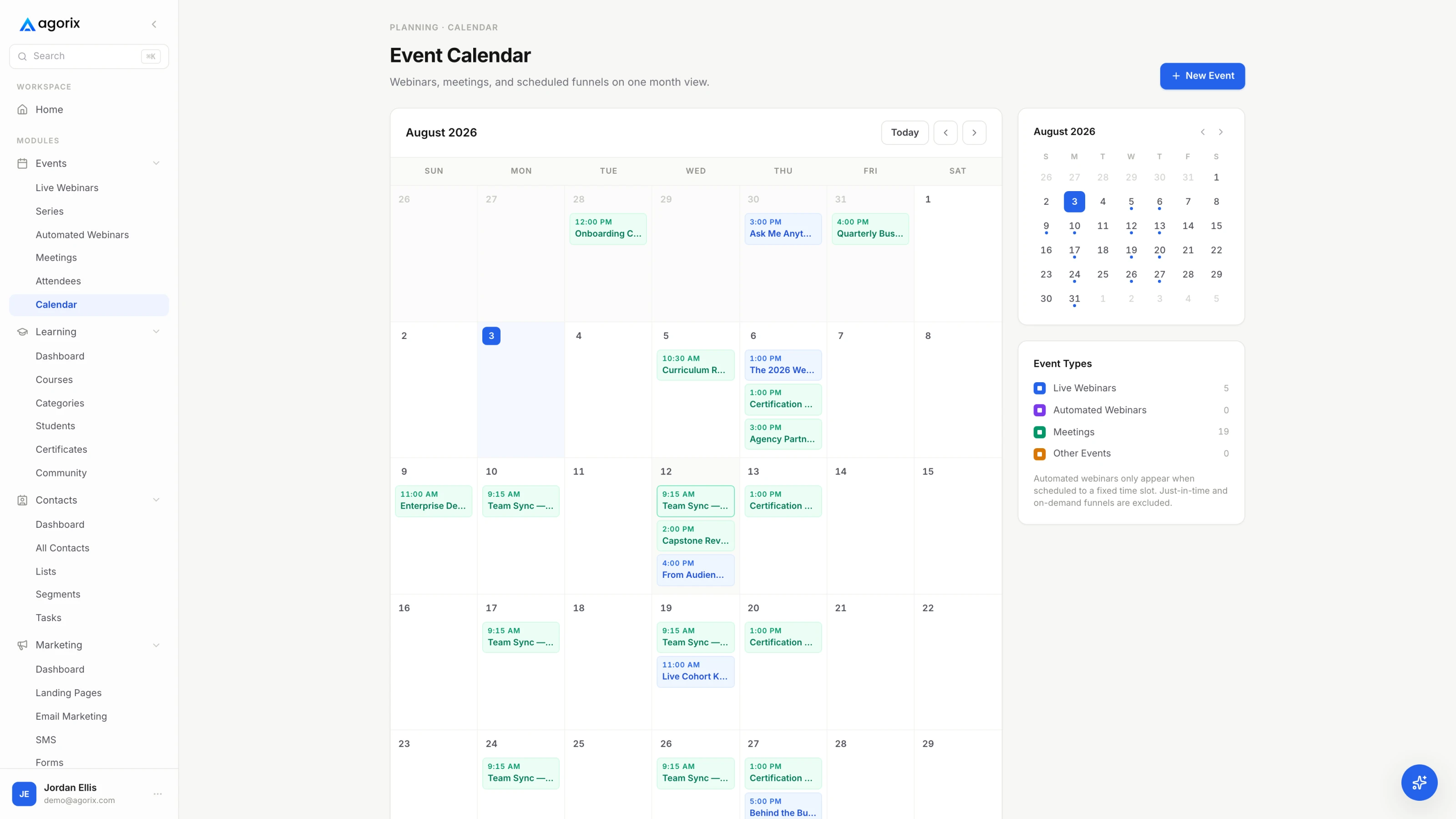
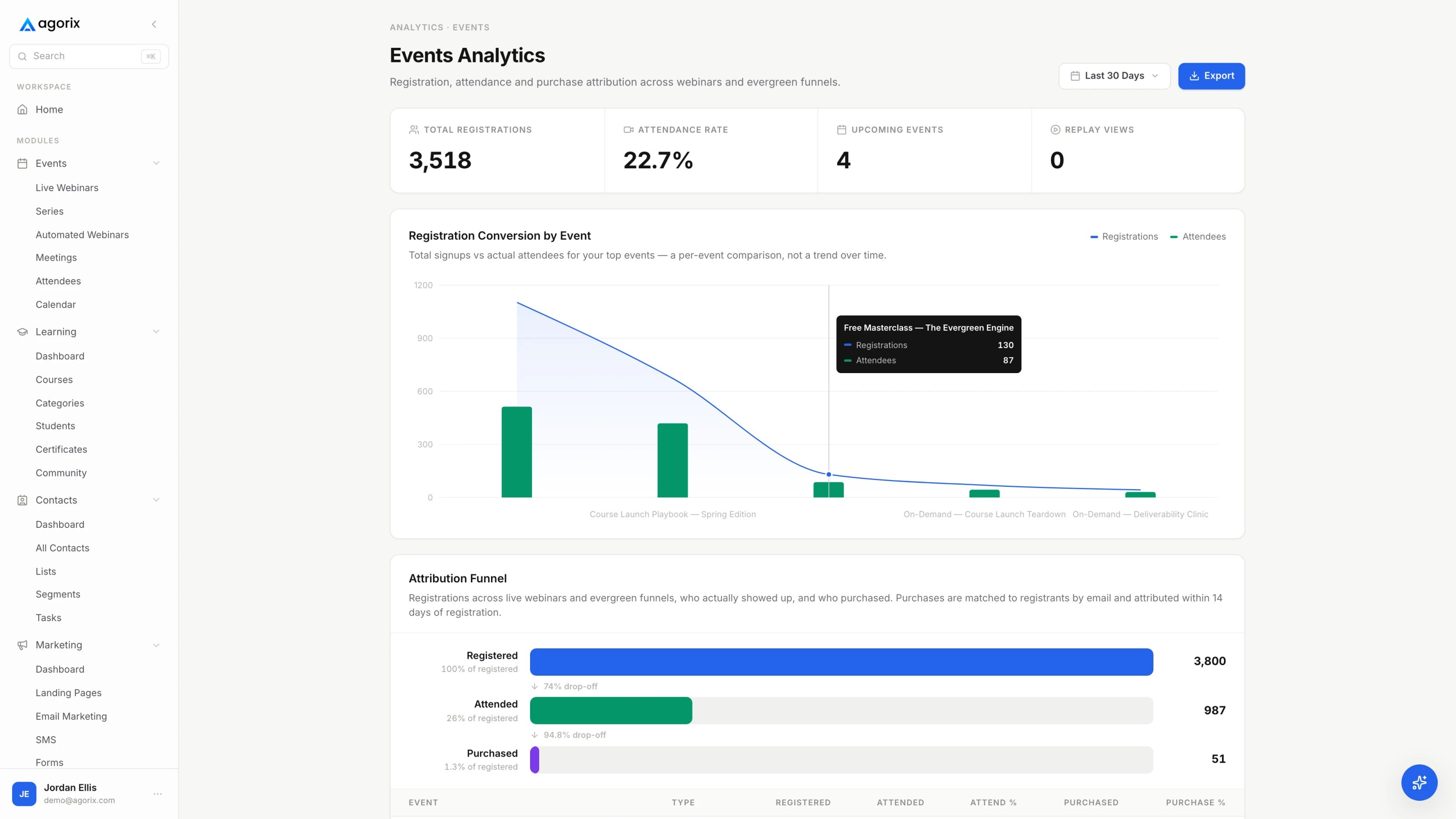
Registration, session attendance and the pass purchase are three different systems in most summit stacks, which is why the follow-up gets built by hand at midnight on day three. In Agorix they sit on one attendee record — see how events and summits work.
Your speakers are the engine. Everything else is a top-up.
This is the structural difference between a summit and a webinar. A webinar is filled from your own audience; a summit is filled from other people’s, and the entire model depends on making that easy, tracked and scheduled.
- A tracked link per speaker. Issued with the kit, before the window opens. Without it you cannot tell a speaker how they did, cannot pay a revenue share honestly, and cannot decide who to invite next time.
- A kit that takes five minutes to use. A full email they can send as-is, two or three short posts, one image, their session details, and the date, time and timezone spelled out in every asset. The easier the kit, the more of them actually send.
- A send calendar, not a send request. Spread speaker sends across the window so they do not all land on one Tuesday. Assign dates; do not hope.
- One reminder each, individually. At roughly the midpoint, to the speakers who have not sent yet. Personal, short, no guilt. Most misses are calendar accidents rather than decisions.
- A visible tally, shared honestly. Tell speakers where their link stands. It is genuinely motivating, and it is also the report you owe them at the end whether or not it flatters anyone.
What you own, in the order it pays back
Your own channels do the rest of the work, and the mechanics are the same as for any event: your list, your owned surfaces, direct invitations, then paid — last, and only against something that has already sold passes. The promotion guide covers each channel in depth, along with a fourteen-day calendar you can lift directly into the summit window.
Two things do change for a summit. Open registration earlier — three weeks rather than two, because your speakers need time inside the window to send. And tag everything from the first link, because at the end you will owe a dozen people a number and there is no way to reconstruct it afterwards.
One source review, roughly ten days out.
Early enough to act, late enough to mean something. It answers one question: is the channel that was supposed to carry this actually carrying it. If two speakers are carrying the whole summit, you now know to help the others rather than to add a channel.
The day before a three-day event is not the day before a webinar.
You are not checking one room and one deck. You are checking a dozen people, several rooms, a schedule that has to survive something going wrong, and a set of emails that must fire on days two and three when you are too tired to notice they did not.
Four things carry disproportionate risk, and all four have to be settled before the last day rather than on it.
- Every speaker has been in the room once. On the platform they will use, from the device they will use, with their screen share tested. A speaker who has never joined the room is an unplanned ten minutes at the start of their session.
- Every pre-recorded session has been played to the end. Not spot-checked. The failures that matter — audio dropping at minute thirty-one, the file that transcoded badly — do not show up in the first ten seconds.
- Every email is scheduled, not drafted. Open the send list and count them: one morning and one evening email per day, the replay window sends, the pass deadline. A drafted email on day two is an email that never went.
- The room ceiling has been checked against registrations. Against the busiest session, not the average, with headroom. Running out of capacity mid-summit is the one failure with no recovery path and no apology that works.
Twenty-eight items, grouped, copyable.
The complete production checklist — registration and offer, speaker logistics, the rooms, email and automations, day-of operations, replay and follow-up — is a page of its own, built to be left open while you produce, with a run-of-show template beside it. Open the virtual summit tech checklist.
Run the sessions. Mind the boundaries between the days.
Individual sessions mostly run themselves; speakers are speaking about their own work. What decides whether the summit feels like an event is the connective tissue — the transitions, the day opens, the day closes, and the two emails at each boundary.
The shape of a day
- Pre-show, thirty minutes. Room open, today’s schedule on screen, host in chat. It gives late joiners somewhere to arrive and gives you thirty minutes to find out that something is broken.
- Day open, five minutes. What is happening today, in what order, and one reason to stay for the last session. On day two and three, also what they missed and where it is.
- Sessions, with hosted introductions. The host introduces the speaker, sets up why this session matters here, and closes it by connecting it to what is next. This is the job that makes a schedule into a summit.
- Real breaks, on the published schedule. Back-to-back sessions look efficient and cost you the afternoon. Breaks are where people decide to come back.
- Day close, five minutes. What happened, what is in the replay window and until when, the pass mentioned once, and tomorrow’s hook by name.
Live, pre-recorded, and the rule that matters more than either
Pre-recorded sessions are the reliable choice: nothing fails on the day, the speaker can be in chat answering while their own session plays, and you can watch the room rather than the clock. Live sessions are right where the room changes the outcome — panels, workshops, anything with real Q&A. Most summits should mix them, and should say honestly on the schedule which is which.
The rule that matters more than the format: somebody from the session is present while it plays. A summit where nobody is in the room is a video playlist, and an audience works that out within one session.
Selling the pass without becoming an infomercial
The pass gets mentioned at the day open, at the day close, and at the natural moment somebody says something you cannot fit into the free window. Three times a day, plainly, with the deadline attached. Not in every session introduction, and never by a speaker who did not agree to sell it.
The replay window is the second event.
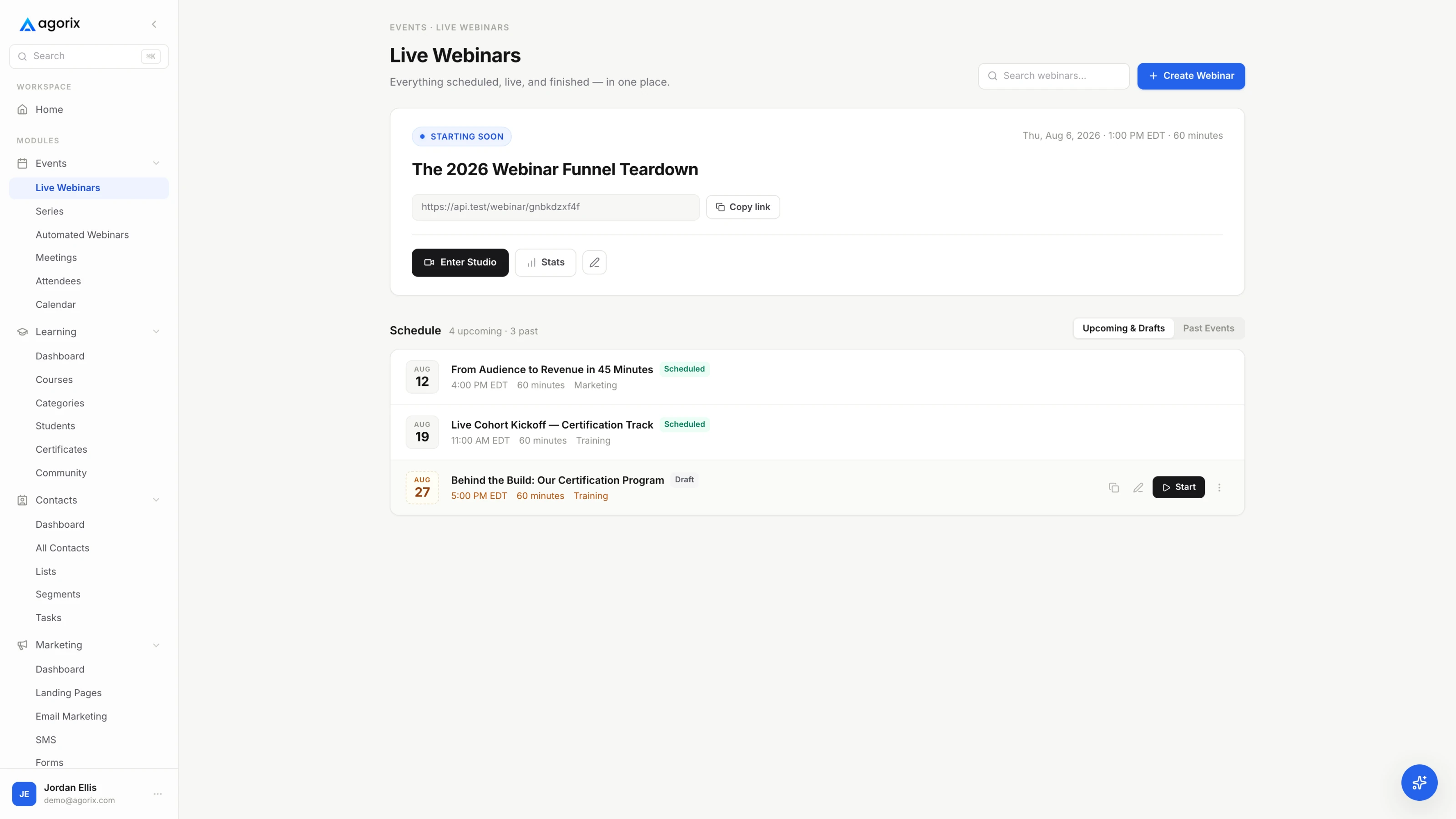
More people will watch your summit after it ends than during it, and the week afterwards is where the pass and the offer are actually decided. Plan it with the same care as the days themselves rather than treating it as cleanup.
A window, and a deadline you keep
Announce the free replay window before the summit starts — a fixed number of hours per session, or each day’s sessions available until a stated time — and then hold it. The pass is the way past that deadline, which is the entire reason the deadline exists. Extending it quietly teaches your list that your deadlines are decorative, and you only get to teach that once.
Five segments, decided before day one
Everyone who registered has done something different, and the follow-up should reflect it. Define these before the summit, because afterwards you will be defining them at speed in a spreadsheet.
- Pass buyers. Out of every pass-selling sequence immediately, into access and orientation. Then treated as your warmest audience for the offer, because they have already paid you once.
- Attended, did not buy the pass. The last-call segment. One honest message before the window closes, about what stops being available and when.
- Registered, never attended. They have not seen the thing. Send the single best session with a deadline, not a summary of eleven — a summit recap to someone who attended nothing is a wall of things they have no reason to care about yet.
- Replay-only watchers. Warmer than their attendance suggests. They chose what to watch, which tells you exactly which offer angle to lead with.
- Speaker-referred. Worth keeping separate for one reason: it is how you report honestly to speakers and how you decide who to invite again.
Then run the offer as a campaign
The offer the summit was for gets its own two weeks, its own emails and its own deadline, segmented by what people actually attended. It does not get squeezed into the final session or bolted onto the recap email. The summit did the teaching and the sorting; the campaign does the selling, and it works because the two were designed together ninety days earlier.
The recordings then have a longer life. A session that held its audience is a candidate for an evergreen funnel, and the library as a whole can carry the pass as an offer long after the event — provided you kept the recordings, the attendance and the buyers on the same record.
Eight numbers, defined precisely
Published summit benchmarks are close to useless: they average across audience sizes, price points, niches and promotion models that have nothing to do with yours. Definitions travel; numbers do not. Record all eight and compare your second summit only to your first.
| Metric | Definition and what it judges |
|---|---|
| Registration rate | Registrations ÷ registration-page visits. Judges the promise and the line-up as presented, nothing else. Track it per source or the difference between your best speaker and your weakest one disappears into an average. |
| Pass take rate | All-access passes ÷ registrations. The number the whole model turns on. Read it twice — once at the end of registration and once after the replay window closes — because the pre-summit pass and the deadline pass are two different offers to two different people. |
| Day-one attendance rate | Unique live attendees on day one ÷ registrations. Judges the reminder sequence and the gap between registration and the first session, not the content of the summit. |
| Retention across days | Unique attendees on the final day ÷ unique attendees on day one. Judges the schedule and whether the promise kept paying. This is the number that decides whether you run three days again or two. |
| Sessions per attendee | Total session attendances ÷ unique attendees. Separates a summit people dipped into from one people cleared their week for. A low number with high registrations usually means the schedule asked more than the promise justified. |
| Replay activation | People who watched at least one replay ÷ people who missed at least one session. Judges whether the replay window and its deadline were communicated clearly — not whether the sessions were good. |
| Speaker-attributed registrations | Registrations carrying each speaker’s tracked link. What you owe every speaker at the end, the honest basis for inviting them again, and the only defensible answer when one of them asks how it went. |
| Revenue per registrant | Pass revenue plus attributed offer revenue ÷ registrations. The only number that survives a change in audience size, which makes it the one to compare summit to summit. |
Ninety days on one page.
Every stage above as a single line, in order. Copy it into whatever you plan in and put real dates against it — the summit starts existing at the moment these become calendar entries owned by named people.
| When | What has to be true | Stage |
|---|---|---|
| T−90d | Model decided: the theme, the audience, the offer the summit feeds, the pass price and what the pass includes. | Decide |
| T−75d | Format locked: how many days, how many sessions a day, how long each one runs, and which sessions are live. | Decide |
| T−60d | Speaker asks go out, each with the rung you are offering and the promotion you are asking for written down. | Recruit |
| T−50d | Line-up confirmed in writing. One reserve identified per day, and one slot on the schedule you could collapse. | Recruit |
| T−45d | Registration page, public schedule and pass checkout live and tested with a real transaction. | Build |
| T−35d | Email spine built: confirmation, warm-up, day-of, day-close, replay window, pass deadline, offer campaign. | Build |
| T−30d | Speaker kits out: tracked link, assets, and the dates each speaker has agreed to send on. | Promote |
| T−21d | Registration opens. Announcement to your list. The first speaker window begins. | Promote |
| T−10d | Source review. Decide which channel needs help while there is still time to act on the answer. | Promote |
| T−7d | Content lock. Pre-recorded sessions received and played end to end, not spot-checked. | Pre-flight |
| T−3d | Tech check with every speaker, on the platform and the device they will actually use. | Pre-flight |
| T−1d | Full pre-flight. Room ceiling checked against registrations. Every email scheduled rather than drafted. | Pre-flight |
| T−0 → T+2d | Run the days. Day-close and morning-of emails go out on the boundaries, every day, without exception. | Run |
| T+1d → T+5d | Replay window open with the deadline you announced. Pass last call before it closes. Then it closes. | Monetize |
| T+7d | Numbers in. Speaker reports out. The offer campaign begins as a campaign, not as a postscript. | Measure |
Six questions before your first one.
How long should a virtual summit be?
Three days of three or four sessions is a workable default for a first summit. The binding constraint is rarely content supply — it is your promotion capacity, your speakers’ availability and the attention your audience can give you in one week. Every extra day multiplies the promotion, the run-of-show, the day-boundary emails and the follow-up. Run a shorter one first and lengthen it only when the schedule was the thing that ran out.
Should summit sessions be live or pre-recorded?
Mixed, and decided per session rather than per summit. Pre-recorded sessions with the speaker present in chat are the most reliable format: the content cannot fail and the speaker is still there to answer. Fully live is right for panels, workshops and anything where the room changes the outcome. The rule worth keeping is that somebody from the session — the speaker, or a host who knows the material — is present while it plays. A summit where nobody is in the room is a video playlist, and the audience will treat it like one.
How much should the all-access pass cost?
Price it against two things: what the replay window withholds, and the offer the summit feeds. The pass is not the revenue model on its own — it qualifies buyers and pays for production, while the offer behind it does the larger work. Decide the price, the inclusions and the date the price changes before you open registration, because every asset you build afterwards has to state all three consistently. Pricing a virtual summit works through the arithmetic.
Do I have to pay speakers?
There are three honest models: no fee, where the speaker gets a well-run session and a clean recording they own; a share of pass revenue through a tracked link; or a flat fee for a name that changes who registers. Pick one per speaker, state it in the first email, and do not change it afterwards. Speakers talk to each other, and a summit’s reputation with speakers is what makes the second one easier to fill — the outreach templates put the terms in the first message where they belong.
How many registrations do I need?
Work backwards from the offer rather than from a round number. Decide how many back-end sales the summit needs to justify itself, then work up the chain: your own past conversion into that offer, the attendance those buyers came from, and the registrations that produced that attendance. If you have never run one, you do not have those rates — so set a registration target you can reach with your own list and your speakers’ lists, and treat the first summit as the measurement that makes the second one plannable. Nobody else’s registration numbers will help you here.
Do I need a dedicated event platform, or will a meeting tool do?
A meeting tool runs a session. A summit adds a public schedule, several rooms across several days, a paid pass, per-session attendance recorded per person, replay windows with real deadlines, and follow-up that depends on all of it. A first summit is genuinely possible on a stitched stack; the cost is the reconciliation afterwards, when registration, attendance and pass purchase live in three systems and only one of them knows who bought. The threshold is the moment the pass becomes the model rather than a nice extra — the tech checklist lists what each part has to do.
The next four things to read.
Ninety days of plan. One system to run it on.
Registration pages, the sessions themselves, the all-access pass checkout, per-session attendance, replays and the follow-up campaign — on one attendee record, so the week after the summit already knows what each person watched and bought. See how the live rooms work.
14 days · $0 due today · Payment method required · Cancel before first charge and pay nothing