Scheduled sessions
“Be there at a time you picked.”
The registration becomes an appointment, and everything downstream — confirmation, reminders, the no-show segment — has a moment to point at.

Three timing models, one decision, and a surprising amount riding on it. What each one does to show-up behaviour, where just-in-time stops earning attendance and starts spending trust, and how to pick without borrowing somebody else’s conversion rate. Written to work with any evergreen tool; where a tool decision genuinely changes the plan, it says so.
Every evergreen timing model is the same recording. What changes is the sentence the viewer hears at the moment they hand over an email address — and that sentence sets an expectation the rest of the funnel either keeps or contradicts.
That framing matters because it moves the question away from the one operators usually ask. “Which model converts best” has no general answer: it depends on your price, your traffic, how well your audience knows you, and how long your argument takes to land. “Which promise can I keep, and which one fits what I am selling” has an answer you can actually reason your way to, and it happens to be the question that protects you later.
The failure that does real damage is not choosing the wrong model. It is choosing one promise and delivering another: live language over a recording, a countdown that is permanently about to reach zero, a chat window with nobody in it. Those are not aggressive marketing decisions. They are claims, and claims get checked.
Before you commit to a model, read your own registration page and ask one question: would this page read the same way if the viewer knew exactly how it worked? If the answer is yes, the model is fine and the rest of this guide is about fit. If the answer is no, you have not found an optimisation — you have found the part of the funnel that will eventually cost you a customer who was paying attention.
“Be there at a time you picked.”
The registration becomes an appointment, and everything downstream — confirmation, reminders, the no-show segment — has a moment to point at.
“It starts in a few minutes.”
The gap between deciding and watching collapses to almost nothing, and so does the opportunity to change their mind on the way.
“Watch it now.”
No wait, no appointment, no borrowed energy from the idea of an event. The content has to carry the whole thing by itself.
A set of recurring start times, the viewer picks one, and the room opens then. It is the closest thing to running the session live, which means it inherits both the behaviour that makes live sessions work and the problem that makes them hard.
The behaviour it inherits is commitment. A chosen time is a small promise to yourself, and reminders have somewhere to point: tomorrow at eleven, in an hour, now. A no-show becomes a real event you can respond to rather than an absence you cannot see. None of that is available in a model where everybody starts whenever they like.
The problem it inherits is the gap. Between registering and starting, interest decays — and unlike a live session, you have chosen to introduce that decay on purpose. Every day of distance between the click and the start is a day for the problem to feel less urgent, for the calendar to fill, and for the person to forget why they cared.
Monday at nine looks completely free when you are looking at it on a Thursday afternoon. This is not a character flaw in your audience; it is how everybody reads their own calendar, and it means the slot somebody chooses is a statement about their intentions rather than their availability. Two things follow. First, pick slots by when your audience actually shows up, not by when you are free — the recording plays either way, which is the entire point of the model. Second, expect the drop and build for it: the reminder sequence is not a courtesy here, it is load-bearing.
The instinct is to add days. The better move is to add hours. Somebody who registers at ten at night wants tomorrow morning, not Saturday, and a funnel that offers three times all inside one working day in one hemisphere quietly discards half of an international audience. Offer times that cover the day, display all of them in the viewer’s own timezone with the timezone named, and make sure at least one start is reachable within a few hours of arrival at any hour.
There is a limit in the other direction. More slots is not automatically better: if the session implies a room full of people and you have spread the same traffic across twenty starts a week, you have created a contradiction the viewer can see. Match the number of starts to the volume you actually have, then read the number that tells you whether you need more: registration-to- attendance split by how far away the chosen slot was.
The page offers a start that is minutes away, so the distance between deciding and watching collapses. It is the model with the best case for it and the worst reputation, and both are earned — usually by different operators.
The case for it is not psychological trickery. It is that the strongest single predictor of whether somebody watches is how close the viewing is to the decision. The person clicking your ad is, at that moment, as interested as they will ever be. Every hour you put between that moment and the session is an hour for something else to take the attention — and for a lot of traffic, particularly cold paid traffic, there is no second visit in which to recover it.
Registration-to-attendance goes up, and it goes up for a mechanical reason rather than a persuasive one: you removed the interval in which people fail to turn up. That is real, and it is worth having. But read the second-order effect before you celebrate the first: some of those new attendees are people who, given three days, would have decided this was not a priority. They arrive anyway, and a portion of them leave in the first few minutes.
So the attendance rate improves while the composition of the room changes underneath it. That is not an argument against the model — it is an argument against judging the model by the number it is guaranteed to improve. Watch depth, offer-stage behaviour and revenue per registrant are the honest scoreboard here.
The wait is manufactured. The room could open the instant they arrive; you are asking for twelve minutes to give the session a beginning. That is defensible when the wait buys the viewer something real — they arrive at a start rather than mid-sentence, they can get a drink, the session has a shape, somebody is watching the inbox. It stops being defensible the moment the wait is dressed as something it is not.
Three specific lines, and they are the common ones. A counter showing how many people are “watching” when nobody is. A chat window seeded with scripted messages on a timer. Copy that says going live. Each of those converts the mechanic from a scheduling choice into a claim about the world, and the claim is false in a way that a single screenshot proves.
Say the next session begins at a stated time and open it then. Do not simulate other people. Do not populate the chat. Let the viewer pick a later time from the same page if minutes from now does not suit them. And make sure the counter reflects a real next start rather than restarting at the same number every time the same person visits — a countdown that resets is the single tell that turns a reasonable model into the thing people write threads about. That rule has its own guide: honest deadline mechanics.
No wait, no appointment, no start time. The model with the least borrowed energy and the least to explain — and in more situations than most funnel advice admits, the one that beats manufactured urgency outright.
It wins clearly in five cases. When the audience already knows you — your own list, past customers, people who have bought before — because they know it is a recording, and making them wait for a start you control is a small tax on a relationship you spent years building. When the purchase is small enough that the ceremony costs more attention than it buys. When the link will be forwarded to somebody who never opted into the theatre. When the offer’s urgency already comes from somewhere real — a cohort start, a price change, an event — so you do not need to invent any. And when the traffic is mobile, distracted and unlikely to return, in which case the delay is not a filter, it is simply the loss.
Three things. There is no appointment, so there is no reminder chain and no no-show segment — a whole branch of behavioural follow-up simply does not exist. Attention is more fragile, because a video that can be watched at any time is a video that can be paused forever. And attendance stops carrying information: essentially everybody who registers starts watching, so the metric that anchors the other two models goes flat.
The replacements are straightforward. Segment on watch depth and exit point rather than attendance, so the follow-up still knows whether somebody reached the offer. Anchor any deadline to the registration or the first view rather than to a session start that no longer exists — which is exactly the case the deadline guide is built around. And accept that the content now carries the whole thing: with no event framing to lean on, the first three minutes have to be worth the next forty.
There are no numbers in this table on purpose. Every published conversion figure for these models was measured on somebody else’s offer, price and traffic, and borrowing one produces a decision with false precision attached. What travels between businesses is the mechanism.
| Axis | Scheduled | Just-in-time | On demand |
|---|---|---|---|
| Show-up behaviour | A chosen time creates a small commitment and a reminder chain that has somewhere to point. The cost is the gap: interest decays between registering and starting, and the further out the slot, the more of it is gone. | The decision and the viewing happen in the same few minutes, so almost nobody drops out in between. Attendance rises; attention does not automatically come with it, because some of those arrivals were never going to prioritise this. | Attendance is immediate and effectively total, which makes the number meaningless. Watch depth becomes the only measure that carries information, and it is usually flatter than a session someone made an appointment for. |
| Honesty strain | Low. A recording playing at a scheduled time is easy to describe accurately, and almost nothing is lost by describing it accurately. | Medium, and it rises the moment the copy starts implying a broadcast. The wait is manufactured, so it has to buy the viewer something real or it is theatre. | Lowest. There is nothing to misrepresent, which is also why there is no borrowed energy to spend. |
| Funnel fit | Fits offers that need a demonstrated argument held for most of an hour, and funnels whose next step is a human conversation. The appointment itself is qualifying. | Fits traffic that will not come back — cold paid clicks, one-time referrals — where the only viewing you are ever going to get is the one available now. | Fits small decisions, warm audiences and offers whose urgency already comes from somewhere real. Also the only model that survives being forwarded to a colleague. |
| Audience expectation | People expect a start, a presenter and some sense of an occasion. Meeting the first is easy; implying the other two about a recording is where operators get into trouble. | People expect the session to begin when the counter reaches zero and to be roughly as advertised. They do not expect to discover that the same counter greets them at any hour of any day. | People expect a video. That is the whole expectation, and it is the easiest one in this table to exceed. |
Read the table for the trade rather than the winner. Scheduled buys attention and pays for it in decay. Just-in-time buys attendance and pays for it in composition and in the honesty it has to be careful with. On demand buys reach and pays for it by removing every structural advantage, leaving the content to do the work alone.
What each model demands of you afterwards. Scheduled sessions need somebody to notice when a slot stops filling and when the reminder sequence quietly breaks. Just-in-time needs the countdown checked on a real device, in a fresh browser, on a schedule — because the failure mode is invisible from the inside. On demand needs the least maintenance and gives the least warning when it decays. All three belong on a recurring maintenance check, because an evergreen funnel repeats whatever you built, including the part that stopped working in March.
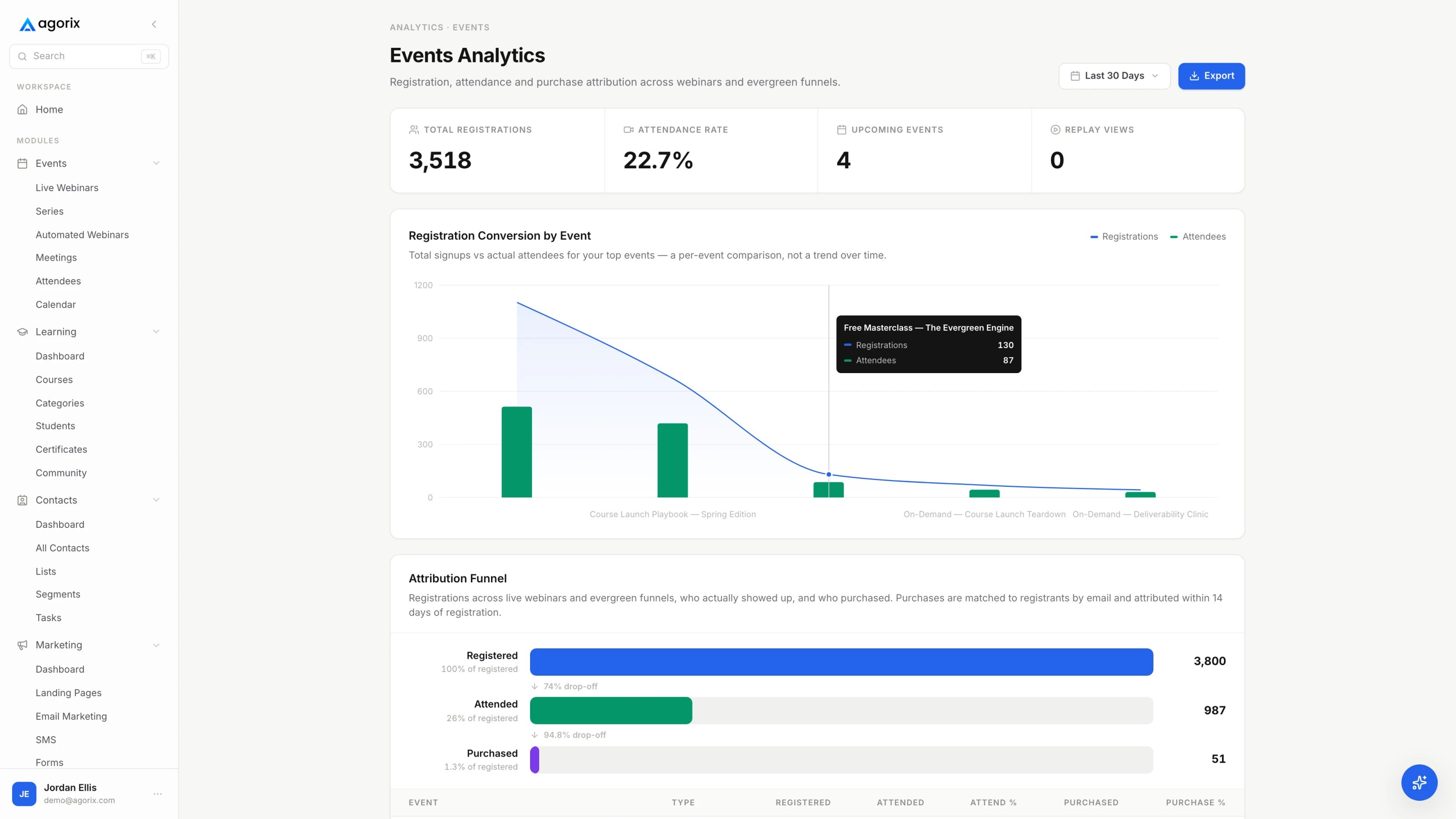
Changing from scheduled to just-in-time is a settings change. Judging the change is not: it needs the traffic source, the start the viewer chose, how far they watched and whether they bought to sit on the same record — otherwise you are comparing an attendance rate from one dashboard against a revenue figure from another. In Agorix those live together — see how evergreen webinars work.
These are starting positions, not verdicts. Each one is a reasoned default for a common situation, and each one should lose to your own data the moment you have any.
| Offer | Start with | Because |
|---|---|---|
| A low-priced digital product | On demand | The decision is small enough that the event framing costs more attention than it buys. Making somebody wait fifteen minutes to be sold something they could have decided about in five is a tax with no return. |
| A course or programme at a considered price | Scheduled, or just-in-time with real times beside it | The argument needs most of an hour to land, and an appointment buys the attention to hear it. Offer an imminent start for people who will not come back, and named times for people who plan. |
| High-ticket, where the next step is a call | Scheduled | Someone who keeps a webinar appointment keeps a call appointment, and that correlation is doing free qualification work for you. The webinar-to-call funnel is where that hand-off gets built. |
| Cold paid traffic | Just-in-time | They will not return. Whatever you are going to get from this click, you get in the next forty minutes or not at all — and a session three days out is a session most of them will never attend. |
| Your own list and existing customers | On demand | They already know it is a recording, because they know you. Asking them to wait for a start you control is a small insult to a relationship you spent years building, and it buys you nothing they were not already going to give. |
| Multi-stakeholder or enterprise buying | On demand, with a scheduled option | The link gets forwarded. A second viewer who never opted into the theatre arrives at “starting in twelve minutes” and reads it as exactly what it is, which is a poor first impression to make on the person signing. |
One pattern runs through the whole table. The colder the traffic and the smaller the second chance, the more the model should compress time. The warmer the relationship and the larger the decision, the more the model should respect the viewer’s own calendar. Manufactured urgency is worth most where there is no relationship to spend, and costs most where there is.
Each single model has one bad trade in it. Most of the useful combinations exist to avoid exactly that trade while keeping what the model was good at.
Running all three with different promises on the same page. A viewer who sees “starting in twelve minutes”, a list of scheduled times and a watch-now button has been given three contradictory statements about what this is, and the honest conclusion — that the start time is arbitrary — is the one they will reach. Pick a default, offer one alternative, and let the page make sense.
Whatever you combine, keep one recording and one follow-up spine branched on behaviour rather than four parallel funnels that drift apart. The evergreen email templates are written for exactly that shape, and the evergreen funnel playbook covers where the branches go.
Nobody sets out to build a dishonest funnel. It happens one setting at a time, each one slightly more effective than the last, until a customer takes a screenshot. Decide where the line is while it is still an abstract question.
Nobody discovers a resetting countdown by being careless. They discover it by coming back to think about it, by checking on another device, by forwarding it to a colleague — which is to say, by behaving exactly like a considered buyer. The mechanisms in the right-hand column select against the customers with the longest deliberation and the largest budgets, which is a strange thing to optimise for. A real deadline costs you the people who would have bought late. A fake one costs you the people who were paying attention.
A just-in-time webinar is an automated session that starts a few minutes after the visitor arrives, rather than at a fixed time later in the week. The page offers a start that is imminent — usually framed as starting in ten or fifteen minutes — so the gap between deciding to watch and watching is almost nothing. The session itself is a recording, exactly as it is in every other evergreen model; the difference is only when the room opens. The pillar guide covers the rest of the build around it.
The mechanic is not; the dressing usually is. Offering somebody a start in fifteen minutes is a scheduling choice, and a defensible one — you are giving the session a beginning so it can be attended rather than half-watched. Simulating live presence around it is a different thing: attendee counters that count nothing, chat populated with scripted messages, language that claims a broadcast. The working test is one sentence — would this page read the same way if the viewer knew exactly how it worked?
No. A recording described as live is a claim that fails the moment anybody checks, and the people most likely to check are the careful buyers you most want. The surprising part is how little you lose by being accurate: a stated start time, a named presenter and a session that begins when it says it will deliver most of the structural benefit, and none of them require the word.
Enough that somebody arriving at any hour can start within the same day in their own timezone. Spread the times across the day rather than across the week — a viewer who registers at 22:00 local wants tomorrow morning, not Saturday. Then check registration-to-attendance against how far away the chosen slot was. If attendance falls off sharply with distance, the answer is nearer slots rather than more of them, and the attendance guide covers what else moves that number.
That cannot be answered generically, and any published figure claiming to answer it was measured on somebody else’s offer, price and traffic source. Settle it for your own funnel: run one model for a stretch, then the other, hold the traffic source constant, and compare revenue per registrant rather than attendance rate. Attendance is the number that flatters just-in-time and on demand, because both of them remove the chance to not turn up. Revenue per registrant is the one that decides.
Yes, and it is one of the cheaper tests available — if the recording, the registration page and the follow-up sequence are separate pieces rather than one hard-coded funnel. What makes the switch expensive is copy that assumes a model in twelve places. Write the sequence to reference the viewer’s own start time as a variable, which is how the evergreen email templates are built, and the change stays a settings change.
Evergreen sessions, the registration page, reminders branched on behaviour, watch-time signals and checkout — on one customer record, so comparing two timing models is a report rather than three exports and an assumption.
14 days · $0 due today · Payment method required · Cancel before first charge and pay nothing