Skip to content
Agorix
Updated 29 July 2026

The evergreen webinar maintenance checklist: 23 things that quietly stop being true.

An evergreen funnel repeats whatever you built, including the parts that broke last month. Six groups of checks, each sitting under a short explanation of what decays while registrations keep arriving — tick them here, or copy the whole pass into whatever you plan in. Works with any stack you have already bought.

23checks
06groups
01calendar

What this page gives you

  • A quarterly pass you can tick as you go, or copy straight into a task list
  • A maintenance calendar with an interval, an owner and a trigger on every row
  • The reason each item exists, so you can skip one deliberately rather than accidentally
  • The four things that decay silently while the funnel keeps taking registrations
  • An honest read on which of these checks a stitched stack makes expensive
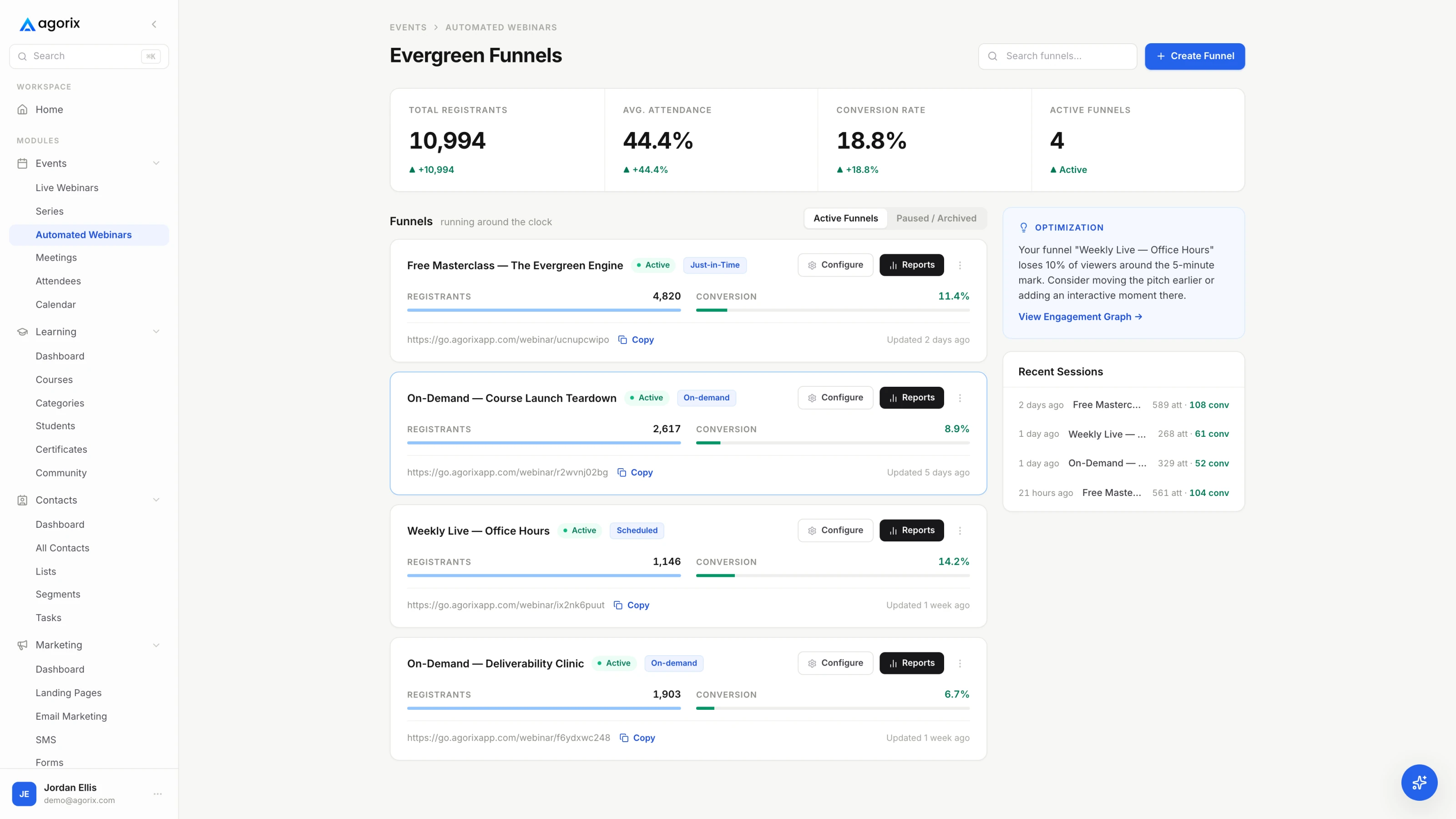
An automated webinar console showing scheduled evergreen sessions and viewer progress.
Group 01Content dating01 / 06

The recording is the only part of the funnel that cannot correct itself.

Everything else can be edited in an afternoon. The presentation is fixed at the moment you recorded it, and it keeps saying what it said then to people watching now.

The phrases that age are rarely the ones you would have flagged while recording. “Earlier this year”, “the new dashboard”, “we just launched”, “as of last month” — every one of those has an expiry date, and none of them look like claims when you say them. A viewer who catches one does not usually leave over it; they start discounting everything else, which is worse and impossible to measure.

Watch it end to end at normal speed once a quarter, with something to write on. Scrubbing finds nothing, and double speed finds only what is visually wrong. The output of this group is not a list of fixes, it is the running list of things you would change if you rerecorded — which is also the thing that tells you when to rerecord.

Content dating0 / 4 done

23 checks, plain text, no account needed. Tick them here as you go, or take the whole pass into your own task manager and put an owner on it.

Group 02Offer accuracy02 / 06

One price, spoken in four places, changed in three.

A price lives in the recording, on the sales page, in the checkout and inside the emails. When it changes, the recording is the one that gets missed, because it is the only one that costs a recording session to edit.

The gap that creates is invisible from the inside and obvious from the outside. Somebody hears a number, clicks through, and is asked for a different one — and the version they believe is whichever is worse for them. The same applies to inclusions: a bonus you retired last spring is still being promised on camera every day until somebody watches the whole thing.

The deadline mechanic is the other one, and it needs testing rather than inspecting. Register as a stranger, let the window run out, and see what happens: whether the countdown genuinely ends, whether the page behind it changes, and whether an order placed afterwards is still accepted. A deadline that resets on refresh teaches an audience that nothing you say about time is true, and you only get to teach that once.

Offer accuracy0 / 4 done
Group 03Deliverability & emails03 / 06

The sequence keeps sending long after the links stop working.

A live campaign’s emails are read once, by you, in the week you write them. An evergreen sequence sends for months with nobody on your side ever opening one, which is how a dead link runs for a whole quarter.

So register with a clean address and read the whole thing on a phone, in order, including the sends that fire days later. Click every link rather than looking at it. Renamed pages, lapsed shorteners and rebuilt checkouts all produce links that look correct in the editor and fail in the inbox, and none of them generate an error anywhere you would see.

Sender health belongs in the same pass. Authentication on the sending domain quietly stops passing after a domain move or a provider change; a reply-to that used to reach somebody stops reaching them when they change roles. Both are invisible until the joins drop, and by then you are diagnosing the wrong end of the funnel.

The timing check is the one specific to evergreen. These sends are keyed to each registrant’s own session rather than to a calendar date, so an email written with an afternoon audience in mind arrives at breakfast for the person who chose the earliest slot. Read the sequence twice: once for a registrant at each end of the day you offer.

Deliverability & emails0 / 4 done
Group 04Funnel numbers review04 / 06

Four numbers, and the one place the ratio moved.

An evergreen funnel does not fail all at once. One ratio slips, total revenue holds for a month because traffic went up, and the problem is six weeks old before anybody names it.

Write four numbers down for the same period: registrations, joins, watch-through to the offer, purchases. Then put the previous period’s beside them. The change is the signal and the level is not — a rate you think of as healthy that fell is a problem, and a rate you think of as poor that rose is progress. There is no benchmark to hit here, only your own last quarter.

Split by source before you conclude anything. A new ad set, a new affiliate, a colder audience or a channel that quietly stopped all look identical to a broken funnel from the aggregate, and all of them are fixed somewhere other than the funnel. If the ratios hold inside each source and only the totals moved, the acquisition changed. If a ratio moved inside a source that was steady, the funnel did.

Then aim one change at one step. Rebuilding a presentation because the purchase number moved throws away the only useful thing the numbers told you — which was where in the sequence of four the drop actually appeared.

Funnel numbers review0 / 4 done
Group 05Tech & playback05 / 06

Register as a stranger and take every path you offer.

You have never seen your own funnel the way a viewer does. You have a bookmark, a logged-in session, a browser that remembers everything, and the habit of clicking past the parts that are broken.

Take each path separately: the earliest session you offer, the latest, and the immediate option if you have one. On a phone and on a laptop, on a connection that is not your office. What you are checking is unglamorous — that the session starts when promised, that it plays from the beginning rather than partway in, and that whatever sits in the room with it still works.

Replay windows need a session that has already run, which is why they are almost never tested. Register for one, wait, and confirm the window opens and closes on the schedule you published rather than the one you intended. An open-ended replay you described as limited is a promise you are breaking every day without noticing.

Finish with a real purchase, refunded afterwards. Three separate things are being tested and only one of them is the charge: whether the purchase lands on the same record as the registration, whether access is granted without anybody intervening, and whether the receipt actually arrives. A card test in the payment processor confirms none of those.

Tech & playback0 / 4 done
Group 06Cadence06 / 06

An evergreen funnel repeats whatever you built, including the broken parts.

This is the group that makes the other five happen. Every check above is easy, and none of them get done, because nothing in an always-on funnel ever asks for attention.

A live event has a date that forces the work. Evergreen has the opposite property: it looks healthiest right up until somebody notices the checkout has been failing for eleven days. The substitute for a date is a recurring calendar event with a person’s name on it. A note in a document is not a cadence, it is a record of an intention.

Then write the triggers, because some checks cannot wait for the quarter. A price change forces the offer group the same day. A domain move forces the deliverability group before the next send. A rebrand forces content dating and every link in the sequence. These are the moments a funnel breaks in one step rather than by drifting.

Log each run in one place: the date, what changed, and what you deliberately left alone. Without the log, every pass starts from zero and you spend the first hour re-investigating the same three things you decided about last quarter.

Cadence0 / 3 done
TemplateMaintenance calendar

Four intervals and four triggers, with a name on every row.

The quarterly pass is the big one, but it is the wrong instrument for a funnel that stopped taking payments on a Tuesday. Three of these rows take ten minutes and catch the failures that would otherwise run for weeks.

Copy it, put real names in the owner column, and create the recurring events before you close the tab. The shaded rows are triggers rather than intervals: they do not sit on a calendar, they attach to a decision somebody is already making, which is the only reliable way to catch a break that happens in one step.

Eight rows, tab-separated. Pastes straight into a spreadsheet, one row per recurring event or trigger.

WhenWhat you runOwnerWhat it catches
WeeklyTen minutes: registrations and purchases for the last seven days, looked at rather than reported on.Funnel ownerA funnel that stopped entirely — a dead page, a failed checkout, a sequence that stalled.
MonthlyThe four funnel numbers, plus bounces and complaints since the last check.Funnel ownerA ratio drifting while total revenue holds it out of sight for another month.
QuarterlyThis whole list, top to bottom, including watching the recording end to end.Funnel ownerEverything that ages quietly: dates, prices, screenshots, links, terms.
Twice a yearSomeone who has not seen the presentation watches it and writes down every moment they stopped believing it.Second readerThe parts that are now confusing rather than wrong, which you can no longer hear.
Price changeThe offer accuracy group, the same day the price changes.Whoever changed itA recording promising one number while the checkout charges another.
Domain moveThe deliverability group, before the next send goes out.Funnel ownerA months-old sequence still authenticating against a domain you no longer send from.
RebrandContent dating and tech groups, plus every link in the sequence.Funnel ownerOld names spoken on camera and links into pages that now 404.
New offerOffer accuracy and the funnel numbers, before the new offer gets traffic.Offer ownerTwo offers competing inside one presentation, and a baseline you can no longer read.

If only one row survives contact with your calendar, keep the weekly one. Ten minutes a week is what stands between a funnel that broke and a funnel that has been broken since the last time anybody looked.

DecideWhere the check gets expensive

Most of this list is free. One group is not.

Watching the recording, clicking the links, testing the deadline and buying your own offer cost the same on any stack. The funnel numbers review is the group where the products you chose decide whether this is an hour or a day.

Several products

The review is a reconciliation

Registrations in one tool, watch time in another, purchases in a third. Every number exists, and answering “where did the drop move” means exporting three files and matching them on email address before you can start thinking.

One record

The review is a filter

Registration, the session chosen, watch-time milestones, exit points, offer exposure and the purchase on one viewer. The same question is a segment you apply, which is the difference between doing this quarterly and meaning to.

That difference compounds in a way it does not for a live event. A live campaign is reconciled once, afterwards, while the memory is fresh. An evergreen funnel asks the same question every quarter forever, and a review that takes a day gets skipped for three quarters, which is exactly how a funnel ends up eleven months out of date.

For a first evergreen funnel a stitched stack is a reasonable choice, and this page works exactly as well on one. The threshold is the moment the funnel becomes something you intend to run for years rather than test for a quarter.

Where a tool decision changes the work

A quarterly review you will actually run again next quarter.

Agorix attaches registration, the session each viewer chose, watch-time milestones, exit points, offer exposure and the purchase to one customer record, so the funnel numbers group is a filter instead of an afternoon of exports — see how evergreen webinars work.

Start your 14-day trial 14 days · $0 due today · Payment method required · Cancel before first charge and pay nothing
Common questions

Five questions about keeping it current.

How often should an evergreen webinar be updated?

Three intervals rather than one. A ten-minute weekly look at registrations and purchases catches a funnel that has stopped entirely. A monthly read of the four funnel numbers catches a ratio drifting. A full quarterly pass — this whole list, including watching the recording end to end — catches everything that ages quietly. On top of that, keep a trigger list: a price change, a domain move, a rebrand or a new offer forces the relevant group immediately rather than at the next quarter. The calendar above lays all of it out.

When should I re-record the presentation instead of patching it?

Patch while the fixes are local: a replaced screenshot, a re-recorded thirty seconds, a slide swapped out. Re-record when the list stops being local — when the interface you demonstrate no longer resembles the current one, when the offer has been restructured rather than repriced, or when the corrections have accumulated to the point where a first-time viewer would notice the seams. The trigger is a viewer noticing, not a number of months on a calendar.

What breaks most often in an evergreen webinar funnel?

Links and deadline mechanics, and both fail silently. Links break when a page is renamed, a shortener lapses or a checkout is rebuilt, and nothing reports it because the sequence keeps sending successfully. Deadline mechanics break when the offer changes, when a countdown is rebuilt, or when the page behind the deadline is never actually closed — the deadlines guide covers how to build one that holds. Both are found by registering as a stranger, not by inspection.

How do I tell whether a drop is the funnel or the traffic?

Split by source before concluding anything. A shift in the source mix — a new ad set, a new affiliate, a colder audience, a channel that quietly stopped — looks exactly like a broken funnel from the aggregate, and it is fixed somewhere else entirely. If the registration-to-join and join-to-offer ratios hold within each source and only the totals moved, the funnel is intact and the acquisition changed. If a ratio moved inside a source that was steady, the funnel changed.

Can I edit an evergreen funnel while it is running?

Yes, with one rule about order. Never leave the funnel in a state where the recording promises something the checkout does not honour, even for an hour — live registrants are moving through it while you work. If a price or an inclusion changes, bring the checkout and the emails back into line with what the recording still says, then change all of them together when the corrected recording is ready. For a larger rebuild, pause paid traffic for the hours the work takes rather than editing under load.

Keep going

The next four things to read.

From a quarterly pass to a funnel you can see

The funnel runs without you. So should the evidence.

Registration, the session each viewer chose, how far they watched, whether they reached the offer, and what they bought — on one customer record, so next quarter’s review is a question you ask rather than three exports you reconcile.

14 days · $0 due today · Payment method required · Cancel before first charge and pay nothing